REVIEW · ACCADEMIA DAVID TOURS
Michelangelo Sculpture Tour in Florence with Skip the Line Ticket
Book on Viator →Operated by Walkabout Florence Tours · Bookable on Viator
Michelangelo’s Florence still feels close. This 3-hour tour strings together the places that shaped him, from church tombs to three major sculpture stops, with an end inside the Accademia Gallery so you can keep going. I especially like how it pairs famous city squares with museum visits, so the art doesn’t feel stuck behind glass.
What I like most is the people part: guides are praised for strong knowledge and clear communication, and the group size caps at 20. One reviewer highlighted a guide named Becky for explaining everything at a level that stood out, even for long-time travelers.
One drawback to plan for: you’re moving through multiple museums and landmarks in a short window, with about 40 minutes at several stops. If you want slow, deep time in one place, you might feel rushed. Also, the experience needs good weather, since part of it is walking.
In This Review
- Key highlights worth planning around
- Why this Michelangelo tour works better than picking one museum
- The walking start in Santa Croce: Florence’s artist-crowd energy
- Museo Nazionale del Bargello: Michelangelo’s sculptures in a real setting
- Piazza della Signoria and the Loggia dei Lanzi: where sculpture meets civic power
- Orsanmichele: when a grain market becomes a sculpture museum
- Santa Maria del Fiore: a quick architectural reset before more sculpture
- Opera del Duomo Museum: Palestrina Pietà and the original Gates of Paradise
- Cappelle Medicee: how Medici power shaped Michelangelo
- Accademia Gallery finale: David, Prisoners, and the best kind of momentum
- Tour logistics that affect your comfort (without getting boring)
- Value check: is $172.86 per person a fair deal?
- Who this tour suits best
- Should you book this Michelangelo Sculpture Tour?
- FAQ
- What is the tour duration and starting time?
- Where does the tour start and end?
- Does the ticket include entry to the museums?
- Which Michelangelo works will I see?
- Is it a skip-the-line tour?
- How big is the group?
- What’s the ticket type?
- Does weather affect the tour?
- What if I need to cancel?
Key highlights worth planning around
- Skip-the-line tickets that help you get into key sites faster
- Four Michelangelo-focused sculpture stops, including the Bargello and Accademia
- Tomb and patronage context, especially through the Medici Chapels
- Opera del Duomo Museum originals, including the Gates of Paradise set
- Small group pacing (max 20) that keeps the tour from feeling chaotic
Why this Michelangelo tour works better than picking one museum
Michelangelo is one of those names you hear everywhere in Florence. The trick is getting beyond a checklist of famous works and understanding how the same artist threads through different parts of the city: religious spaces, Medici power, public squares, and the museums that preserve the results.
This tour does that by pairing a walk through the city center with time inside the big sculpture and art museums. It also ends inside the Accademia Gallery. That matters because Accademia is where your momentum should peak—once you’ve seen the related works and context, you’re ready to look closely at David without feeling like the tour is already over.
The walking start in Santa Croce: Florence’s artist-crowd energy
You begin with Florence’s monumental church scene at the Basilica di Santa Croce. This is a big Franciscan Gothic building and a long-time symbol of the city. It’s also known as a meeting place for artists and thinkers—people like theologians, religious figures, writers, and politicians.
Why I think this opening stop is smart: it sets the tone that Florence’s art isn’t only about beauty. It’s about status, faith, and reputation. Santa Croce also includes tombs of major artists—so you quickly get the sense that Michelangelo’s story lived inside a broader network of creators and patrons.
Practical note: churches can be cool and dim. If you’re the type who likes to take photos, remember that low light may mean you’ll need steadier hands or lower expectations for crisp shots.
Museo Nazionale del Bargello: Michelangelo’s sculptures in a real setting
Next you head to the Museo Nazionale del Bargello, one of the best places in Florence to see Renaissance and Mannerist masterpieces together. You’ll focus on four Michelangelo sculptures: Tondo Pitti, Bacchus, Brutus, and David-Apollo.
Here’s what I love about this lineup. You get variety fast:
- Tondo Pitti is tied to the well-known idea of non finito—where Michelangelo leaves parts unfinished, and the unfinished feel becomes part of the work.
- Bacchus and Brutus show how Michelangelo could shift mood and expression depending on the subject.
- David-Apollo is a reminder that Michelangelo wasn’t trapped in one theme. He worked across classical references and interpretive forms.
The stop is about 40 minutes, with admission included. That time is short enough to keep you moving, but long enough to see the major pieces and get explanations that connect them to other artists. The tour also points out parallels with bronze David sculptures by Donatello and Verrocchio, which helps you see Michelangelo as part of a workshop-and-genius ecosystem, not an isolated superstar.
If you’re super sensitive to crowding, arrive in the mindset of looking, not lingering. This museum is terrific, but the tour format keeps it focused.
Piazza della Signoria and the Loggia dei Lanzi: where sculpture meets civic power
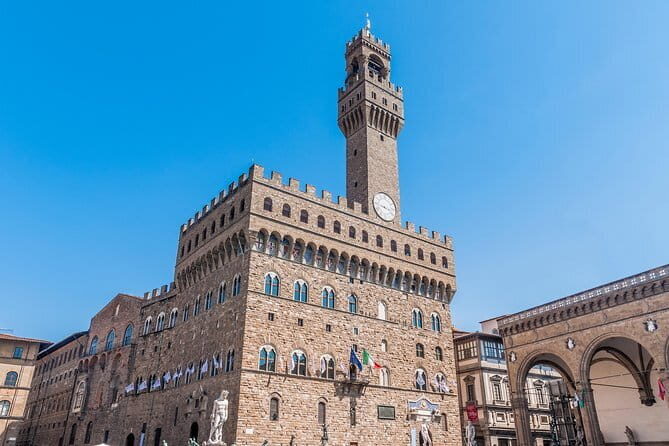
Between museums, you step into the heart of political and social Florence at Piazza della Signoria. This is the city’s central square, tied to civil power and public life, located south of the cathedral area.
Right beside it is the Loggia dei Lanzi, an arcade structure next to the Uffizi Gallery. You’ll see its distinctive arches and you’ll get the story of why this space matters for sculpture. The tour notes that Michelangelo suggested encircling Piazza della Signoria with these kinds of arches, linking him not only to art objects but to the shaping of public space.
Then there’s Palazzo Vecchio (the town hall), looking out over the square. Even if you don’t go inside, the building’s presence anchors the whole idea that art and authority were always intertwined in Florence.
Why this section is valuable: it helps you understand that sculpture wasn’t meant only for private contemplation. In Florence, it often belonged in the middle of decisions, ceremonies, and city identity.
Orsanmichele: when a grain market becomes a sculpture museum
You’ll stop at Orsanmichele, a historic building in central Florence. The tour explains its evolution: it started as a loggia for grain storage and market space, then later became a church tied to the guilds and arts.
Today, the upper floors house a museum space featuring originals from sculptural cycles that once sat on the building’s exterior niches—plus famous statues connected to artists like Donatello and Ghiberti.
I like this stop because it explains a Florence pattern you’ll notice again and again: structures shift roles over time. A place built for practical trade can later become a stage for religious meaning and artistic display.
Santa Maria del Fiore: a quick architectural reset before more sculpture
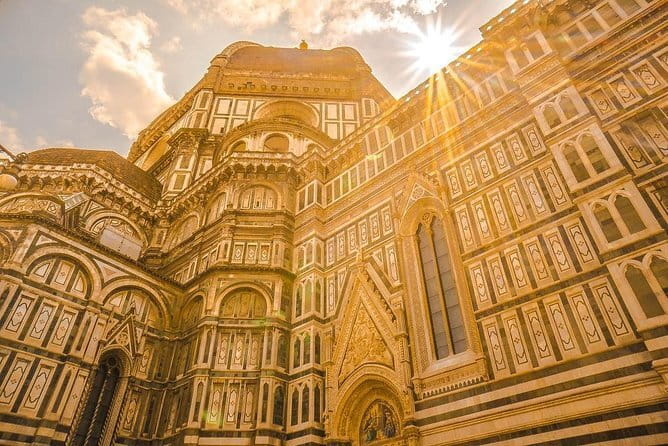
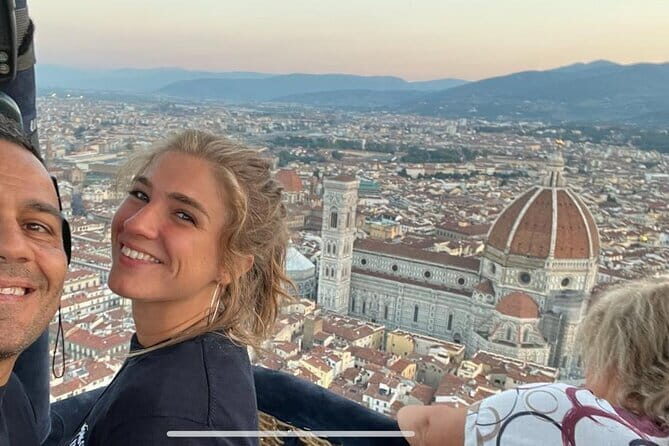
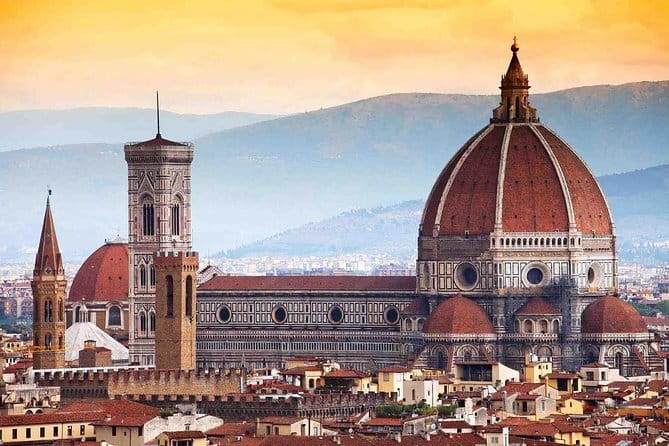
You also pass by Santa Maria del Fiore, Florence’s cathedral complex. The tour gives you the big picture: triple-nave basilica structure, the immense dome, and the key visual idea that the building is centered around that massive octagon.
It also connects the name. The “Our Lady of the flower” title links to Florence as Florentia, tied to the lily emblem and the idea of a city destined to bloom.
This is not a long cathedral visit in this format, but it works like a reset for your brain. After looking at sculpture, you get your bearings in the broader architectural scale that Michelangelo knew and worked within.
Opera del Duomo Museum: Palestrina Pietà and the original Gates of Paradise
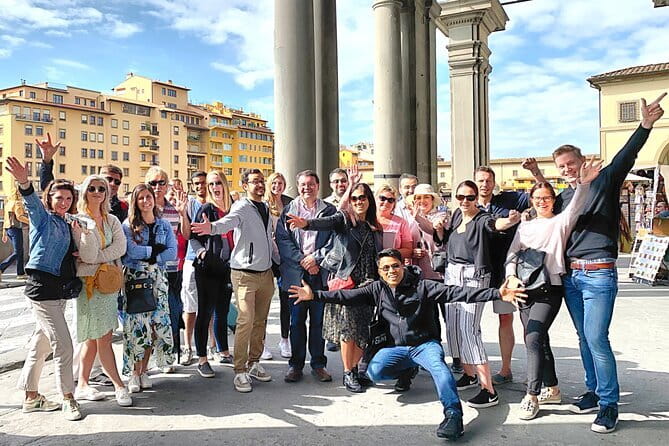
Now you move into one of the tour’s most satisfying value moments: the Opera del Duomo Museum.
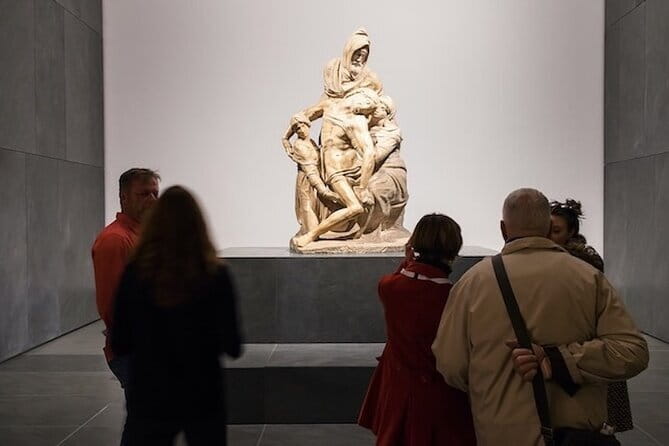
You’ll see the Palestrina Pietà, described as one of Michelangelo’s final creations. This is the kind of work that rewards understanding, not just seeing it at a glance. The tour emphasizes that the presentation is special and that it’s hard to fully grasp without the right viewing context—so you don’t just get a name, you get help with what to notice.
You’ll also see the original Gates of Paradise inside the museum: the main gate designed for the Battistero di San Giovanni. The tour notes these were created by Florentine goldsmith and sculptor Lorenzo Ghiberti between 1425 and 1452, and that they were installed on the eastern portal of the Baptistry.
Why this stop matters even on a Michelangelo-focused tour: it shows the artistic competition and influence happening all around Michelangelo. You’re seeing a landmark work from a different master, placed in the same Florence ecosystem where Michelangelo made his reputation.
Time at this museum is about 40 minutes, with admission included.
Cappelle Medicee: how Medici power shaped Michelangelo
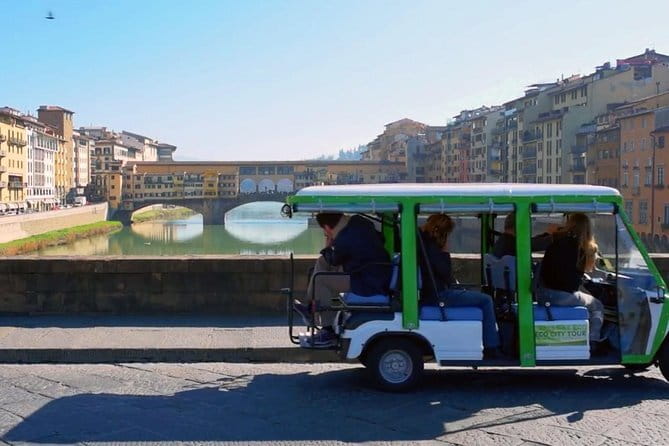
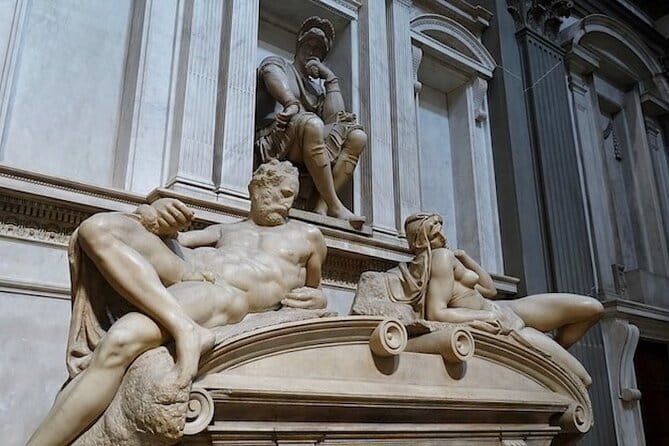
Next is Cappelle Medicee and specifically the New Sacristy at the Medici Chapels. If you want to understand Michelangelo, you need to understand patrons—and the Medici are the big name here.
This stop is where the tour connects art to sponsorship and influence. You’ll be guided through the tombs of Medici family members and see why this is a must-do part of a Michelangelo itinerary. The tour frames it as a moment where you can feel how deeply the artist and his work were shaped by Medici support.
This is another 40-minute segment with admission included, so think of it as a focused introduction to a deeper story. If this is the part you care about most, don’t be afraid to plan extra time later after the tour ends, if you’re still energized.
Accademia Gallery finale: David, Prisoners, and the best kind of momentum
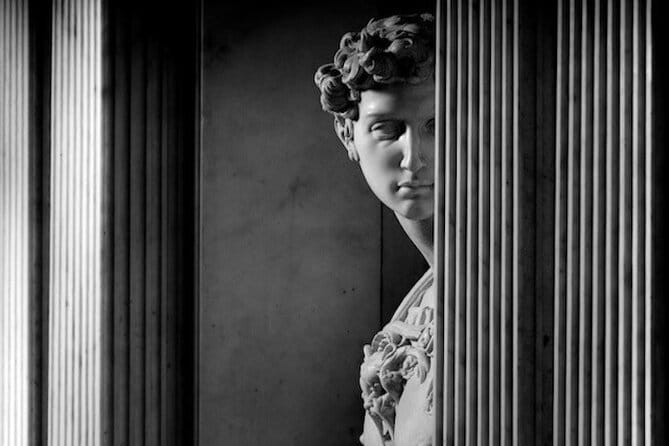
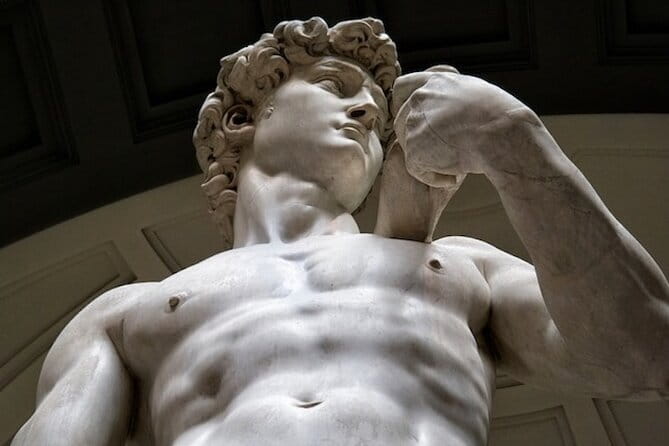
Your tour ends inside the Galleria dell’Accademia di Firenze at the point where you most want to land: Michelangelo’s David.
The tour gives you time to look at David and also to see another major Michelangelo work-in-progress called Prisoners—commissioned for Pope Julius II’s tomb but never completed as originally planned.
I like ending here because the pacing builds. You start with Florentine context, you move through linked museums, and you finish at the most iconic object. That makes your attention sharper. Instead of “one famous statue,” you’re seeing David as part of a wider web: Florence’s religious and political world, plus the sculpture ideas that Michelangelo kept evolving.
Accademia time on this tour is about 40 minutes with admission included, and the tour ends inside. You can keep exploring on your own.
Tour logistics that affect your comfort (without getting boring)
- Duration is about 3 hours, so it’s best if you’re trying to make smart use of a single morning.
- Group size max is 20, which usually means quicker access and more interaction.
- You’ll use a mobile ticket, which is handy in museums where paper tickets can slow things down.
- The meeting point is Via Vinegia, 23R, 50122 Firenze FI, Italy, with the tour ending at Galleria dell’Accademia di Firenze, Via Ricasoli, 58/60, 50129 Firenze FI.
- Start time is 9:00 am, and the experience requires good weather since walking is part of the day.
Wear comfortable shoes. Florence cobblestones are pretty, but they’re not delicate.
Value check: is $172.86 per person a fair deal?
At $172.86 per person, this isn’t a bargain-basement tour. The value comes from three things you get all at once:
- Skip-the-line access for key sights, which is a big deal at Florence’s most in-demand museums.
- Multiple admission-included stops across major venues (Bargello, Opera del Duomo Museum, Medici Chapels, Accademia).
- A guided through-line that connects sculptures, patrons, and public spaces instead of treating each museum as a separate field trip.
If you were planning to buy tickets for Bargello, Opera del Duomo, Medici Chapels, and Accademia anyway—and you want guidance while you’re there—this format often makes more sense than stitching the day together on your own. If you only care about David and want to spend most of the day there, then you’d probably do better with a more flexible, single-site plan.
Who this tour suits best
You’ll likely enjoy this tour if you:
- want a Michelangelo-focused morning that still includes Florentine city power and architecture
- like sculpture with context, especially Medici patronage
- appreciate a guide who explains what you’re looking at in plain language
- prefer a group that doesn’t balloon past 20 people
If you’re the type who wants to sit with one artwork for a long time, consider using this as an opener and then adding your own solo time at Accademia or Bargello afterward.
Should you book this Michelangelo Sculpture Tour?
Yes, with one clear caveat: book it if your goal is to connect Michelangelo’s work to Florence, quickly and intelligently. This tour’s strongest asset is the way it moves from public Florence to the sculpture rooms where the big names live, ending at David with momentum instead of exhaustion.
Skip it only if you hate short museum stops. This is paced. It’s about seeing a lot without losing the story.
FAQ
What is the tour duration and starting time?
The tour is about 3 hours and starts at 9:00 am.
Where does the tour start and end?
It starts at Via Vinegia, 23R, 50122 Firenze FI, Italy and ends inside the Galleria dell’Accademia di Firenze at Via Ricasoli, 58/60, 50129 Firenze FI.
Does the ticket include entry to the museums?
Yes. The tour includes admission tickets for Museo Nazionale del Bargello, Opera del Duomo Museum, Cappelle Medicee, and Galleria dell’Accademia.
Which Michelangelo works will I see?
You’ll see Michelangelo sculptures at the Bargello and then visit David at the Accademia. The tour also includes Prisoners at Accademia, and the Palestrina Pietà at the Opera del Duomo Museum.
Is it a skip-the-line tour?
Yes, it includes a skip the line ticket.
How big is the group?
The tour has a maximum of 20 travelers.
What’s the ticket type?
You use a mobile ticket.
Does weather affect the tour?
Yes. The experience requires good weather. If it’s canceled due to poor weather, you’ll be offered a different date or a full refund.
What if I need to cancel?
You can cancel for a full refund if you cancel at least 24 hours before the experience’s start time.
If you tell me your travel dates (and whether you’re more into Michelangelo’s sculptures or the Medici/political context), I can help you decide if a morning like this fits your Florence plan.