REVIEW · BOLOGNA
Bologna: A Self-Guided Audio Tour from Porta Galliera to Le Tre Frecce
Book on Viator →Operated by VoiceMap Audio Tours · Bookable on Viator
Bologna has a talent for storytelling. This self-guided audio walk strings together the city’s key landmarks and local legends, with offline audio that moves you from one stop to the next. You follow a path that starts at Porta Galliera and finishes in front of Le Tre Frecce, with narration that explains what you’re looking at as you go.
I especially like the easy, step-by-step app navigation. The directions work with your location so the commentary lines up with your walk. I also like that it’s a good “you control the pace” format: no waiting around, and you can linger for photos or duck into a quick visit.
One thing to consider: you need to bring your smartphone and headphones. They are not included, so plan for that before you head out.
In This Review
- Key things to know before you go
- Bologna without a guide, but with direction that actually works
- Price and timing: what $11.99 buys you
- Logistics that matter: start point, end point, and what to bring
- Getting the app ready before you leave
- Porta Galliera: the 1848 rebellion that shaped the city’s mood
- Il Pincio and Parco della Montagnola: Napoleon’s French-style garden entrance
- Piazza Otto Agosto and the rhythm of daily life in central Bologna
- Canale delle Moline and Via Indipendenza: when Bologna looked more Venice-like
- San Pietro: a quieter stop that still helps you read the city
- Piazza del Nettuno and the Fountain of Neptune’s cheeky secret
- The Whispering Gallery under Torre dell’Arengo: romance with a mythic twist
- San Petronio: the city’s largest and most important church
- Quadrilatero and Via Rizzoli: cafés, restaurants, and where Bologna smells like lunch
- Garisenda and Asinelli: Bologna’s Two Towers up close
- Piazza della Mercenzia and the feel of older lanes
- Le Tre Frecce: finishing with legends, including one involving nudity
- Food and breaks: how to time pauses without losing the flow
- Who should book this VoiceMap audio walk
- Should you book Bologna: Porta Galliera to Le Tre Frecce?
- FAQ
- Is the tour available in English?
- How long does the Porta Galliera to Le Tre Frecce audio walk take?
- Where does the tour start and where does it end?
- Do I need to bring a smartphone and headphones?
- Does this tour include entry to museums or attractions?
- Can I change or get a refund if my plans change?
Key things to know before you go
- Offline audio, maps, and geodata help you keep going even with sketchy phone signal
- English narration keeps the story clear without needing a live guide
- A tight 1 to 1.5 hour route that you can stretch if you stop for sights or breaks
- Location-aware stopping points mean the audio cues arrive when you reach each spot
- Classic Bologna highlights plus legend-heavy stops (including Le Tre Frecce)
- No museum walkthroughs included, so any entry fees are on you
Bologna without a guide, but with direction that actually works
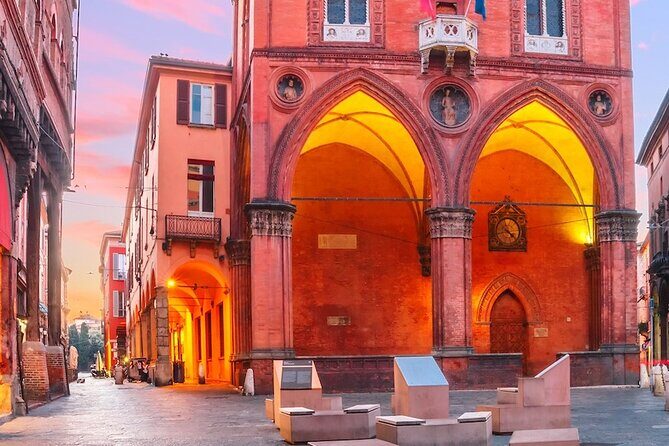
This route is built for travelers who want the good stuff without the usual tour-group friction. You start at Porta Galliera, walk through central Bologna’s squares and churches, then finish at Le Tre Frecce. Along the way, the audio turns sidewalks into a guided storyline.
What makes it feel better than a random walking playlist is the way the narration is tied to your movement. The app uses your phone location to guide you and start the right commentary as you reach each stop. It’s not a “press play and hope” situation. You get the feel of a private tour for a small area of the city, just without the cost of a live guide.
And Bologna rewards this style of travel. The city is compact enough to explore on foot, but still full of tight lanes, sudden viewpoints, and architectural details. The audio keeps you from wandering aimlessly, while still giving you freedom.
You can also read our reviews of more guided tours in Bologna


Price and timing: what $11.99 buys you
At $11.99 per person, this is low-cost compared with a typical live-guided tour. You’re paying for the audio experience plus the app access. You also get lifetime access to the tour in English, so it’s not a one-and-done purchase if you come back to Bologna.
Duration is listed as about 1 hour to 1.5 hours. That’s the “walk and listen” version. In real life, the route length stays comfortable because you can pause. If you stop often for photos, shop windows, or a quick drink, it can stretch longer. That flexibility is part of the value: you can make it a short orientation walk or a longer slow stroll.
This is also marked as a private activity for your group. In practice, that means you won’t be shuffled with strangers. You can move at your pace without the usual group-control issues.
Logistics that matter: start point, end point, and what to bring
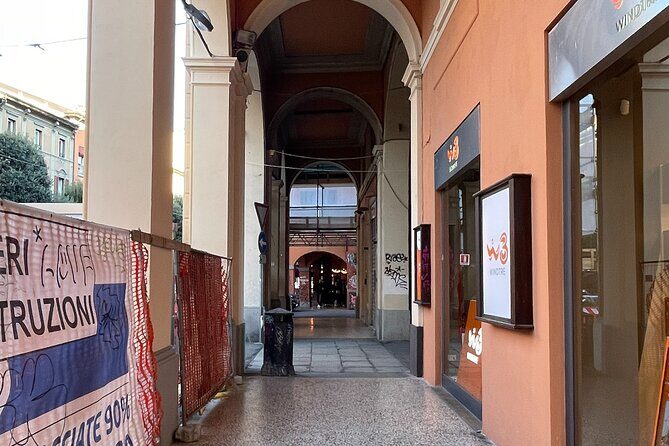
Your start is at Porta Galliera (P.za XX Settembre, 40121 Bologna). Your finish is in front of Le Tre Frecce (Str. Maggiore, 19, 40125 Bologna). Plan to arrive a little early so you’re not fighting traffic or construction right at the first steps.
Bring a fully charged smartphone and headphones. The tour includes VoiceMap Application and offline access to audio, maps, and geodata, but it does not include the phone or the audio hardware. If you show up with low battery, you’ll feel it.
One more useful detail: there’s no live guide shepherding you into museums or paying for attraction access. The tour won’t take you through museums or other ticketed spots mentioned along the route. If you choose to enter, you’ll need to pay on your own.
Getting the app ready before you leave
Before you begin, do a quick setup at home or at your hotel:
- Download the tour content so offline audio and maps are available.
- Test your headphones sound level.
- Make sure location services are enabled so the GPS tracking can line up commentary with your walk.
Once you’re outdoors, follow the app’s prompts. The best part of this kind of route is timing. If you wander off for a long detour, the audio might not match your position. Staying close to the recommended path keeps the story coherent and makes the experience feel tightly planned.
Porta Galliera: the 1848 rebellion that shaped the city’s mood
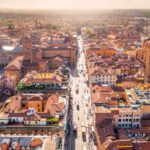
The tour starts at Porta Galliera, a city gate with serious historical baggage. The narration frames Bologna as more than scenery. It introduces the idea that Bologna has multiple identities, from the red-roof look to its food reputation, and from its tower-filled skyline to its famous university tradition.
Right at the gate, the audio focuses on the 1848 rebellion by Bolognese forces that helped push an Austrian army back. This is a strong opening because it tells you what to notice. Porta Galliera is not just a photo stop. It’s a reminder that walls and gates exist for a reason, and Bologna’s political stubbornness isn’t new.
Practical tip: take one minute to orient yourself before you walk. If you’re tracing the line of the route on your phone, you’ll find it more relaxing from the start.
You can also read our reviews of more tours and experiences in Bologna




Il Pincio and Parco della Montagnola: Napoleon’s French-style garden entrance
Next, the route guides you past Il Pincio, the entrance area for Parco della Montagnola. This is where Bologna shows a different face: planned greenery rather than only medieval and university-era stone.
The narration notes that the park reflects a French style garden commissioned by Napoleon. That’s a detail worth holding onto. It makes you see the space with context, instead of treating it like just another park. Gardens can feel decorative until you learn the political taste that shaped them.
As you walk, look for how the park’s entrance acts like a transition zone. You go from the city’s hard edges into a softer breathing space before heading back into squares and churches.
Piazza Otto Agosto and the rhythm of daily life in central Bologna
From Il Pincio, you move toward Piazza Otto Agosto. This is one of those plazas where locals naturally pass through. The audio helps you treat it like a real room in the city, not just a point on a map.
The value here is pacing. The tour doesn’t only hit “big-name” sights. It also makes time for the everyday. That matters because Bologna’s charm often lives in the in-between parts: streets that funnel people, open spaces where you feel the city’s tempo, and buildings that look ordinary until you learn what they were for.
If you want a break from constant walking, this is a good place to slow down for a few minutes and reset.
Canale delle Moline and Via Indipendenza: when Bologna looked more Venice-like
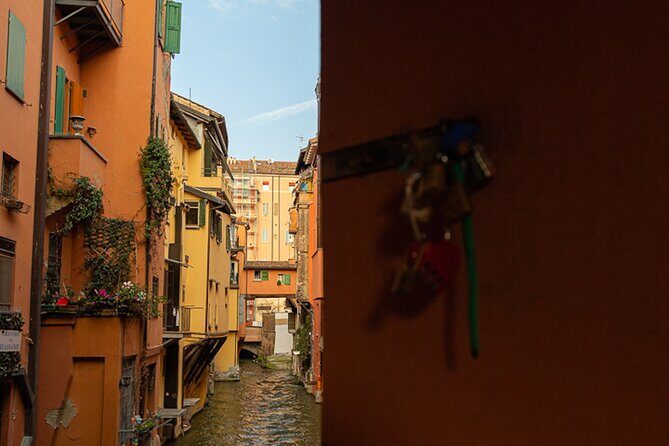
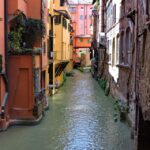
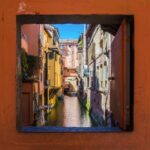
One of the coolest story turns in the route is when the narration compares Bologna’s waterways to Venice. You get a glimpse of the criss-cross of canals and rivers feel while passing Canale delle Moline. Then the walk along Via Indipendenza is framed as what things were like in the post-Risorgimento period.
This is more than trivia. It gives you a lens. Bologna isn’t frozen in time, and the city has layered identities. Streets and water routes reflect practical changes, trade patterns, and new eras of rebuilding.
Practical tip: this segment is a good moment for photos, but keep your phone secure. Side streets can funnel you closer to walls and traffic.
San Pietro: a quieter stop that still helps you read the city
You’ll also pass San Pietro. The audio doesn’t treat it like a random church frontage. Even with the tour’s short format, it uses places like this to teach you how Bologna’s religious buildings sit inside everyday urban life.
If you’re the kind of traveler who loves architecture but doesn’t want a full museum day, this tour fits that mood. It gives you enough context to understand why a church matters, without demanding a ticket and a time-consuming visit.
If you decide to enter any religious site you pass, do it on your schedule. The tour itself is not designed as a guided ticketed walkthrough.
Piazza del Nettuno and the Fountain of Neptune’s cheeky secret
At Piazza del Nettuno, you’ll hear the story behind the Fountain of Neptune. The narration focuses on a sculptor’s trick: making Neptune appear particularly well-endowed despite a church prohibition. It’s the kind of detail that makes you smile and then look differently at what you see.
This is a great stop to pause. Squares like this are made for people-watching. And because the audio provides the story, you’re not stuck guessing what you’re looking at.
If you’re traveling with someone who doesn’t usually care about fountains, this is a good moment to pull them in. A story like this turns “water and stone” into a fun conversation.
The Whispering Gallery under Torre dell’Arengo: romance with a mythic twist
One of the most memorable parts of the route is the Whispering Gallery under the Torre dell’Arengo (Tower of Arengo). The audio shares a legend about lovers murmuring sweet nothings without their legitimate partners realizing.
Even if you treat it as legend, it’s still useful. The story makes the space feel alive and human. It’s not just a tower you walk past. It becomes a stage for behavior—real or imagined—that tells you something about how people used the city.
Practical tip: stand in a comfortable spot. The point of this stop is listening and looking, not rushing.
San Petronio: the city’s largest and most important church
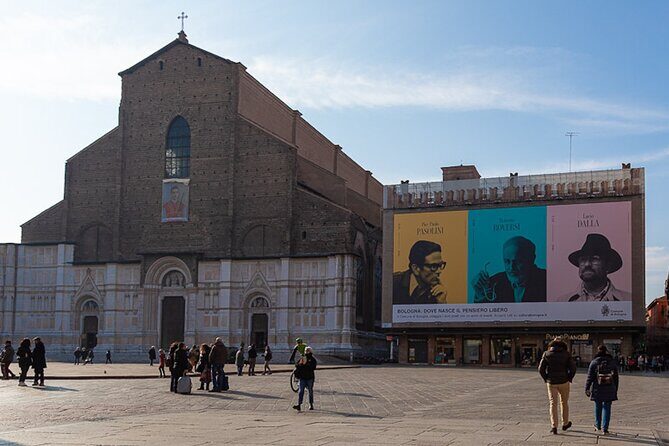
The tour then brings you to San Petronio, described as the largest and most important church in Bologna. This stop is a heavyweight in the route, and the audio gives you a reason to pay attention beyond the façade.
San Petronio can feel overwhelming if you walk up cold. The tour’s narration helps you focus on what makes it central to Bologna’s identity. It’s also a reminder that this city’s “culture” label isn’t only about scholars and towers. Religion and civic life are tied together here.
If you want to spend extra time, do it. Just remember: the tour is designed as a walking experience, and any deeper entry time is your call.
Quadrilatero and Via Rizzoli: cafés, restaurants, and where Bologna smells like lunch
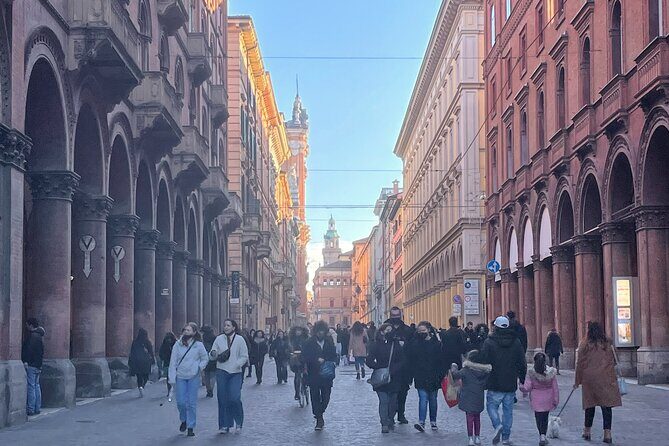
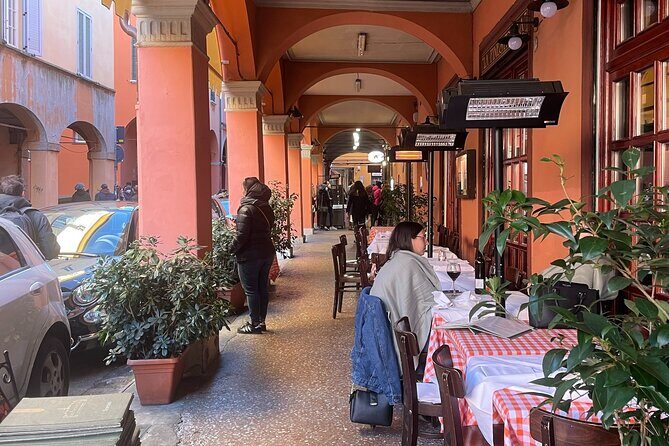
Next comes the Quadrilatero neighbourhood, with its density of cafés and restaurants. The narration then guides you along Via Rizzoli, another key street where life moves fast and people find places to eat.
This segment is valuable for two reasons:
- It teaches you the city’s “eat and wander” geography.
- It helps you plan where you might want to return later for a proper meal.
Food is not included, of course. But this part of town is exactly where you’ll want to pause for a drink or snack after the walking story. Even a short stop lets you reset for the tower section ahead.
Practical tip: if you’re hungry, this is the moment to decide whether you want a quick aperitif or to keep walking toward the end-of-tour payoffs.
Garisenda and Asinelli: Bologna’s Two Towers up close
Then the audio takes you toward Garisenda and Asinelli, the city’s Two Towers. These towers are a core Bologna image, but the tour makes them more than postcards by tying them to the broader theme of Bologna as the towered city once marked by over 100 towers.
Seeing them with an explanation in your ears changes the experience. You stop thinking only about what a tower looks like and start thinking about why towers mattered: visibility, power, rivalry, and civic identity.
Practical tip: towers are photo magnets, so pick a spot and give yourself a few minutes. If you’re in a rush, the photos will look like everyone else’s.
Piazza della Mercenzia and the feel of older lanes
You’ll pass through Piazza della Mercenzia. This helps the route land in a human scale. Not every stop is supposed to be dramatic. Some are there so you feel the city’s walking rhythm.
Squares like this also help you shake off the “tour mode.” The narration keeps you oriented, but you’re still free to look, step aside, and absorb the street textures.
If you’re someone who gets tired of constant commentary, this is where the experience can feel balanced. You get story moments, then you get breathing space.
Le Tre Frecce: finishing with legends, including one involving nudity
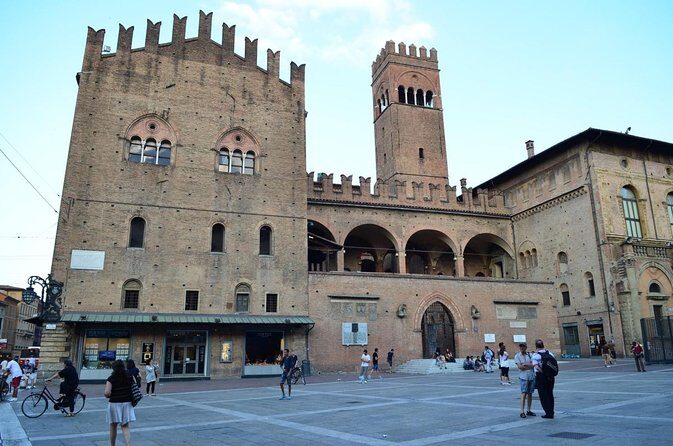
Your ending is Le Tre Frecce on Str. Maggiore, with the audio promising legends tied to the Three Arrows, including one involving nudity. That kind of detail is exactly why this route works as a full circle.
It’s not just a list of monuments. It’s a set of stories that land on a punchline. You finish with something memorable enough that the walk sticks in your mind, not just the architecture.
Also, ending at Le Tre Frecce gives you a different Bologna angle than the center-only tours. It helps you leave with the sense that you actually explored the city, not only photographed it.
Food and breaks: how to time pauses without losing the flow
Even though the tour doesn’t include food or drink, you’ll naturally pass areas where you’ll want to stop. The smart way to handle it is simple:
- If you plan a longer break, pause the walking tempo but keep your phone handy.
- For short stops, stay close to the path so the audio keeps matching your position.
A lot of the enjoyment here is comfort. Bologna is ideal for taking your time, and the app format supports it. You’re not trapped in a fixed schedule. You’re guiding yourself, with the narration keeping your bearings.
Who should book this VoiceMap audio walk
This is a great fit if you:
- Want a low-cost introduction to Bologna that doesn’t require a group or a ticketing plan.
- Like city history that shows up through specific details—like legends, architecture, and political stories tied to places.
- Prefer moving at your own pace, with stops that keep your walking coherent.
It’s also a smart backup plan if you can’t line up a live guide. The app experience can get you “almost private tour” energy with less effort.
Should you book Bologna: Porta Galliera to Le Tre Frecce?
Book it if you want an efficient, story-driven walk that helps you see Bologna as more than a checklist. The price is reasonable, the app includes offline audio and maps, and the route hits a strong mix: gates, gardens, canals, churches, squares, towers, and the legendary finish at Le Tre Frecce.
Skip it (or at least think twice) if you hate tech-based navigation or you don’t want to bring headphones and rely on your phone. This tour is smooth when you’re set up. It’s less smooth when you’re scrambling.
If you’re an independent walker who enjoys local quirks and short, vivid explanations at each stop, this is a very practical way to spend a morning or afternoon in Bologna.
FAQ
Is the tour available in English?
Yes. The tour is offered in English.
How long does the Porta Galliera to Le Tre Frecce audio walk take?
It’s listed as about 1 hour to 1 hour 30 minutes, approximately. Your exact time will depend on how often you pause.
Where does the tour start and where does it end?
It starts at Porta Galliera (P.za XX Settembre, 40121 Bologna) and ends in front of Le Tre Frecce (Str. Maggiore, 19, 40125 Bologna).
Do I need to bring a smartphone and headphones?
Yes. A smartphone and headphones are not included.
Does this tour include entry to museums or attractions?
No. You won’t be guided through museums or other attractions mentioned en route. If you choose to enter, you’ll need to pay independently.
Can I change or get a refund if my plans change?
No. This experience is non-refundable and cannot be changed for any reason.