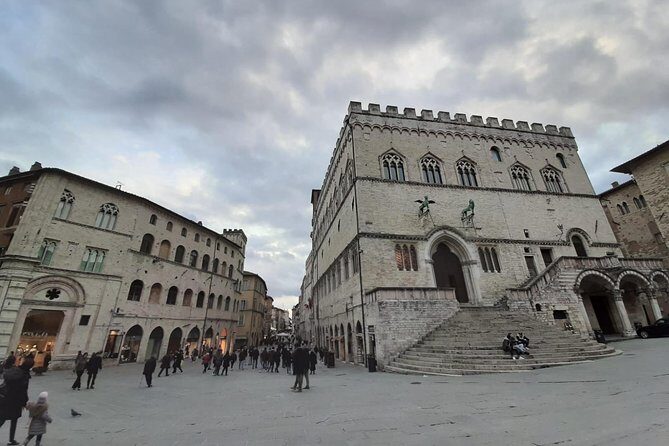
REVIEW · SAN GIMIGNANO
San Gimignano Cathedral & Museum of Sacred Art Entry Ticket
Book on GetYourGuide →Operated by GetYourGuide Tours & Tickets GmbH · Bookable on GetYourGuide
San Gimignano saves its biggest story for inside the Duomo. This entry ticket pairs cathedral access with a complimentary audio guide, so you can actually read what the walls are saying: New and Old Testament frescoes painted by the 14th-century Sienese school, plus a Renaissance highlight in a medieval setting.
I really like the way this experience is built around the cathedral’s visual facts. You’ll see the interior’s striking Tuscan columns (14 total), including four octagonal ones, and you’ll be guided through the fresco programs that cover both right and left walls.
One consideration: you have to exchange your voucher at the ticket office in Piazza Pecori before you enter, and the audio guide is physical but depends on availability at the attraction.
In This Review
- Key Things to Know Before You Go
- Piazza Pecori Ticket Exchange: Start Here
- Entering the Cathedral: Columns, Vaults, and the “Why This Matters”
- The Right Wall New Testament Cycle With Lippo and Federico Memmi
- The Left Wall Old Testament Stories of Bartolo di Fredi (1367)
- Santa Fina Chapel: Renaissance Artists Inside a Medieval Church
- What Else to See in San Gimignano While You’re Nearby
- Price and Value: Is $11 a Good Deal?
- Timing and Duration: Fit It Into a One-Day Visit
- Language Options for the Audio Guide
- The Best-Fit Visitor: Who Will Enjoy This Most?
- Should You Book This Cathedral Entry With Audio Guide?
- FAQ
- Where is the meeting point for this ticket?
- Do I need to exchange my voucher?
- What’s included in the ticket?
- Is the audio guide included, and in what languages?
- How long does the experience take?
- Are there specific starting times?
- Is this experience wheelchair accessible?
- How much does it cost?
- Can I cancel for a full refund?
- Who provides the experience?
Key Things to Know Before You Go

- Fresco-first visit: The cathedral is basically a picture book, with New Testament scenes on the right and Old Testament scenes on the left.
- Audio guide support: You get a complimentary physical guide in multiple languages (availability dependent).
- Specific artist names: Lippo and Federico Memmi, Bartolo di Fredi, plus Santa Fina Chapel artists Giuliano da Maiano, Benedetto da Maiano, and Domenico Ghirlandaio.
- Architectural details are part of the story: Look for the round and octagonal columns, plus the painted-blue cross vault and striped arch intrados.
- Plan a short extra wander nearby: The ticket experience is a good anchor for checking out other churches and convents in town.
Piazza Pecori Ticket Exchange: Start Here
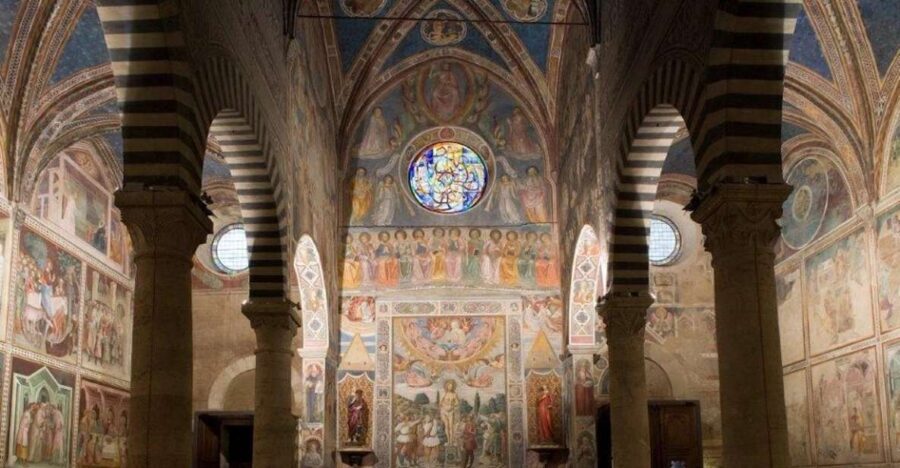
Your entry starts in Piazza Pecori, at the ticketing office on the left side of the San Gimignano Duomo (Cathedral). The key practical point: you’ll need to exchange your voucher there before your visit.
This matters because San Gimignano can feel like it’s all stone and stairs, so the less time you spend hunting paperwork, the faster you can get to what you paid for. Also, since the audio guide is physical, it’s smart to swap your voucher promptly so you don’t end up waiting around near the entrance.
You can also read our reviews of more tours and experiences in San Gimignano.



Entering the Cathedral: Columns, Vaults, and the “Why This Matters”
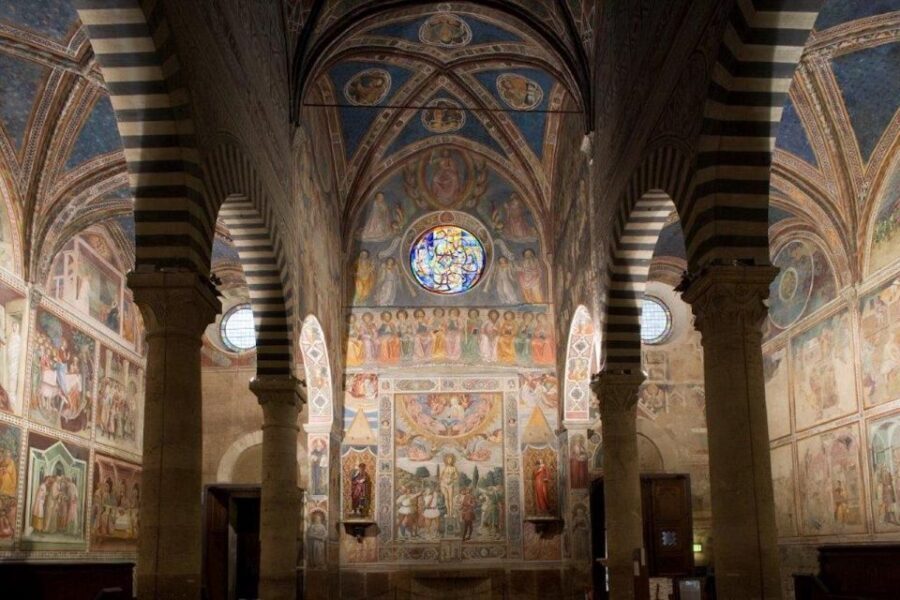
Once inside, the cathedral doesn’t ease you in with quiet art. It hits you with structure and decoration that look intentional down to the last detail.
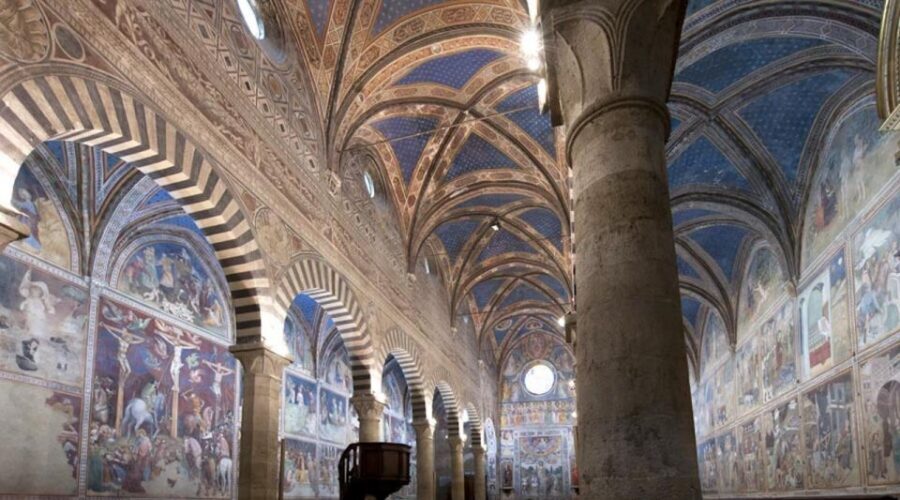
I’d treat this as a two-layer visit: first, the architecture (how the space is built), then the painted stories (what the walls are telling). The interior is known for its 14 Tuscan stone columns—10 round and 4 octagonal—which give the nave and aisles that rhythmic, medieval look. If you’re the type who likes to understand how buildings work, those columns give you something concrete to focus on instead of just admiring from a distance.
Then watch what happens when your eyes move upward. The cathedral includes medieval-style polychrome decoration, including a painted-blue cross vault and patterned decoration on the intrados of the arches that separate the nave from the aisles. That striped motif is one of those details that’s easy to miss if you’re staring only at the biggest paintings.
This is where the audio guide earns its keep. You’re looking at scenes that connect together, and having an ordered explanation helps the fresco cycle make sense instead of feeling like a random wall of religious imagery.
The Right Wall New Testament Cycle With Lippo and Federico Memmi

If you want one “main event” inside, start with the cathedral’s right wall. This side holds a New Testament fresco cycle described as a masterpiece by Lippo and Federico Memmi.
Why I think that’s worth prioritizing: artist attribution gives you something to track as you move. Instead of only noticing subject matter (birth, miracles, teachings, the usual), you can also look for how the Memmi work creates a consistent visual language across the wall.
The practical way to use the audio guide here is simple: pause long enough to let one sequence register before moving on. The stories are painted to be read in order, and trying to “speed-run” frescoes often turns them into pretty background.
The Left Wall Old Testament Stories of Bartolo di Fredi (1367)
On the left wall you’ll find the Old Testament stories, painted in 1367 by Bartolo di Fredi.
This pairing—Old Testament on the left, New Testament on the right—creates a helpful framework for your attention. Your brain tends to sort visual information better when it has a clear structure. As you move between the two sides, you start to see how the cathedral’s program is designed to connect the faith stories across time.
One of the smartest choices you can make: don’t force yourself to memorize everything. Instead, pick a couple of scenes, follow the audio guide’s explanation for those, and then sweep your gaze across the rest. You’ll get the meaning without burning your energy.
If you’re doing this as part of a walking day through San Gimignano, this is also a good moment to slow down. The cathedral’s artwork rewards patient looking, not sprinting.
Santa Fina Chapel: Renaissance Artists Inside a Medieval Church
After the fresco cycles, the cathedral offers a different kind of art experience: the Chapel of Santa Fina. It’s described as a precious Renaissance jewel, and it stands out because three famous Florentine artists worked on it in recognizable roles:
- Giuliano da Maiano (architect)
- Benedetto da Maiano (sculptor)
- Domenico Ghirlandaio (painter)
That mix of architecture, sculpture, and painting is exactly why this chapel feels like a “story within the story.” You’ve been surrounded by 14th-century fresco narrative, and then you step into a space connected to a beloved local saint.
For you, the value is how it changes your perspective. Medieval churches can feel uniform at first glance; a chapel like this reminds you that art styles and goals shift even within the same building. The cathedral doesn’t just preserve art—it shows how taste and technique evolved.





What Else to See in San Gimignano While You’re Nearby
The highlights for this cathedral visit don’t stop at the Duomo doors. The idea is that you can use the cathedral as your anchor point and then explore nearby treasures such as the Collegiata, other churches, and convents.
Here’s how I’d approach it without overplanning: after your cathedral time, walk a loose loop through town and choose one or two additional religious stops based on what time and energy you have. San Gimignano is compact, but stone streets and stairs add up fast. If you’re already thinking you might do more than one church, build in breaks so you actually enjoy the art instead of just ticking boxes.
Price and Value: Is $11 a Good Deal?
The entry ticket is listed at $11 per person, plus there’s an €1.5 booking fee included. On paper, that’s not a huge spend for a monument that contains specific, named artwork and a structured fresco program.
Here’s the value logic I’d use:
- You’re paying for entry to one of San Gimignano’s most important monuments.
- You’re also getting a complimentary audio guide, which can turn “I saw paintings” into “I understand what I’m looking at.”
- The cathedral includes both major fresco cycles (New and Old Testament) and the Chapel of Santa Fina with major Renaissance contributors.
The only thing that could affect value for you is how you like art. If you love soaking in details and reading scenes slowly, the audio guide becomes more than a nice extra. If you’re the type who prefers a quick exterior view, you may not fully use the time inside.
Still, for most people, this looks like a fair deal: small-town ticket pricing, with big-art payoff.
Timing and Duration: Fit It Into a One-Day Visit
This experience is set for 1 day, with starting times based on availability. That flexibility is useful in a town like San Gimignano, where you might plan around crowd levels or the rest of your itinerary.
My practical suggestion: choose a time that gives you breathing room. Even with an audio guide, frescoes are not “look for five minutes and move on” art. Give yourself enough time to read at least part of each side wall cycle and to see the Santa Fina Chapel without feeling rushed.
Also, remember you’ll spend some moments at the ticket office in Piazza Pecori swapping your voucher. Build that in so your entry doesn’t feel like a scramble.
Language Options for the Audio Guide
One of the strengths of this ticket is that the audio guide is offered in multiple languages. It’s a physical guide, and it’s subject to availability at the attraction.
The languages listed are:
- English
- French
- German
- Italian
- Russian
- Spanish
If you’re traveling as a mixed-language group, this is also a real planning advantage. You can keep the visit together without one person missing out on the narration.
The Best-Fit Visitor: Who Will Enjoy This Most?
I think this ticket is a great match if you:
- want a cathedral visit that explains what you’re seeing (not just staring at art)
- care about art history at the “named artists and dated works” level
- enjoy slow looking, especially with fresco cycles
- want one major monument on a one-day San Gimignano plan
It may be less ideal if you only want quick photo stops or you’re pressed for time and can’t sit with the frescoes.
Should You Book This Cathedral Entry With Audio Guide?
I’d book it if you want the cathedral to make sense as you walk through it. For the money, you’re getting entry, plus a physical audio guide that supports the cathedral’s main strength: its fresco-driven story walls and the Chapel of Santa Fina.
It’s also a smart option because it’s built around a simple start: exchange your voucher in Piazza Pecori, then focus on the art once you’re inside. The only reason to skip is if you know you won’t use the audio guide and you prefer fast visual browsing.
If you’re already in San Gimignano for a day, this is one of the best ways to spend that time—because it turns a beautiful building into a readable experience.
FAQ
Where is the meeting point for this ticket?
The ticketing office is in Piazza Pecori, on the left of the San Gimignano Duomo.
Do I need to exchange my voucher?
Yes. You’ll need to exchange your voucher at the ticketing office before your visit.
What’s included in the ticket?
The ticket includes entry and a complimentary audio guide to the San Gimignano Cathedral, with a booking fee included.
Is the audio guide included, and in what languages?
The audio guide is included, and a physical guide is available in English, French, German, Italian, Russian, and Spanish, subject to availability at the attraction.
How long does the experience take?
The duration is listed as 1 day.
Are there specific starting times?
Starting times depend on availability, and you can check availability to see the options.
Is this experience wheelchair accessible?
Yes, it is listed as wheelchair accessible.
How much does it cost?
The price is listed at $11 per person, and a €1.5 booking fee is included.
Can I cancel for a full refund?
Yes. You can cancel up to 24 hours in advance for a full refund.
Who provides the experience?
The provider listed is GetYourGuide Tours & Tickets GmbH.