REVIEW · FLORENCE
Self Guided Tours Florence With 100 Captivating Audio Stories
Book on Viator →Bookable on Viator
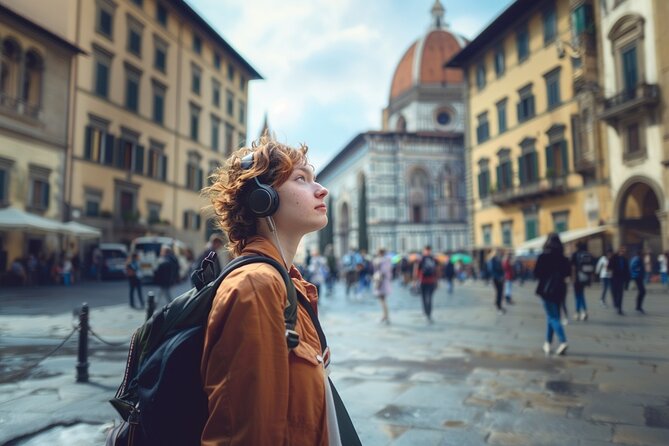
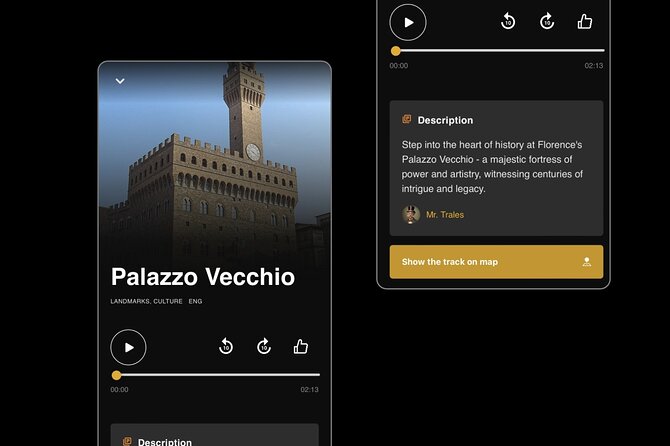
Florence, narrated right as you walk. This self-guided audio tour uses your smartphone and headphones to deliver 100+ location-based stories around the city, and you start it from your browser with no downloads. The whole idea is to help you move at your pace, pausing at Duomo or Ponte Vecchio when something catches your eye.
I especially like how the narration is easy to follow, with story windows built around major spots so you do not feel lost. One consideration: you need a reliable internet connection, and this is not an admission ticket system for churches or museums.
In This Review
- Key points at a glance
- Florence audio stories on your phone: how the experience feels in real life
- Getting started fast: web app map, browser launch, and the phone-code step
- Duomo to Ponte Vecchio: a short walk that tells big stories
- Piazza della Signoria: where art, politics, and statues share the same air
- Santa Maria Novella and San Miniato: religious spaces with sound-led storytelling
- Mercato Centrale to the Uffizi area: food-energy and museum gravity
- Price and value: what you really get for about $3.47
- Timing and pacing: making 1 to 2 hours actually work
- Potential snags to plan for: tickets, codes, and internet
- Who this Florence self-guided audio tour suits best
- Should you book this Florence audio-story tour?
Key points at a glance
- 100+ location-based audio stories tied to landmarks and famous people
- Web app map so you can find each stop without complicated setup
- Browser-based start with no downloads (you just use what your phone already has)
- Short, practical story timing (many stops are around 10 minutes)
- Private by default so you explore only with your group
- No offline access, so plan for connectivity as you walk
Florence audio stories on your phone: how the experience feels in real life
This kind of tour works best when you want Florence without the classic group-travel script. You do not have to wait for a guide, match someone else’s pace, or commit to one fixed order for hours. Instead, you get audio prompts at key sights and you choose which stories to play as you pass.
The sound design matters here. The audio is not just facts read like homework; it comes with soundscapes that make the city feel present. You can listen while you walk through piazzas or stand still and let the story take over for a few minutes.
What makes it particularly useful is the promise of “location-based” stories. In practical terms, you are not clicking around blindly all the time. You can treat it like a walking itinerary that you control, with the option to stop, start, and skip.
Getting started fast: web app map, browser launch, and the phone-code step
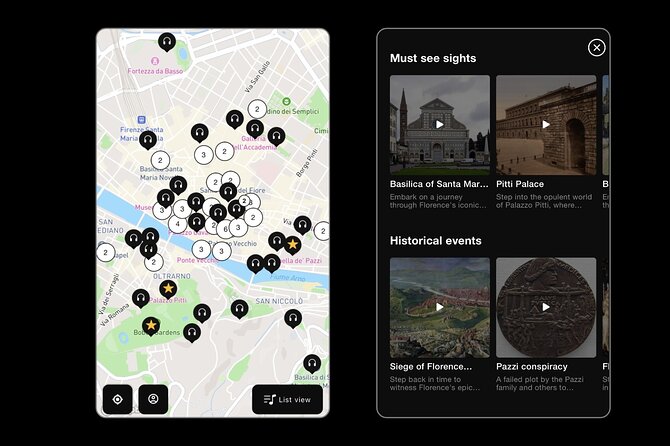
Setup is designed to be simple: you use a web app with a map and you activate through a one-step link. No downloads means less time fiddling with storage and permissions, which is a real win when you are traveling light.
You will also want to plan for activation before you reach the busiest sights. After booking confirmation, the process asks you to enter the last 5 digits of your phone number in the promo code field at Trales.io. That extra step is small, but it’s the kind of thing that can trip you up if you do it in a hurry while you are already standing at the entrance.
Because there is no offline access, your phone needs internet while you listen. That means you should expect normal city connectivity issues at times, especially when signal is weak between buildings. If you rely on mobile data, check that you have enough for the whole walk, including times you might need the map.
One more practical note: you bring your own smartphone and headphones. If you are traveling with a second person, both of you will need your own listening setup for the best experience.
Duomo to Ponte Vecchio: a short walk that tells big stories
Your first major stop is the Duomo area: Cattedrale di Santa Maria del Fiore. The audio here is built around why this cathedral matters, framing it as a symbol of human creativity and resilience. Even if you only listen for the short story window, you will get more out of the façade and the surrounding streets than just looking.
What you should watch for: the itinerary says the story access at this stop is admission-ticket free, but that does not automatically mean you can walk into every church space you want. A safe way to think about it is this: the tour supports the experience through audio, not through entry tickets you do not already have.
From there, you move to Ponte Vecchio. The audio story at the bridge highlights a specific point that makes the place feel dramatic: it’s the only survivor of WWII. That detail changes how you see the bridge. It stops being only pretty architecture and becomes a structure with survival built into its story.
If you want a good strategy, use this part like a reset. Take a few minutes at the bridge to listen, then keep walking rather than over-staying. It’s easy to get stuck photographing the same angle, and the audio format works best when you let it guide your pace.
Piazza della Signoria: where art, politics, and statues share the same air
Next up is Piazza della Signoria, right in Florence’s power-and-culture zone. The audio is aimed at uncovering the secrets of the square, with history and culture braided together in the heart of Tuscany.
This is one of those locations where you can accidentally turn into a statue tourist and call it a day. The advantage of the audio format is that it helps you connect what you’re seeing to why the spot mattered. You are not just passing monuments; you are learning what kind of public stage this was.
A practical tip: plan to pause before you cross into the busiest photo angles. Use your headphones for the story, then step out of the loudest crowd moment to get a clearer view. The audio does not require you to stay in one exact spot, so you can find a calmer pocket nearby.
Santa Maria Novella and San Miniato: religious spaces with sound-led storytelling
Two church stops follow: Basilica of Santa Maria Novella and Basilica San Miniato al Monte.
For Santa Maria Novella, the audio experience focuses on the basilica as a sanctuary of art and history, and it references the bell tolling to guide you into the experience. That’s the key: you are not only reading about what’s inside, you are being guided by the atmosphere around you. The bell reference also helps anchor the story timing, which makes it easier to follow even if you are walking in and out of small crowd flows.
Then comes San Miniato al Monte, which is described in a Romanesque style lens. The audio encourages you to notice the quieter character of this site compared with the most central landmarks. This is a good stop if you want your Florence walk to feel a little less crowded and a little more old-world.
One thing to remember at any church stop: the tour is for listening, not for solving entry rules. If you plan to go inside specific areas, keep your own ticket/entry expectations clear in advance. The audio does not replace that.
Mercato Centrale to the Uffizi area: food-energy and museum gravity
After the basilicas, you get a change of pace with Mercato Centrale. This stop is about how history and flavors collide in a food market setting, and it’s tied to the Renaissance spirit of the place. The audio approach is helpful here because markets are sensory chaos. Sound helps you organize what you’re seeing and tasting rather than just rushing from stall to stall.
If you want to make the most of it, use the audio story first, then buy something after. That way you connect the context to the food you actually choose. And if you skip the eating part, at least listen for a few minutes so you see the market as more than just a place to grab a snack.
Finally, the itinerary includes the Uffizi Gallery area. The audio description points you toward the treasures inside its grand corridors. The useful way to treat this stop is as a “context bump.” Even if you do not spend much time inside, listening helps you understand what kind of museum it is and what you might want to focus on when you do go.
If you plan to enter the Uffizi itself, plan like a regular museum visit. The audio format can build excitement, but museum entry still has its own rules and timing.
Price and value: what you really get for about $3.47
At $3.47 per person, this audio guide is priced for access, not for luxury. The value comes from three things:
First, you get a web app map plus 100+ stories, so you are paying for flexible content you can choose from rather than a single fixed route. If you only listen to a handful of stories, you still get a meaningful Florence overview.
Second, you get top sights, historic events, and famous people packaged into short listening segments. That matters because Florence is dense with major landmarks. A guide that forces you to sit for long blocks can be exhausting. Short story windows are easier to fit into sightseeing without slowing you down.
Third, you avoid the biggest friction of many self-guided audio tours: downloads. No offline requirement also keeps setup simple, but it does mean you should keep an eye on internet access.
A quick word on commitment: the experience is listed as non-refundable and cannot be changed for any reason. That matters if your trip timing is uncertain. If you know you’ll walk for 1–2 hours during good weather and you have solid phone connectivity, the value math gets even better.
Timing and pacing: making 1 to 2 hours actually work
The overall duration is about 1 to 2 hours, which is a sweet spot for jet-lag days or days when you want to fit in multiple neighborhoods. Many stops are set around roughly 10 minutes, so you can plan a mini-route without overthinking it.
Here’s a practical pacing idea: pick 3–4 stops for listening and treat the rest as optional. Duomo, Ponte Vecchio, and Piazza della Signoria can fit neatly into a first Florence circuit. Then, if you still have energy, add Santa Maria Novella or San Miniato.
Because you can start and stop anytime and at any place, you do not have to force yourself to follow every stop in order. If crowds are thick at one landmark, you can move, listen elsewhere, and come back later.
Potential snags to plan for: tickets, codes, and internet
The biggest real-world risk with any phone-based guide is assuming it includes everything. This one is an audio guide, not an all-in-one entry pass.
The most important expectation to set: if you’re trying to get into a specific church or museum area, you should not assume the audio guide will also hand you an access QR code or guarantee entry. Plan your entry separately so you do not waste your time at security or doors.
Next, activation codes can be timing-sensitive. The tour relies on you using a promo code step involving the last 5 digits of your phone number after confirmation. To avoid stress, do the activation before you reach the first major stop, and double-check you entered the digits correctly.
Finally, no offline access means you should prepare for connectivity gaps. If you lose internet, your audio may pause or your map may stop updating. A simple workaround is to keep the browser open, use Wi-Fi when available, and avoid listening only in the deepest low-signal stretches.
Who this Florence self-guided audio tour suits best
This experience is a good match if you like to walk, like to choose what you focus on, and you want Florence stories without the pressure of a group schedule.
It fits well for:
- Couples or friends who share a route but want personal listening
- First-time visitors who want the major landmarks explained in manageable bites
- People who prefer exploring at their own timing rather than committing to long guided blocks
- Anyone comfortable using a smartphone while walking
It is not the best match if:
- You strongly need offline listening
- You have hearing accessibility needs (it is not recommended for travelers with hearing impairment)
Also, the tour is listed as private/activity-only your group, which is helpful if you do not want to share headphones with strangers in your orbit. You’ll be using your own devices anyway, so the “private” setup is more about the experience not being a mixed group.
Should you book this Florence audio-story tour?
Book it if you want a low-cost, low-effort way to connect Florence landmarks to stories you can actually use while walking. The combination of 100+ location-based audio stories, short story pacing, and browser access with no downloads makes it a smart option for a 1–2 hour sightseeing slot.
Skip or reconsider if you’re expecting this to function like an entrance ticket system, or if you know your phone plan coverage is spotty and you can’t rely on internet. If you can sort activation calmly and keep connectivity in mind, this is a flexible Florence add-on that pays off fast.