REVIEW · BOLOGNA
Bologna Classic Guide Bike Tour
Book on Viator →Operated by TRAVELHOO · Bookable on Viator
Two hours, and you see the real Bologna. This guided bike ride strings together the sights that define the city, from medieval gates to the Two Towers and Santo Stefano. I love the helmet + radio-guides setup because it keeps you focused on the road and the stories. One thing to keep in mind: Bologna can feel tight on a bike, and you may get an adrenaline spike from close passes and traffic flow.
I also like that the group stays small—up to 20 riders—so you’re not lost in the crowd. The ride starts at 10:30am from Via del Monte, and it’s offered in English, so you can actually follow along. If the weather turns ugly, the tour requires good conditions, but a raincoat is available on request.
Most stops are quick photo-and-walk breaks, and the good news is the stops listed here are admission-ticket free, so you’re not paying extra just to look. You will still want a little patience: expect short stops around corners and piazzas, then back on the bike.
In This Review
- Key highlights at a glance
- Entering Bologna through Porta Galliera’s gate-and-wall story
- Racing your way past Prendiparte Tower and toward the Two Towers
- Piazza Maggiore: where politics, church power, and a crowd-proof fountain meet
- Archiginnasio and San Petronio’s bigger context: education and authority
- Santo Stefano and the “Seven Churches” layer on Roman ground
- Finestrella canal views and Via Zamboni’s student-energy street
- Bike comfort, traffic reality, and why the headset matters
- What’s included (and why it’s better than it sounds)
- Timing, group size, and where you start
- Price and value: is $90.31 fair for Bologna by bike?
- Who should book this Bologna Classic Guide Bike Tour
- Should you book this tour?
- FAQ
- What is the duration of the Bologna Classic Guide Bike Tour?
- What time does the tour start, and where do I meet?
- Is the tour offered in English?
- What’s included in the price?
- Are there admission tickets required at the stops?
- Do I need a high fitness level?
- How big is the group?
Key highlights at a glance
- A headset-style radio setup helps you hear your guide while riding (people call it a game changer)
- Two-hour loop, start to finish in the center, built for seeing a lot without rushing
- Iconic Bologna targets: Porta Galliera, the Two Towers, Piazza Maggiore, San Petronio, Neptune Fountain
- University and water-network stories at stops like Archiginnasio, Santo Stefano, and Finestrella
- Small group feel with a cap of 20 riders, so you’re not fighting for attention
Entering Bologna through Porta Galliera’s gate-and-wall story
The ride starts where the city wall legend still feels close: Porta Galliera in Piazza XX Settembre. This isn’t a random monument stop. It’s one of Bologna’s historic gates from the last circle of walls—the “third” set—that held the city together until those walls were destroyed in the early 20th century.
What I like about starting here is that it gives you a mental map fast. Bologna looks medieval all over, but the walls explain why the city’s layout feels so intentional. You’ll get a chance to pause and look at how the gate anchors the streets nearby, then you’re off again with the story of how the city grew outward.
Time is short here, so don’t expect a long lecture. Use it like a warm-up: check the bike fit, take in the piazza, and mentally note where you are before the route pulls you toward the towers.
You can also read our reviews of more cycling tours in Bologna
Racing your way past Prendiparte Tower and toward the Two Towers
Next comes Torre Prendiparte, one of Bologna’s tallest medieval towers, clocking in at 59 meters. It’s described as second only to the Asinelli tower, and it’s also known as la coronata—the crowned one—because of decorative elements near the top that resemble a pointed crown.
This is a good stop if you like details. Towers can blur together on a tourist day, but Prendiparte earns attention with its “crowned” look. Also, it’s close enough to the action that it feels real—like you’re learning the city as you go, not ticking boxes from a bus window.
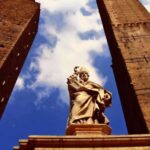
Then you hit the part everyone came for: Le Due Torri, including Torre degli Asinell. The idea here is simple: Bologna and its towers go together. In the Middle Ages, there were many towers—around a hundred—yet only a couple dozen survived, and the Two Towers are the names that still do the heavy lifting for the skyline.
A quick practical note for tower photos: on a bike tour, you’ll want to be ready before you stop. Have your phone out, your shot planned, and your helmet strapped. The guide’s pacing keeps it moving, so you’re capturing moments, not doing a long climb.
Piazza Maggiore: where politics, church power, and a crowd-proof fountain meet
Now you’re in Piazza Maggiore, the true heart of Bologna. This square began in the early 13th century as a marketplace, but it later became the seat of city government. Even today, the City Council’s offices remain in this area, so the square isn’t just pretty—it still functions.
One reason this stop works well on a bike tour: you don’t just look. You connect the dots between civic power and religious power.
A few steps away sits Basilica di San Petronio, famous for its characteristic unfinished façade. It towers over the square—almost like the city planned a grand statement and then stopped mid-production. That unfinished look is part of the appeal. It tells you Bologna’s story didn’t always follow a neat “perfect completion” plan.
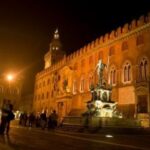
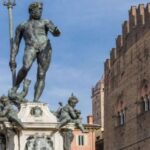
Then you cross to the Fontana del Nettuno (Neptune Fountain), opposite the Sala Borsa building. It’s one of Bologna’s standout landmarks, and the story around it is very practical: it was originally planned for the center of Piazza Maggiore, but demonstrations and large events made that placement too risky. They moved it to a more protected location to prevent damage.
This is where the tour’s pacing pays off. A bike makes the square feel like a living stage. You get the main scenes in one sweep, and you leave with a real sense of where people gather.
Archiginnasio and San Petronio’s bigger context: education and authority
From the square, the route leans into Bologna’s identity as a learning city with Archiginnasio di Bologna. The building was designed by the Bolognese architect Antonio Morandi, known as Terribilia, and built in 1563. The tour framing here matters: it wasn’t just a school building. It was tied to the Pope’s control over the city.
You also get an interesting link to the Neptune Fountain. According to the tour information, Pope Pius IV ordered the construction of both the Archiginnasio building and the Neptune Fountain. That’s a big “wait, really?” moment that helps the city’s icons click together. Bologna isn’t just stone and stairs—it’s power, politics, and influence played out in architecture.
Next you’ll walk past Basilica di San Domenico, positioned overlooking Via Garibaldi near the Pavaglione and Piazza Galvani. The area used to sit outside the city walls in medieval times, and the old church name—San Nicolò delle Vigne (San Nicolò of the Vineyards)—signals that it wasn’t always the same kind of neighborhood. It’s a reminder that today’s elegant streets weren’t always inside the protected city core.
For a short stop, San Domenico gives you atmosphere. You get the sense of a city that kept moving its borders, even while its religious buildings stayed grounded.
Santo Stefano and the “Seven Churches” layer on Roman ground
The ride then brings you to Basilica – Santuario di Santo Stefano, known as Sette Chiese (Seven Churches). This is one of the most fascinating stops because it’s not just one church. It’s a complex with layers that build over time.
The tour story ties it to the first Christian martyr, and it also connects the site to Roman history: the complex was built on ground that once held a temple dedicated to Isis. That contrast—Roman temple to Christian sanctuary—explains why Bologna feels stacked. You don’t just walk through history here; you walk through changes in belief and authority.
It’s also close to the Two Towers area, so the stop makes sense in the flow. You’re watching the city layer itself: skyline towers, then church weight, then deeper ground-level meaning.
Time is brief, but you’ll usually leave with a stronger mental image than you started with, especially if you like places where the past doesn’t sit politely in one era.
You can also read our reviews of more guided tours in Bologna

Finestrella canal views and Via Zamboni’s student-energy street
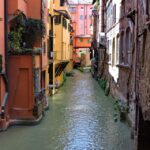
After the churches, the ride turns toward a quieter kind of Bologna: water and canals. At Finestrella di Via Piella, you look through a famous opening onto a canal called Canale delle Moline. The tour explains that this is part of a wider network of underground waterways. Long ago, Bologna’s water system didn’t run entirely below ground. It flowed under open air at one point, and the city even had a river port to handle trade and exchanges.
This matters because it changes how you “see” Bologna from street level. You start noticing that the city’s plan wasn’t just for pedestrians and politics. It was built around movement of goods and people, with waterways playing a real economic role.
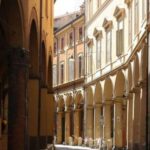
Then you roll into Via Zamboni, one of the iconic streets in the university area. The street connects the Two Towers area to Porta San Donato, another surviving city gate. The route frames Via Zamboni as more than a street you pass through. It’s dotted with places of interest and important buildings, and the guide explains what you’re looking at as you ride.
This is a great final flavor because it balances the heavy hitters—towers, major churches, big plazas—with street-level Bologna. You get that “I could spend more time here” feeling without dragging the tour into an all-day plan.
Bike comfort, traffic reality, and why the headset matters
Let’s talk about the part that can make or break a bike tour: the road feel.
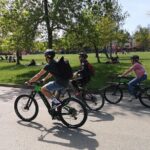
Some people get an adrenaline rush they didn’t expect. That usually comes from a mix of traffic density and the close timing of cars, scooters, and bikes in a city center. I’d call this normal for Bologna, but it’s still worth planning for. If you don’t love tight streets, choose your riding mindset carefully: stay smooth, keep your line, and don’t stare at landmarks while you’re actively moving.
Here’s the good news: the radio-guide / headset setup genuinely improves the experience. One review highlights a headset with a mic and one earpiece, which means you can hear the guide without fully losing awareness of what’s around you. If your guide is someone like Harry, or another pro like Giuseppe, you’ll feel that difference: clear cues, steady pacing, and a focus on keeping the group together.
Also, bring basic bike-touring sense. The tour is around 2 hours, and it expects moderate physical fitness. You’re not doing a long climb fest, but you will be riding continuously, then stopping briefly at each landmark.
One more tip: if you can, consider a Sunday morning. A review specifically calls out quieter streets and less traffic then. Since your brain already has to manage road awareness, calmer traffic makes it easier to enjoy the history part.
What’s included (and why it’s better than it sounds)
This tour includes a lot of the “make it easier” items:
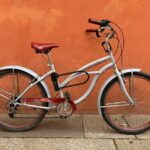
- City bike and helmet
- Radio-guides (the guide can speak clearly while you ride)
- Tour guide
- Third-part liability insurance
- Raincoat on request
- Mobile ticket
For a price like $90.31 per person, the value isn’t just the landmarks. It’s the friction removal. You don’t have to deal with bike rental logistics, you get safety basics (helmet), and the headset style radio helps you hear explanations without craning your neck or stopping every two minutes.
Also, the stop list is built around places where you’re not paying for entry—each listed stop is admission ticket free. That means the money goes into guiding and getting you between locations efficiently, not into squeezing in extra purchases.
Timing, group size, and where you start
This experience runs about 2 hours and starts at 10:30am. You meet at Via del Monte, 8a, 40126 Bologna (near public transportation), and you return back to the same starting point.
Group size caps at 20 travelers, and that’s a real quality signal. Smaller groups usually mean smoother instruction and less wandering for the tour guide to manage.
If you’re thinking about weather, keep it simple: the tour requires good weather. It’s not a “we’ll run in any rain” situation. Still, you can ask for a raincoat, which helps if you get a light drizzle.
Price and value: is $90.31 fair for Bologna by bike?
At $90.31 for roughly two hours, you’re paying for a compact “best-of” route with guiding, safety gear, and a communication system that helps you stay present.
The value case looks strongest if:
- you want multiple major landmarks without spending half the day figuring out transit and parking,
- you like hearing the why behind the sights (not just dates and labels),
- you care about comfort and safety (helmet + guide setup),
- you’re okay with short stops and a bit of street riding.
It’s not the cheapest way to see central Bologna, but it’s also not trying to be. Instead, it behaves like a guided “orientation ride,” giving you context so your later solo exploring makes more sense.
If you’re the kind of traveler who likes to linger at one church for 45 minutes, this format might feel too quick. If you like variety and a steady pace, the value will feel right.
Who should book this Bologna Classic Guide Bike Tour
This fits best if you:
- want a guided sampler of Bologna’s most recognizable places,
- enjoy biking on city streets and can handle moderately busy conditions,
- prefer small-group tours over big bus crowds,
- travel in English and want the story delivered in plain terms,
- like mixing skyline towers with churches and canal/water-system details.
It’s less ideal if you:
- hate close traffic feel and want zero stress,
- are looking for long museum-style stops,
- need lots of free time at each location before moving on.
Should you book this tour?
Yes—if your idea of a good day is cycling between major Bologna sights with a guide who explains what you’re seeing and helps you connect the dots fast. The combination of radio-guides, helmet, a small group size, and admission-free stops makes the price feel reasonable for what you cover.
Book it with confidence if you want towers, Piazza Maggiore, and the church-and-water stories that give Bologna its special “layered” feel. Just go in knowing traffic can feel close, and plan to ride calm and steady. That’s the trick to turning the adrenaline into enjoyment.
FAQ
What is the duration of the Bologna Classic Guide Bike Tour?
The tour lasts about 2 hours.
What time does the tour start, and where do I meet?
The start time is 10:30am, and the meeting point is Via del Monte, 8a, 40126 Bologna, Italy.
Is the tour offered in English?
Yes, the tour is offered in English.
What’s included in the price?
Included items are a city bike, helmet, radio-guides, tour guide, third-part liability insurance, and a raincoat on request. You also get a mobile ticket.
Are there admission tickets required at the stops?
The listed stops in this tour are admission ticket free.
Do I need a high fitness level?
The tour asks for a moderate physical fitness level.
How big is the group?
The maximum group size is 20 travelers.