REVIEW · FLORENCE
Florence: Architectural walk with urban sketching
Book on GetYourGuide →Operated by Francesca Serri · Bookable on GetYourGuide
Florence has a way of making you look twice. This architectural walk turns that moment of admiration into paper-and-pencil progress, with stops for sketching views around Piazza della Signoria and the line of the Vasari Corridor. The format is simple: you get a short setup lesson, then you wander, pause, and draw what you actually notice.
I love that the instruction is built around easy rules and an intuitive approach to perspective, so you’re not stuck chasing “perfect” drawings. I also like that you’re not just sketching buildings—you’re sketching the feeling of discovering a World Heritage city, one architectural detail at a time. One drawback to consider: there’s been a real no-show problem in past attempts, so I’d book with a plan to stay flexible if something goes wrong.
In This Review
- Key things to know before you sketch in Florence
- Florence is a gift for urban sketchers
- Finding your guide by the Neptune Fountain at Palazzo Vecchio
- The 1.5-hour plan: Piazza della Signoria to Vasari Corridor line
- What you’ll likely draw (so you can prepare your expectations)
- The perspective lesson: the trick is intuitive, not complicated
- Stop strategy: architectural details plus city-view moments
- Art supplies included: what you get and how to use them
- Price and value: is $32 fair for 1.5 hours in Florence?
- Who this walk is best for (and who might want to skip it)
- One important risk: guide no-show issues have happened
- Should you book this Florence architectural sketch walk?
- FAQ
- How long is the Florence architectural walk and sketching session?
- Where does the experience start?
- What language is the instruction offered in?
- Who leads the urban sketching?
- What’s included in the price?
- Do I need to bring sketching materials?
- Is food or drinks included?
- Can I extend the time beyond 1.5 hours?
- What should I wear, and what’s not allowed?
Key things to know before you sketch in Florence
- Architect-led drawing guidance: instruction focuses on architectural urban sketching, guided by instructor Francesca Serri.
- Intuitive perspective, not math class: you practice a practical way to make buildings look convincing on paper.
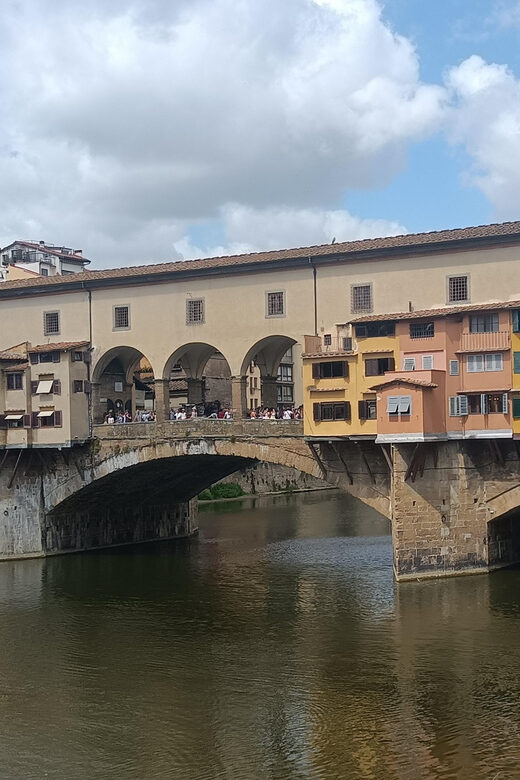
- Route centers on recognizable landmarks: the walk links Piazza della Signoria with the Vasari Corridor line and the Arno River areas for view stops.
- You get the art setup: art supplies are included for the sketching session.
- Time moves at a comfortable walk pace: about 1.5 hours, with an option to add extra drawing time if you want.
Florence is a gift for urban sketchers
Florence rewards attention. You can’t help but notice how streets tighten into viewpoints, how towers rise in layers, and how façades change with the angle of the light. That’s exactly why this kind of walk works: you’re not doing a museum sprint, and you’re not drawing from a single postcard view. You’re drawing architecture as you experience it—slow enough to notice proportion, rhythm, and that quick spark of wonder.
And the approach matters. Urban sketching here isn’t framed as “talent vs. no talent.” The core idea is that imagination drives the drawing first, then perspective gives it structure. That’s a relief if you’ve ever felt intimidated by “perspective” as a subject.
You can also read our reviews of more walking tours in Florence
Finding your guide by the Neptune Fountain at Palazzo Vecchio
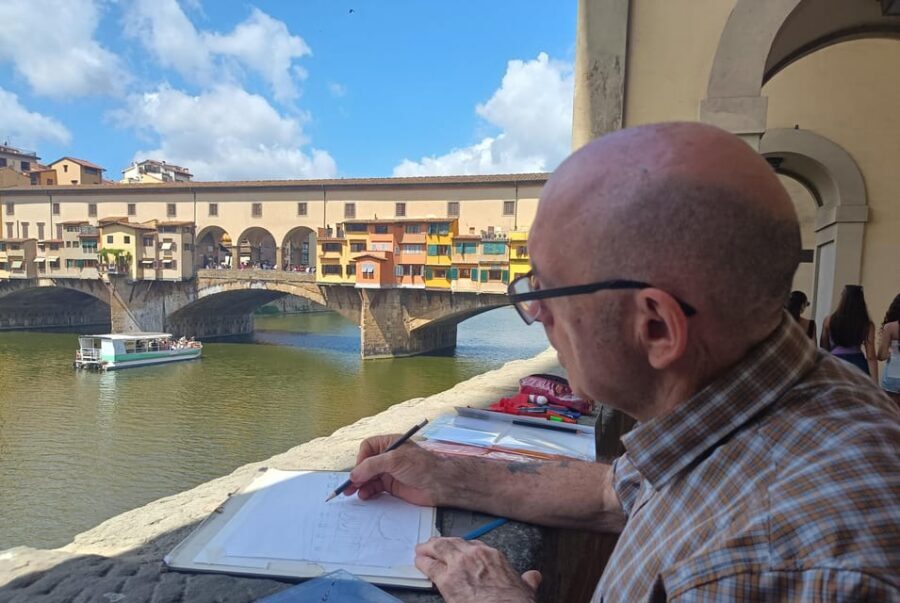
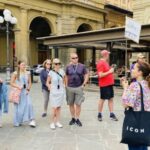
You’ll start in the city center, with the meeting point by the Beyond the Neptune Fountain area, close to the refilling water point built into the wall of Palazzo Vecchio, just behind the fountain. The guide will hold a drawing square and a sheet of paper with the experience name in hand, so you can spot the right person quickly.
This early detail is more than cute—it sets the tone. You’re not rummaging for materials or guessing what’s going on. You show up ready to draw, and that reduces the usual first-10-minutes chaos that can throw off your confidence.
What to bring is straightforward: comfortable shoes. The walk includes time stopping to sketch and some strolling between view points, so anything you wouldn’t comfortably walk in all afternoon is a risk.
The 1.5-hour plan: Piazza della Signoria to Vasari Corridor line
The route is designed around one big idea: follow the architectural story through Florence, rather than bouncing randomly between photos.
From the meeting point, you’ll head toward Piazza della Signoria. After a brief introduction to how you’ll compose the drawings, you’ll begin focusing on architectural details—small shapes, edges, repeating windows, and the way buildings sit on their streets.
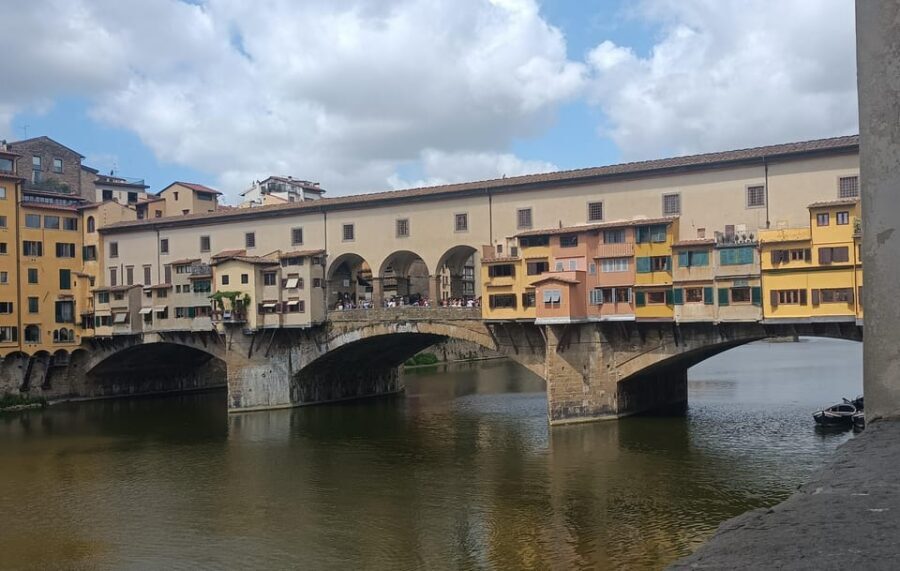
Then the walk follows the line connected to the Vasari Corridor. You won’t be treating this as a strict interior tour. Instead, you follow the corridor’s architectural line while walking through the city’s built beauty, including time along the Arno River. The corridor itself is noted as something that will become accessible in the future as part of the museum system, but this experience focuses on what you can do right now: observe and draw the architectural alignment and the views it creates.
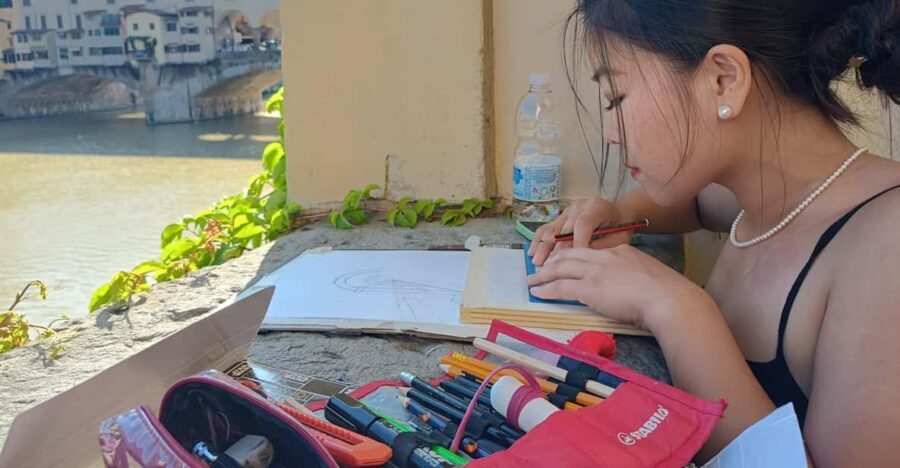
Along the way, you’ll stop to make drawings of the city. You can also stop longer to embellish what you’ve already started. That flexibility is important because city sketches rarely happen in one clean burst—your first line is usually messy, and your second pass is where it starts to feel like your drawing.
What you’ll likely draw (so you can prepare your expectations)
You should expect short sketch sessions aimed at views and architectural details, not a single finished masterpiece. This isn’t a “sit for hours and shade everything” style outing. It’s more like guided momentum: you learn an approach, try it in real conditions, and get time to strengthen the lines and proportions before moving on.
The perspective lesson: the trick is intuitive, not complicated
Urban sketching lives or dies by perspective, but you don’t need a background in geometry to make it work. This walk is built around the idea that you can create architectural views with a few easy notions of intuitive perspective.
What “intuitive” means in practice here is this: you’ll be encouraged to set up your drawing in a way that makes the building’s structure behave on paper. Instead of aiming for exact technical draftsmanship, the goal is to make the scene read correctly—especially the big relationships: verticals, horizontals, and how lines guide your eye toward depth.
You’ll also learn how to compose before you start. That’s a big deal. Many people jump straight into drawing details and end up with a page full of disconnected parts. Composition first helps you decide what belongs in the scene and what you can simplify.
If you’re the type who always gets overwhelmed by “where do I start,” this is designed to solve that problem. The instruction is about getting you drawing quickly with rules that feel usable on the street.
- Tuscany Day Trip from Florence: Siena, San Gimignano, Pisa and Lunch at a Winery
★ 5.0 · 21,634 reviews - The Best tour in Florence: Renaissance & Medici Tales – guided by a STORYTELLER
★ 5.0 · 12,316 reviews

Stop strategy: architectural details plus city-view moments
This walk doesn’t treat stops as random breaks. Stops are the engine. You move, you pause, and you draw something specific—then you move again with fresh eyes.
You’ll focus on architectural details at some points, which helps you practice seeing things as shapes and patterns: window grids, cornice lines, arches, and the way façades stack. Those details also give your page energy even when your view changes.
Then you’ll have broader city-view moments. Those stops are where perspective practice becomes visible. If you’ve been doing small details, your eye gets trained; if you’ve been only doing scenic wide shots, your drawing often turns into a blur. This mix is what makes the experience feel like progress instead of repetition.
And because you can stop longer to embellish your drawings, you get to close the loop: first you capture the moment, then you refine it while your memory of the view is still fresh.
Art supplies included: what you get and how to use them
Art supplies are included, and that’s a real value. It means you don’t have to show up with a perfect kit you bought months ago and never used. You’ll also bring less stuff through the historic center, which makes the day easier.
The guide will bring specific materials for this type of art and propose new techniques. Even if you’ve sketched before, having a set of materials matched to the lesson can help you avoid the common problem of drawing with tools that aren’t giving you the results you want.
To get the most out of supplied materials, keep this simple mindset: draw confidently, even if it looks rough at first. Architectural urban sketching rewards an approach that records the major structure early, then adds smaller cues.
Price and value: is $32 fair for 1.5 hours in Florence?
At $32 per person for about 1.5 hours, the price is mostly about guided instruction plus art supplies—not admission fees. The value is strongest if you like two things:
1) You want a guided method for perspective and composition, not just a nice walking route.
2) You want to leave with sketches that feel structured rather than accidental.
The fact that art supplies are included matters. If you’ve ever priced out a beginner-friendly sketch kit in a tourist area, you know it can quickly become more expensive than you’d expect. Here, you’re paying for the learning experience plus materials, and that’s a better deal than buying supplies and figuring it out on your own.
One small consideration: drinks or food are not included. The good news is the walk happens in the city center, so you’ll be able to stop for a snack if you need one—but you should plan to handle that yourself.
Who this walk is best for (and who might want to skip it)
This experience is ideal if you’re curious about drawing architecture but don’t want to feel like you’re taking a test. It’s also good if you enjoy being outside with a plan—wandering, stopping, and drawing—rather than following a strict museum-style itinerary.
It’s not suitable for children under 12, and it’s described as a private group. I’d treat “private group” as a plus if you want a steadier pace and more direct attention, but it also means you should check how the timing fits your day since you’re still tied to the selected start time.
Comfort-wise, plan for walking and stopping. Comfortable shoes are the only requirement listed, but your body will thank you for thinking about grip, especially on any uneven historic pavement.
One important risk: guide no-show issues have happened
I can’t ignore the issue shown in past experiences: there have been occasions where the guide didn’t show up and couldn’t be reached by phone. That’s not a small inconvenience. For a short, structured 1.5-hour activity, a no-show can waste the most valuable part—your time in the city.
How to protect yourself:
- Keep your plans flexible around the start time.
- If you’re traveling in a tight schedule, consider building in buffer time so one hiccup doesn’t derail everything.
- If the company offers any support channel in your booking flow, use it early if something looks off.
It’s unfortunate, but it’s also practical to know before you commit.
Should you book this Florence architectural sketch walk?
Book it if you want a guided way to draw Florence’s architecture using intuitive perspective, and you like the idea of learning by doing—walk, stop, sketch, refine. The route through Piazza della Signoria and along the Vasari Corridor line makes it a strong match for people who want their drawing to connect to real places, not just theoretical instruction.
Skip or think twice if your schedule is extremely strict and you can’t absorb the impact of a possible guide issue. This is short, so you’ll feel delays more than on longer tours.
If you’re flexible and you’re excited by the idea of turning admiration into a sketch page, this is a smart use of 90 minutes in Florence.
FAQ
How long is the Florence architectural walk and sketching session?
The experience lasts about 1.5 hours.
Where does the experience start?
You meet at Beyond the Neptune Fountain, closer to the refilling water point located in the wall of Palazzo Vecchio, just in the back of the fountain.
What language is the instruction offered in?
The instructor provides instruction in English and Italian.
Who leads the urban sketching?
The experience is guided by Francesca Serri.
What’s included in the price?
Included items are drawing expertise and art supplies.
Do I need to bring sketching materials?
No. Art supplies are included, and the guide also brings specific materials for this type of art.
Is food or drinks included?
No. Drinks or food are not included.
Can I extend the time beyond 1.5 hours?
Yes. The experience is approximately 1.5 hours, and the guide accepts a free offer for extra time if you want to continue.
What should I wear, and what’s not allowed?
Wear comfortable shoes. The experience does not allow luggage or large bags, pets (assistance dogs allowed), mobility scooters, alcohol and drugs, skateboards, scooters, and making fire.
More Walking Tours in Florence
More Tour Reviews in Florence
- Tuscany Day Trip from Florence: Siena, San Gimignano, Pisa and Lunch at a Winery
★ 5.0 · 21,634 reviews - The Best tour in Florence: Renaissance & Medici Tales – guided by a STORYTELLER
★ 5.0 · 12,316 reviews