REVIEW · PERUGIA
Perugia Walking Tour with Audio and Written Guide by a local
Book on Viator →Operated by Walking Cap · Bookable on Viator
Perugia is best met on foot. This walking tour gives you audio and written commentary you can control, with key stops from Etruscan walls to a papal fortress. For about $7.81, you also get the kind of practical guidance that helps you actually enjoy the walk, not just race between highlights. I especially like the self-paced format and the way the route connects monuments into a single story you can follow at your own speed.
The one catch is tech: you’ll rely on a smartphone with internet for the digital guide, and headphones aren’t included (you can use your phone speakers, if needed). If your signal is weak or you don’t want to juggle a map plus instructions, you may find the experience a bit fiddly. Still, the route is focused, the essentials are free to enter, and the final payoff views are worth the effort.
In This Review
- Key highlights to look for
- Walking Perugia’s center at human speed
- The Etruscan Gate: starting with a big landmark
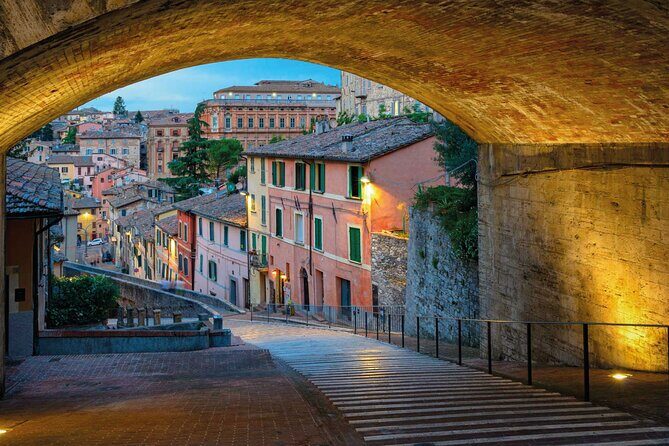
- Aqueduct Medievale: water engineering you can almost hear
- Pozzo Etrusco under Palazzo Sorbello: plan for the one paid stop
- Piazza IV Novembre: Perugia’s heart in real time
- Cathedral of San Lorenzo: where layers stack underground
- Braccio Fortebracci’s Loggia and Corso Vannucci: power meets daily life
- Rocca Paolina: a papal fortress built by force
- Belvedere del Borgobello: finish with the view that makes the walk worth it
- Price and value: why $7.81 can work for you
- Tech, pacing, and the real-world gotchas
- How to plan your 3–4 hours
- Who should book this walking tour
- Should you book it?
- FAQ
- FAQ
- How long is the Perugia walking tour with audio and written guidance?
- What languages are available for the audio and text guide?
- Do I need headphones?
- Do I need internet on my phone?
- Is there a live guide walking with the group?
- Is Pozzo Etrusco included in the price?
- Where does the tour start and end?
Key highlights to look for
- Local audio + text in multiple languages (English, Spanish, Italian, German, French), so you can read when you want and listen when you don’t.
- A very walkable 3–4 hour loop through Perugia’s central historic core, with short breaks built in at major squares.
- Solid “what am I looking at?” context at every stop, from Etruscan stonework to Renaissance-era power moves.
- Most monuments cost nothing to enter on this route, with one notable exception: Pozzo Etrusco is not included.
- Real-world food and culture tips, including guidance for authentic restaurants and the city’s famous chocolate baci discussion.
- You control the pace, which is great when you want extra time in a church or you’re simply moving slower uphill.
Walking Perugia’s center at human speed
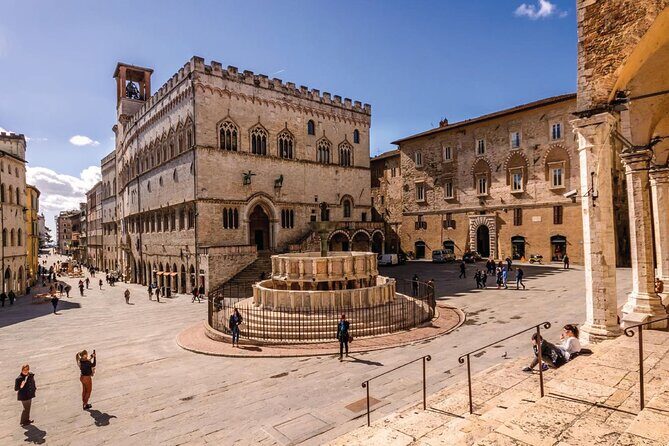
Perugia’s charm comes from details: stone gates, angled streets, and viewpoints you only notice once you start walking. This tour fits that reality because it’s designed to be self-guided—you decide when to pause and when to keep moving.
The duration estimate is around 3 to 4 hours, and the sightseeing rhythm works out well if you don’t rush. You’ll also get a mobile ticket and a guide you can revisit later, which is useful if you want to re-check a stop while you’re still in town.
Because it’s not a live guide walking alongside you, the value is in interpretation plus directions. Think of it like having a local explain what you’re seeing while you explore—without pressure to keep up.
You can also read our reviews of more walking tours in Perugia

The Etruscan Gate: starting with a big landmark
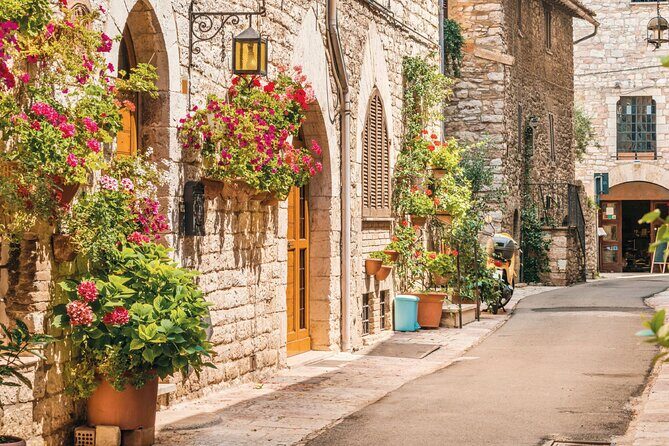
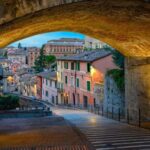
Your walk begins on Via Ulisse Rocchi, at stop 1: the Etruscan Arch, also called the Monumental Etruscan Gate. This gate is tied to the old city walls, which stretch for about 3 kilometers, and the structure is thought to date to the 3rd century BC.
What I like about starting here is that it sets the tone fast. You’re not starting with a postcard church—you’re starting with how Perugia once defended itself, and how that older world still shows itself in the stonework.
Entry here is marked as free, so you can spend a few calm minutes looking before the route pulls you onward.
Aqueduct Medievale: water engineering you can almost hear
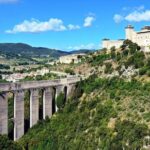
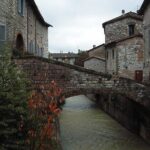
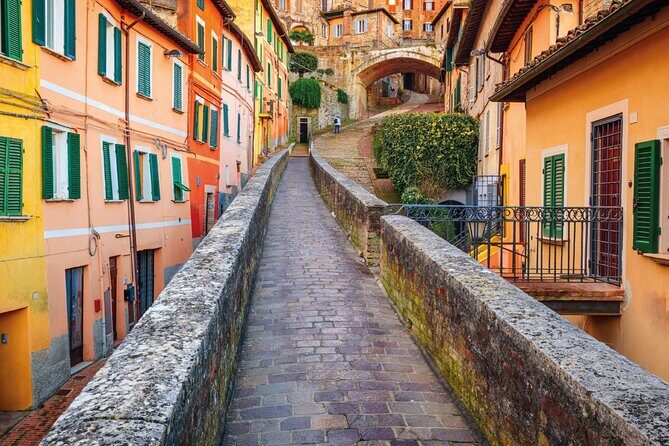
Stop 2 is the Acquedotto Medievale, a medieval aqueduct stretch that runs about 4 kilometers. Construction began in 1254, and its purpose was to move water from Monte Pacciano to the Fontana Maggiore area—another stop the route sets up for later in the city story.
This is a great checkpoint if you like seeing how cities worked before modern plumbing. It’s also a reminder that “history” isn’t only about palaces and churches; it’s about daily survival technology.
Entry is free, and you’ll get short, focused guidance rather than a long lecture. That makes it easier to keep the pace without feeling lost.
Pozzo Etrusco under Palazzo Sorbello: plan for the one paid stop
Stop 3 is Pozzo Etrusco, the Etruscan Well located in the basement of Palazzo Sorbello. The well is described as built in the second half of the 16th century, and later acquired by the Bourbon di Sorbello family in 1780. The palace is still owned by their descendants.
Here’s the practical part: admission isn’t included. If you’re trying to keep the whole day budget-tight, this is the one place you may need to decide on the spot whether it’s worth the extra cost for you.
Why do it anyway? A “well” is oddly personal—everyone depended on water—so it tends to feel less abstract than some major monuments. Plus, this stop breaks up the walk with something enclosed and atmospheric.
Piazza IV Novembre: Perugia’s heart in real time

Stop 4 is Piazza IV Novembre, one of Perugia’s main gathering places. It’s described as the symbolic and cultural heart of the city, central to political and religious life for centuries.
What makes this square feel alive is the modern calendar on top of the old stone. The guide context includes references to events like Umbria Jazz, Eurochocolate, and the International Journalism Festival, all tied to the square’s role as a stage for major moments.
Entry is free, and the visit window is short—about 20 minutes—so it’s a good place to reset. Take a breath, orient yourself, and use the guide audio to connect what you’re seeing to the city’s bigger shifts.
You can also read our reviews of more guided tours in Perugia


Cathedral of San Lorenzo: where layers stack underground
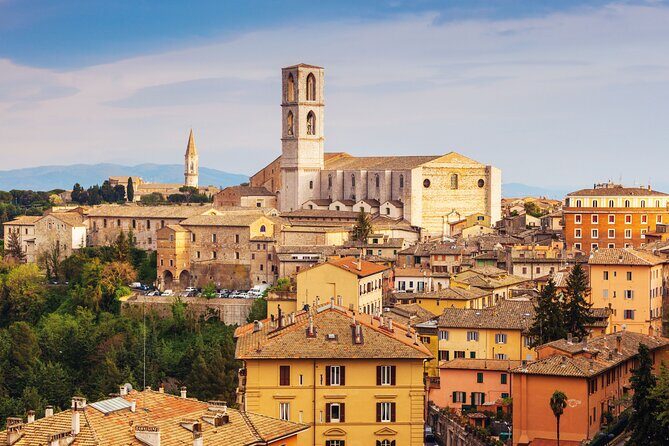
Stop 5 is the Perugia Cathedral (San Lorenzo). It stands on the site of an earlier church: a 12th-century Romanesque building that itself occupied an area of an older Etruscan and Roman acropolis, now underground.
This stop is one of the most meaningful on the route because it shows how Perugia kept rebuilding on the same ground. If you like your sightseeing to have a “why here” explanation, this is where the guide’s background helps you interpret details you might otherwise ignore.
The cathedral stop is free to enter and is given about 30 minutes. That’s enough time to look around, read the guide’s key points, and not feel like you’re sprinting through a sacred space.
Braccio Fortebracci’s Loggia and Corso Vannucci: power meets daily life
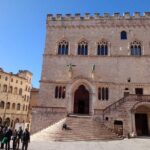
Stop 6 is the Loggia di Braccio Fortebracci. Braccio Fortebracci da Montone is described as a determined leader who expanded his control across central Italy, pushing as far north as Bologna. In 1416, he gained control of Perugia after defeating Carlo I Malatesta, who was chosen by the Church as a Defender of Perugia.
The guide also notes that in 1423, Braccio commissioned the Bolognese architect Fioravante to create a loggia overlooking Piazza IV Novembre, including a staircase leading toward his stately residence.
You’re not just learning names here. You’re seeing how authority was displayed in architecture: a perspective aimed at the public square, a way to watch and influence what happened below.
Stop 7 is Corso Vannucci, the city’s main avenue and historical spine. Named after Pietro Vannucci, known as Perugino, it connects Piazza Italia to Piazza IV Novembre and cuts across the historic center.
This pair of stops makes the walk feel complete: one side shows how leaders ruled; the other shows how everyday movement flows through the city. Both entries are free, and the time windows are short—around 15 minutes each—so they keep the route moving without rushing.
Rocca Paolina: a papal fortress built by force
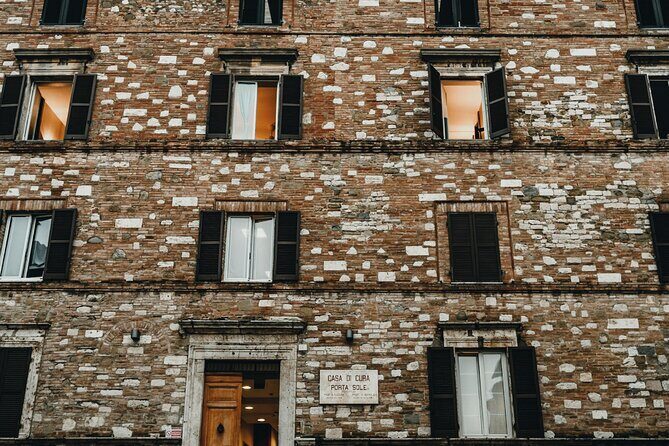
Stop 8 is Rocca Paolina, a 16th-century papal fortress built by order of Pope Paul III Farnese between 1540 and 1543. The route explains that it was part of how papal power solidified after the Salt War against the people of Perugia.
This fortress was designed by military architect Antonio da Sangallo the Younger. One detail that makes it hit harder is the note that construction required demolition of about a quarter of the city, and the structure was divided into two complexes: a larger fortress on Landone hill and a smaller “Tenaglia” lower down, connected by three fortified passages.
Even if you only walk through part of it, the place changes your sense of Perugia. It feels like the city’s story includes conflict, control, and rebuilding—not only art and church facades.
Entry is listed as free on this route, and you’ll have about 30 minutes, which is just enough time to grasp the layout and focus on the most relevant sections.
Belvedere del Borgobello: finish with the view that makes the walk worth it
Stop 9 is the Belvedere del Borgobello, one of Perugia’s most fascinating panoramic points. From here, you can admire the buildings, the historic center, and typical Umbrian surroundings, plus it’s described as a meeting spot for young people and families.
This final stop works like a reward. After Etruscan gate, medieval water, church layers, and fortress walls, the belvedere lets you step back and see Perugia as a whole.
Time is around 15 minutes, so you don’t need to linger forever. But do take a moment to look, then listen again to the last bits of audio so it “lands” while the city is in view.
Price and value: why $7.81 can work for you
At $7.81 per person, the value is strongest if you want a flexible, low-cost way to cover central Perugia. You’re paying for interpretation (audio + written guide), not for a live escort, and that trade-off matters.
What’s included is meaningful:
- Audio-guide and text in multiple languages
- Tips for monuments, history, and curiosities
- Best advice for local restaurant choices with authentic food
- A digital guide format you can use at your own speed
- A mobile ticket
What’s not included:
- Headphones (you use smartphone speakers or your own headphones)
- Pozzo Etrusco admission (optional on this route)
That means you can keep costs predictable, with just one optional extra. If you’re trying to see a lot with minimal spending, this setup is exactly the kind of budget-friendly approach that works well in Italy.
Tech, pacing, and the real-world gotchas
You’ll need a smartphone with internet connection to use the digital guide. The activation details are in your voucher, so read that part carefully before you start. If you arrive and scramble, you’ll lose time right when you want to be enjoying the walk.
Audio plays through your phone speakers or your own headphones, which is a practical option if you’re traveling light. Still, don’t underestimate the “app life” part: one review noted the experience can feel challenging because you have to toggle between the map and info, and another noted the audio sometimes cut out.
So here’s the simple way to avoid frustration:
- Keep your phone charged enough for the whole loop
- Use reliable signal in the historic center
- When you stop, give the guide a few seconds before moving again
And one more smart tip: if rain hits, you’ll still be outdoors for chunks of the route. The tour doesn’t promise weather-based flexibility beyond the standard refund rules, so plan for umbrella season.
How to plan your 3–4 hours
This walk is laid out with short visits at each main site, roughly adding up to a 3 to 4 hour experience once you factor in walking between stops. The timing per stop ranges from about 10 minutes for the quick hits to 30 minutes for bigger anchors like the cathedral and the fortress.
Pace it like this:
- Spend your “extra time” at one or two major stops (cathedral and Rocca Paolina are the best bets)
- Use the short stops to keep orientation and flow
- Let the belvedere be your slow finish
Also note the maximum group size is listed at 108 travelers. Since it’s digital, that number mostly matters for the activity setup rather than a constant crowd inside each monument.
Who should book this walking tour
This is a strong fit if you:
- Want a cheap, self-guided way to understand central Perugia
- Prefer setting your own pace (especially helpful if you want photo breaks)
- Like having restaurant recommendations built into your sightseeing plan
- Feel comfortable using a phone as your guide
It’s less ideal if you:
- Don’t have a working smartphone or stable internet access
- Strongly prefer live narration and constant human Q&A
- Want zero screen use while walking
If you’re a solo traveler, a couple, or a small family, this format can be especially convenient because you’re not stuck with a group rhythm. The walking loop also makes sense for visitors who want a clear “must-see” spine without paying for a full private tour.
Should you book it?
I’d book it if your goal is to get value and context while moving through Perugia’s core at your own speed. For $7.81, the combination of multilingual audio, text support, and practical local tips (including food guidance and references like chocolate baci) is a real win.
Skip it only if you really dislike smartphone navigation. If the idea of toggling between map and info sounds like a chore, you’ll probably want a live-guided alternative.
FAQ
FAQ
How long is the Perugia walking tour with audio and written guidance?
It’s designed for about 3 to 4 hours.
What languages are available for the audio and text guide?
The guide is available in English, Spanish, Italian, German, and French.
Do I need headphones?
Headphones are not included. You can hear the audio through your smartphone speakers or use your own headphones.
Do I need internet on my phone?
Yes. You’ll need a smartphone with internet connection to use the digital guide.
Is there a live guide walking with the group?
No. It’s not an in-person guide experience; the visit is done via digital guide.
Is Pozzo Etrusco included in the price?
Pozzo Etrusco’s admission is not included. The other listed major stops are marked free.
Where does the tour start and end?
It starts at Via Ulisse Rocchi, 39, 06123 Perugia and finishes at Rocca Paolina, Piazza Italia, 11, 06121 Perugia.