REVIEW · ASSISI
Assisi Walking Tour with Audio and Written Guide by a Local
Book on Viator →Operated by Walking Cap · Bookable on Viator
Assisi moves fast, but this walk keeps you in control. You get a digital local guide with audio and text that helps you connect the church façades, medieval politics, and Roman layers of the city as you go. It’s built for wandering at your pace, not marching on someone else’s schedule.
I especially like the freedom to take the route in the order that works for your day, with the ability to skip sections when you want. And I like that it includes practical restaurant advice and monument tips, so the tour doesn’t end when you reach the last church stop.
One thing to consider: this is fully phone-based. Headphones are not included, and if your phone is low on battery or you lose internet, the experience can feel less smooth.
In This Review
- Key highlights at a glance
- Assisi in a few hours: a self-guided walk with a local voice
- Before you start: smartphone setup and how the route works
- Basilica di Santa Chiara: the opening scene across the hill
- San Rufino museum and crypt: medieval rooms you can pause in
- Birthplace tradition and the 1615 makeover: Chiesa Nuova di San Francesco Convertito
- Rocca Maggiore: pink-stone fortifications and a view worth the climb
- Piazza del Comune: medieval civic power on top of Roman foundations
- Palazzo del Capitano del Popolo: where medieval order got enforced
- Roman Forum and Archaeological Museum: the city under your feet
- Oratorio dei Pellegrini: built for pilgrims who needed a seat
- Basilica Superiore di San Francesco d’Assisi: the finishing big moment
- Where the value really comes from at $7.81
- Who this walking tour suits (and who should choose something else)
- Should you book this Assisi audio walking tour?
- FAQ
- How long is the Assisi walking tour?
- What is the starting point and where do I finish?
- Is there an in-person guide?
- Do I get headphones with the tour?
- Do I need internet on my smartphone?
- What languages are included?
- Is the admission free at every stop?
- Can I choose the order of the stops?
- Is there a group limit?
- What is the cancellation policy?
Key highlights at a glance

- Local audio + written text in multiple languages (Eng, Esp, Ita, De, Fr)
- Self-guided walking with the option to adjust your order and pace
- Value-focused price ($7.81) with most monument stops free
- Assisi’s big stories in layers: Franciscan sites, medieval Rome, and civic power
- Small-ish group cap (maximum 115) even though there’s no in-person guide
- Helpful end-to-end direction flow, including maps inside the guide
Assisi in a few hours: a self-guided walk with a local voice
This tour is designed for the way most people actually tour Assisi: you want meaning, but you also want time to look. The format is simple—audio and text on your smartphone, walking between key sights—so you aren’t stuck waiting for anyone else’s pace.
For me, the best part is that the city stops aren’t treated like isolated monuments. You get cues that help you see how Assisi talks to itself: churches face each other across hills, a central square sits on top of an ancient Roman forum, and a fortified complex uses the same pink stone that gives the whole town its recognizable look.
At $7.81 per person for a 4 to 5 hour experience, the value comes from what’s included, not just the sightseeing list. Most stops have free admission (you’ll still see the big names), and the guide throws in restaurant and site-curiosity tips so you get more than postcard facts.
You can also read our reviews of more walking tours in Assisi
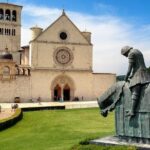
Before you start: smartphone setup and how the route works
This is not an in-person guided tour. You’re using a digital guide that you activate using details in your voucher, so read that message carefully before you leave.
Here’s what you should plan:
- You’ll need a smartphone with an internet connection to use the guide.
- You can hear the audio through your phone speakers or through headphones you provide (headphones are not included).
- The tour includes both audio and text, so if you prefer reading for a moment, you can switch modes.
- The experience is designed so you can take the tour in any sequence that fits your timing, and you can skip segments if something isn’t clicking.
Also, headphones matter more than you’d think in Assisi’s tight streets. Phone speakers work, but if you’re near other groups or in echo-y church spaces, headphones can make the guide easier to follow.
Basilica di Santa Chiara: the opening scene across the hill
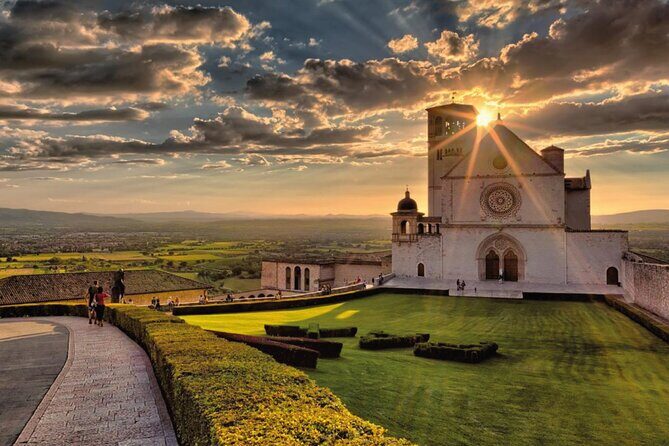
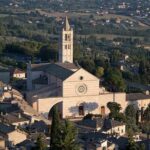
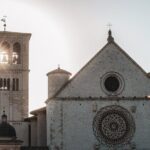
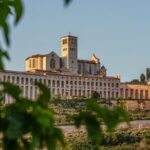
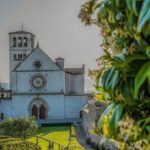
Your walk begins at Basilica di Santa Chiara (P.za Santa Chiara, 1). This stop is a great first chapter because it sets up Assisi’s visual dialogue. Santa Chiara sits on the opposite hill from Basilica of San Francesco, and the two create a kind of conversation through their simplicity.
Look for the details the guide emphasizes: the façades are inspired by a Romanesque model, and you’ll see a triangular tympanum plus a central rose window. The rose window is explained as a spiritual gesture—an embrace toward the pilgrims moving through Assisi’s streets.
It’s also a practical start. This site has free admission, and it gives you an early win: even before you get to the biggest Franciscan complex, you’re already oriented to the city’s religious architecture and the way the hills shape what you see.
San Rufino museum and crypt: medieval rooms you can pause in
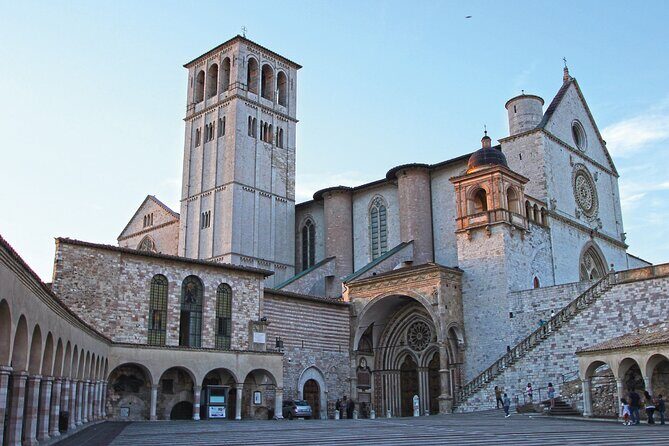
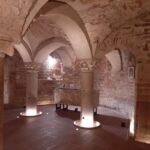
Next, you’ll head to the Diocesan Museum and Crypt of San Rufino, located near the Cathedral of San Rufino. This is one of those stops that works well when you don’t feel rushed.
The museum sits in medieval rooms, including decorated spaces and ancient cloisters. Instead of only showing art behind glass, it places you in environments that already feel like they belonged to a long chain of worship and community life.
What makes this stop especially valuable for independent travelers is the contrast. Churches are awe-inspiring, but museums help you slow down and understand context. From here, the Franciscan story later in the walk won’t feel like separate scenery—it will feel like part of a bigger Assisi ecosystem.
Admission is not always a cost hurdle here: the guide list indicates free admission for this segment.
Birthplace tradition and the 1615 makeover: Chiesa Nuova di San Francesco Convertito
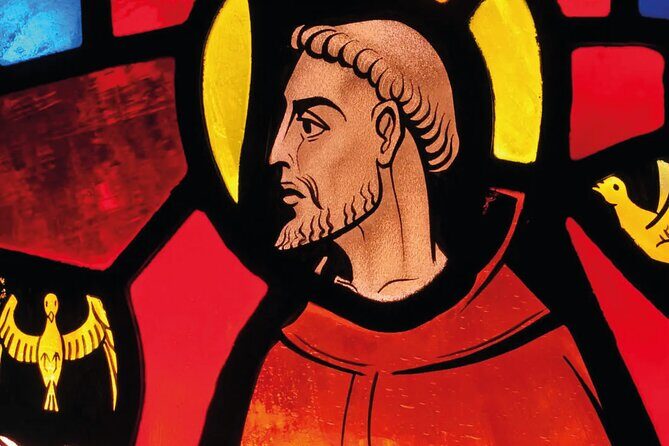
Stop by the Chiesa Nuova di San Francesco Convertito, which sits at a place traditionally identified as the birthplace of Saint Francis. That tradition alone draws people in, but the real hook is what happened later.
In 1615, the Friars Minor—supported financially by Philip III, King of Spain—transformed the space into a church. That shift matters because it connects a medieval saint’s story to early modern patronage and institutional support.
This is a shorter stop (about 20 minutes) and free admission, which makes it ideal if you like your walks with a rhythm: big stops, then smaller ones that add a clear layer of meaning without draining your energy.
You can also read our reviews of more guided tours in Assisi
Rocca Maggiore: pink-stone fortifications and a view worth the climb
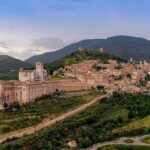
Then comes the fortified section: Rocca Maggiore (the Rocca di Assisi), formed by two main structures—Rocca Maggiore and Rocca Minore, also called Cassero di Sant’Antonio. You’ll spot the characteristic pink stone of Assisi again, reinforcing how “Assisi look” is literally built into the materials.
This is where the tour widens from purely religious sites into the city’s defensive and political past. A fortress in town isn’t just a view—it’s a reminder that power needed walls, and Assisi’s story includes civic control, not only spiritual devotion.
Plan about 45 minutes here, and note that admission is not included for Rocca Maggiore. If you’re trying to budget tightly, this is the one stop on your list that may add a ticket cost.
If you want a practical tip: arrive with water, because if the weather is warm, the fortification paths can feel longer than the time estimate suggests.
Piazza del Comune: medieval civic power on top of Roman foundations
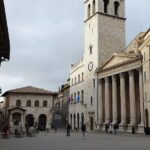
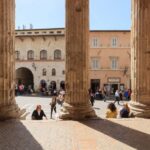
Now you reach Piazza del Comune, a square that functions like Assisi’s hub. The guide explains why it matters: the main roads leading out of the city gates converge here. In Roman times, the location worked as a public forum and political-social center.
In the Middle Ages, major buildings rose around it, including the Temple of Minerva, the first seat of the Municipality, the Palazzo del Capitano del Popolo, and the Torre del Popolo.
This is a great segment for travelers who enjoy seeing layers rather than just reading placards. The square helps you understand why Assisi’s city life developed where it did: big streets meet here, institutions built here, and power anchored here. It also sets up the next stop—because you’ll literally go below this square.
Free admission applies to the square segment.
Palazzo del Capitano del Popolo: where medieval order got enforced

Adjacent to the square, you’ll see Palazzo del Capitano del Popolo, built at the end of the 13th century. The building served as the seat of the Capitano del Popolo, a role representing municipal power.
The guide focuses on the practical side of government back then: the Capitano helped maintain order and administer justice. That may sound abstract until you’re standing in a civic building that’s clearly meant to project authority.
This is a short stop (about 15 minutes) and free, so it doesn’t feel like a detour. It works best if you enjoy the human side of history—the way roles were set up to keep society moving, even when life was uncertain.
Roman Forum and Archaeological Museum: the city under your feet
Beneath Piazza del Comune sits the Roman Forum and an archaeological area of the ancient city of Asisium. This was discovered through excavations by a French architect in the first half of the 19th century.
Here’s the practical detail that makes it worth planning: you can visit it by accessing the crypt of the former Church of San Niccolò in Via Portica. So even though you’re “at” Piazza del Comune, you’ll follow a path down into the past through the crypt route.
Expect about 45 minutes for this portion, and note that admission is not included. If you’re deciding how to spend your time, treat this as the most likely ticketed add-on besides Rocca Maggiore.
This stop is also a good reset point. If you’ve been looking at churches all morning, Roman forum archaeology offers a different kind of “read”—more ground-level, less symbolic, more structural.
Oratorio dei Pellegrini: built for pilgrims who needed a seat
Next, you’ll visit Oratorio dei Pellegrini. This is one of the quieter emotional stops on the route, because it’s tied to real logistics: pilgrims passing through needed a place to take part in religious functions.
The oratory was built in 1457 by order of the brotherhood of Sant’Antonio Abate and San Giacomo. It was created to allow pilgrims hosted in the nearby hospital to participate.
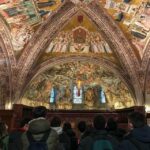
Inside, the guide highlights a square plan with a cross vault and frescoed walls. Even if you don’t catch every fresco, the layout tells you how space was used to serve people, not just impress them.
Admission is listed as free, and the time estimate is about 15 minutes, making it easy to fit in without losing momentum.
Basilica Superiore di San Francesco d’Assisi: the finishing big moment
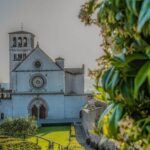
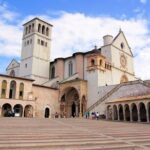
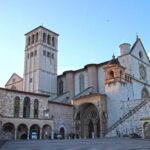
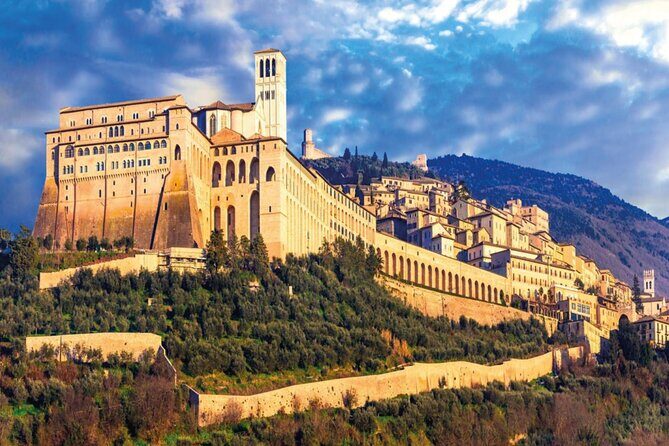
Finally, the walk ends at the Papal Basilica and Sacred Convent of Saint Francis, with your finishing point near Piazza Inferiore di S. Francesco, 2.
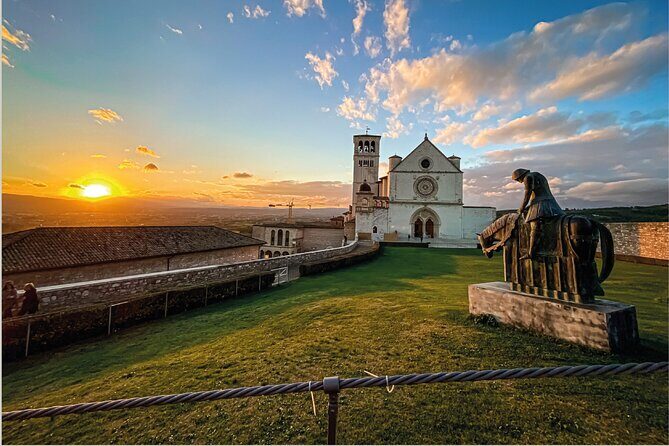
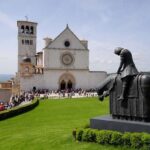
This is the stop that anchors everything you’ve learned. After Saint Francis died in 1226, the decision came quickly to build a basilica to hold his relics. The basilica’s importance was recognized immediately—on July 15, 1228, Pope Gregory IX (a friend of Saint Francis) laid the first stone and also proclaimed him a saint.
The basilica is built on a hill near Assisi, toward the north, which matters because it changes the way you experience the site. You aren’t only looking at architecture; you’re moving through a town shaped for spiritual sightlines.
The guide describes this segment with a free admission marker and about 30 minutes for your visit.
One practical note to keep your experience smooth: if you’re hearing audio that feels like it’s referencing the wrong part of the basilica, pause and restart your audio segment from where you are. The guide is digital, so small mismatches can happen depending on how the audio sections trigger on your phone. A quick reset usually puts you back on track.
Where the value really comes from at $7.81
Let’s talk value in plain terms. You’re paying $7.81 per person for a self-guided route that covers major Assisi themes: Franciscan sites, civic medieval structures, and Roman archaeology.
What makes this good value:
- Most stops show free admission on the tour’s segments (Santa Chiara, San Rufino museum/crypt, Chiesa Nuova, Piazza del Comune, Palazzo del Capitano del Popolo, Oratorio dei Pellegrini, and Basilica Superiore).
- The included guide isn’t only religious facts. You get audio and text in multiple languages, plus tips for monuments, history, and curiosities.
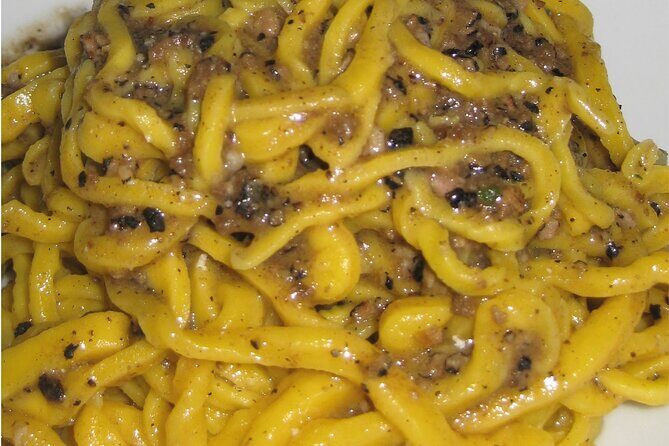
- The tour also includes best advice for a local restaurant with authentic food, which is useful when you’d otherwise be guessing.
What might reduce value for you:
- You’ll still want to budget for places marked as admission not included (notably Rocca Maggiore and Roman Forum/Archaeological Museum).
- The experience depends on your smartphone setup (internet access, battery life, and being able to hear audio in your environment).
Still, if you’re the type who likes to walk, read a little, and look at details without being tied to a group, this price can feel like a bargain.
Who this walking tour suits (and who should choose something else)
This tour fits well if you:
- Want a 4–5 hour plan that you can stretch or tighten.
- Prefer self-guided flexibility over scheduled group timing.
- Like seeing how Assisi layers religion, civic power, and Roman remains in one coherent loop.
- Appreciate a guide that includes practical life stuff like restaurant recommendations.
It might not be your best match if you:
- Want an in-person guide to answer questions on the spot (this is explicitly digital only).
- Really need a paper written guide. A few people expected physical paper materials and ended up disappointed, so set your expectations: this is a mobile guide, with text and audio on your phone.
And if you’re traveling with kids or you don’t want phones in hand, consider whether you’d enjoy switching between text and sight. The route can work, but the experience style is phone-first.
Should you book this Assisi audio walking tour?
Book it if you want an independent way to cover Assisi’s top spiritual and historical highlights without paying for a full in-person escort. The blend of Santa Chiara + San Francesco, plus the civic and Roman layers (Piazza del Comune, Palazzo del Capitano del Popolo, Roman Forum below) is exactly the kind of route that makes a short trip feel bigger.
Skip it or rethink it if you don’t want to rely on your phone. You’ll need internet to run the digital guide, and while the audio works through your speakers, it’s easier with headphones you provide.
If you do book, do this before you start: confirm the guide activation steps in your voucher, charge your phone fully, and plan to spend a bit longer at the basilica and the Roman archaeology if you’re enjoying yourself. The tour works best when you treat it like a choose-your-own pace story.
FAQ
How long is the Assisi walking tour?
It runs about 4 to 5 hours.
What is the starting point and where do I finish?
You start at Basilica di Santa Chiara (P.za Santa Chiara, 1, Assisi) and finish near Piazza Inferiore di S. Francesco (Piazza Inferiore di S. Francesco, 2, Assisi).
Is there an in-person guide?
No. This is a digital guide experience using your smartphone.
Do I get headphones with the tour?
No. Headphones are not included. You’ll hear the audio through your smartphone speakers or through headphones you bring.
Do I need internet on my smartphone?
Yes. You need a smartphone with an internet connection to use the digital guide. The activation details are in your voucher.
What languages are included?
The guide provides audio and text in Eng, Esp, Ita, De, Fr. The tour is offered in English.
Is the admission free at every stop?
Not at every stop. The guide indicates free admission for several segments, while Rocca Maggiore and the Roman Forum/Archaeological Museum have admission listed as not included.
Can I choose the order of the stops?
Yes. The experience is designed so you can take the tour in any sequence and at your own pace.
Is there a group limit?
Yes. The tour has a maximum of 115 travelers.
What is the cancellation policy?
You can cancel up to 24 hours in advance for a full refund.