REVIEW · FLORENCE
Bargello Museum: Face to Face with Donatello’s David
Book on Viator →Operated by Star Florence · Bookable on Viator
Florence can feel like a giant art contest.
This Bargello Museum tour is a focused hour with a guide, aimed right at major Renaissance sculpture, including Donatello’s Saint George, the Lion, and the David. You also get the museum’s big story early on: this building served as the Capitano del Popolo and later the Podestà, then became tied to policing and imprisonment, which makes the setting feel more than just pretty walls.
I especially like two things. Skip-the-line entry with a reservation means you spend less time stuck and more time looking at marble. Headsets/radio system make it easy to catch every point your guide makes, even in louder rooms.
One consideration: the museum’s second floor can be affected by renovations. One guide, Matteo, had to adapt because about half of that level was closed, which is a real buzzkill if glazed terracotta is your main goal.
In This Review
- Key things I’d circle before you go
- Bargello: why this Florence museum is worth your time
- The tour format: reserved entry, headsets, and a real guide
- Ground-floor masterpieces: Michelangelo’s four big works
- Donatello and Verrocchio: Saint George, the Lion, and David
- The second floor della Robbia terracotta you’ll want to time right
- The guides make or break it: Matteo, Martina, Francesca, and more
- Value and price: what $58.87 buys you in real time
- Who should book this Bargello Museum tour
- Should you book this Bargello Museum tour?
- FAQ
- How long is the Bargello Museum tour?
- What’s the price per person?
- Is admission included?
- Is skip-the-line access guaranteed?
- What language is the tour offered in?
- Where does the tour start?
- What happens if the museum changes access during renovations?
Key things I’d circle before you go
- A short, one-hour format that keeps you from getting museum fatigue
- Reserved, skip-the-line entry that works even in peak season, barring museum delays or strikes
- Michelangelo’s sculptures on the ground floor including Bacchus, Brutus, Tondo Pitti, and David-Apollo
- The Donatello and Verrocchio section highlighting Saint George, the Lion, and the David
- Second-floor della Robbia glazed terracotta by Andrea and Giovanni della Robbia
- Small-group feel (max 25) plus headsets so you can actually follow the talk
Bargello: why this Florence museum is worth your time
The Bargello (Museo Nazionale del Bargello) is one of Florence’s best “sculpture-first” museums. If you’ve felt overwhelmed by the big picture at the Uffizi or the crowds at the Accademia, this is a calmer way to get your hands on the goods: figures, reliefs, bronze, marble, and story-driven Renaissance design.
What I like most is how the building itself adds context. Before it was a museum, it was connected to city power and punishment: Capitano del Popolo, Podestà, then police headquarters, and later a prison. That background changes how you read the art. You’re not only looking at genius; you’re looking at why a city would commission, display, and obsess over the human form.
Also, it helps that the tour is built around a tight set of masterpieces. In one hour, you can get oriented fast, understand what you’re seeing, and still have time to go back to any favorite piece after the guided portion ends.
You can also read our reviews of more museum experiences in Florence

The tour format: reserved entry, headsets, and a real guide
This is not a “wander and hope” visit. You meet at Museo Nazionale del Bargello, Via del Proconsolo 4, 50122 Firenze FI, and you enter with reserved skip-the-line access. In peak season, that time saved is huge. You’re also not expected to decode the museum alone because you’ll have an official certified guide.
Your guide brings a radio system/headsets, which is a big deal in museums. You don’t have to hover near the front of the group just to hear what’s going on. The sound system keeps the pace comfortable and makes the experience feel more like a talk that happens inside the gallery, not a lecture you have to strain to follow.
Group size tops out at 25, which helps keep the visit from turning into cattle-herding. And since entrance tickets are delivered by the guide or their representative right at the meeting point, you avoid the awkward scramble that can happen when people are hunting for their tickets.
One practical note: you need to arrive on time. If you show up after the tour start time, you won’t join and you won’t be refunded or rescheduled.
Ground-floor masterpieces: Michelangelo’s four big works
The ground floor is where this tour earns its name, even if it’s not all Donatello. You’ll start with the museum’s structure and the building’s past, then move into the space with the key Tuscan works from the 16th century.
This is the part where I think you get the strongest payoff for an hour. Your guide will spotlight four Michelangelo works that are especially worth your attention:
- Bacchus
- Tondo Pitti (a relief with Madonna and Child)
- Brutus
- David-Apollo
Even if you’ve seen images before, it’s different in person. Michelangelo’s figures read more clearly when you’re guided through what to look for: posture, how the body occupies space, and what the sculptor seems to be saying through expression and proportion. Your guide also connects these works to the larger Florentine story so they don’t feel like random masterpieces stuck in a room.
Then the tour widens out. You’ll also spend time on works by artists like Bartolomeo Ammannati, Benvenuto Cellini, and Giambologna, including Giambologna’s Flying Mercury. The goal here isn’t to make you memorize names. It’s to learn what kinds of craftsmanship Florence valued: movement, anatomy, and surfaces that catch light differently as you walk around.
One more reason the ground floor is such a strong start: you’ll see objects from the Carrand collection, including precious ivories and bronzes with Roman and Byzantine examples. That mix matters because it shows Florence wasn’t copying the past only for decoration. It was building taste by studying older cultures and bringing that knowledge forward.
Donatello and Verrocchio: Saint George, the Lion, and David
After the Michelangelo focus, the tour shifts into early Renaissance mode, where the big names get the spotlight. Here, you’ll learn about Donatello’s masterpieces—Saint George, the Lion, and the David—and also hear context for Verrocchio.
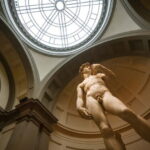
This is one of the best “face-to-face” parts of the visit because Donatello’s figures don’t just look real; they feel like they’re in motion emotionally. When a guide points out what’s going on—how the sculpture communicates bravery, tension, or presence—you start noticing details your eyes might otherwise slide over.
I also like the way this portion links artists together. Donatello and Verrocchio are not just two separate stops on a list; the guide helps you see how ideas about form and realism changed in Florence during the Renaissance.
If you came specifically for Donatello’s David, you’ll appreciate that the tour doesn’t isolate it. It frames it within the wider workshop world and the evolving style of the period. That context makes the statue more than a photo moment.
The second floor della Robbia terracotta you’ll want to time right
The second floor is dedicated to glazed terracotta by Andrea and Giovanni della Robbia. If you’ve never seen glazed terracotta up close, this is the kind of thing that can change your view of Renaissance materials. The surface glow and the way light hits the glaze are hard to capture well in pictures, and up close you get a clearer sense of how the material was chosen for effect.
Your guide will escort you through the highlights there, and the whole tour still stays about an hour total. That timing matters because it helps you avoid the worst museum problem: spending too long in a single section and leaving without enough energy to explore the rest on your own afterward.
One wrinkle to know: part of the second floor has been reported as closed for renovation. In at least one experience, Matteo had to adjust because roughly half of the level wasn’t accessible. If the della Robbia terracotta are your top priority, it’s smart to stay mentally flexible and treat the tour as a best-available highlights experience.
- The Best tour in Florence: Renaissance & Medici Tales – guided by a STORYTELLER
★ 5.0 · 12,316 reviews



The guides make or break it: Matteo, Martina, Francesca, and more
You’ll notice a pattern in the best versions of this tour: guides don’t just list facts. They pick a few strong points and teach you how to look.
Matteo is a great example. The talk style was described as witty and genuinely excited, and when the second-floor wing was closed, he adapted and still made the visit work. That adaptability is what keeps the hour from feeling like a wasted ticket.
Martina also gets strong praise for pacing and context—she gives you a brief Florence and Bargello frame first, then hits the key works at just the right speed. Francesca is another name that stands out, with a presentation that kept the tour interesting even for people who had already done other Florence galleries.
For families, Helena is mentioned for being kind and accommodating, including when children were part of the group. Even if your group includes adults only, that kind of practical, approachable tone can help you relax and ask questions.
And if you like a guide who answers directly, Hilary is noted for being very knowledgeable and responding kindly to questions.
Value and price: what $58.87 buys you in real time
At $58.87 per person for about an hour, you’re paying for three main advantages: a guide, reserved entry, and the audio system.
If you try to DIY the Bargello, you can still enjoy it. But you’ll lose time figuring out what’s worth your attention first, and you might miss the “why” behind what you’re seeing. The tour’s structure turns a large collection into a readable story: building history, key Renaissance sculpture, specific artists, then terracotta finishes.
You’re also buying time efficiency. Skip-the-line access matters because Bargello isn’t just “a museum.” It’s a place where attention is the currency. A delay at the start can mean you rush your way through the best pieces instead of stopping long enough to see how a sculpture is built.
With a group cap at 25 and headsets included, you also get a better chance of hearing the guide without constant shoulder-checking. For an hour, that’s the kind of quality-of-life upgrade that turns a visit into a proper experience.
One more value note: this tour is often booked around 41 days in advance. That’s not a requirement, but it’s a hint that good time slots get taken quickly. If your schedule is tight, booking earlier is a smart move.
Who should book this Bargello Museum tour
This tour fits best if you:
- Love sculpture and want to see major works without museum overwhelm
- Want a guide to connect Donatello, Verrocchio, and Michelangelo into one coherent Florence story
- Appreciate efficient visiting—an hour that hits the right highlights and then lets you roam after
It also works for people who don’t want an art history marathon. The tour’s length is short enough to keep your brain switched on, while still giving you meaningful context.
If you’re traveling with kids, the tour may be a good size and pace for families, especially with a guide who can keep things clear and engaging.
Should you book this Bargello Museum tour?
If you want a smart, time-friendly way into the Bargello’s sculpture collection, I’d book it. The reserved skip-the-line entry plus headsets makes the experience smoother, and the guide-led focus on Michelangelo and Donatello gives you a strong “I get it now” feeling fast.
I’d consider a second-floor renovation risk if glazed terracotta is your main obsession. But even then, the best guides adjust on the spot, and you’ll still come away with the core Bargello highlights. For most art lovers in Florence, this is a practical way to see more, understand more, and end the visit with energy left to explore on your own.
FAQ
How long is the Bargello Museum tour?
It lasts about 1 hour.
What’s the price per person?
The price is $58.87 per person.
Is admission included?
Yes. The entrance ticket with reservation to the Bargello Museum is included.
Is skip-the-line access guaranteed?
Yes, skip-the-line access is guaranteed, including during peak season, except in cases of museum delays or strikes.
What language is the tour offered in?
The tour is offered in English.
Where does the tour start?
You meet at Museo Nazionale del Bargello, Via del Proconsolo, 4, 50122 Firenze FI, Italy.
What happens if the museum changes access during renovations?
The tour is still designed to cover major highlights, but there can be closures during renovations. One tour note mentioned about half of the second floor being closed, and the guide adapted by focusing on what was accessible.


More Museum Experiences in Florence
More Tour Reviews in Florence
- Tuscany Day Trip from Florence: Siena, San Gimignano, Pisa and Lunch at a Winery
★ 5.0 · 21,634 reviews - The Best tour in Florence: Renaissance & Medici Tales – guided by a STORYTELLER
★ 5.0 · 12,316 reviews