REVIEW · FLORENCE
Essential Florence Walking Tour with an Expert Local Guide
Book on Viator →Operated by Walkabout Florence Tours · Bookable on Viator
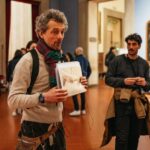
Florence clicks when you walk it. This Essential Florence tour uses an expert local guide to connect guild stories, the Medici era, and Renaissance design from the Duomo core to Oltrarno. I like the small group feel and the three-hour pace that keeps you moving without rushing.
The route hits major landmarks and the useful in-between details. I especially appreciate the way stops like Orsanmichele, the Baptistery, and Santa Trinita come with clear context, plus a taste of local gelato along the way.
One thing to consider: you’re walking on uneven cobblestones for most of the 3 hours, and every stop is brief (about 15 minutes). Plan for quick looks, not long museum time, even though there are bathroom breaks.
In This Review
- Quick takeaways
- Why this 3-hour Florence walk works so well
- The practical flow: where you start, how it feels, what you’ll do
- Orsanmichele: the grain loggia turned art treasure
- Passing Dante’s neighborhood: why the poet belongs here
- Duomo, Baptistery, and Giotto: Florence’s skyline lesson
- Santa Maria Novella and the Dominicans: church as a landmark system
- Palazzo Rucellai: Renaissance ideas made into stone rules
- Palazzo Strozzi: scale, ambition, and the cost to clear space
- Santa Trinita and Ghirlandaio frescoes: the church interior moment
- Palazzo Pitti and the Medici-to-royalty storyline
- Santa Felicita: oldest-feeling Oltrarno pace
- Vasari Corridor: the elevated route behind power moves
- Gelato and bathroom breaks: small comforts that help the whole day
- Price and value: what $40.12 gets you
- What to wear and bring for a comfy, problem-free walk
- Who this tour is best for
- Should you book this Essential Florence Walking Tour?
- FAQ
- FAQ
- How long is the walking tour?
- Where does the tour start and where does it end?
- Are there admission fees for the stops?
- What group size should I expect?
- What time does the tour begin?
- What if the weather is bad or I need to cancel?
Quick takeaways
- Tight 3-hour circuit with a start at Piazza della Repubblica and an end at Piazza della Signoria
- Free-admission stops listed at each featured site on the route
- Don’t-miss art stops: Donatello and Ghiberti at Orsanmichele, plus Ghirlandaio frescoes at Santa Trinita
- Dante gets real-life context as you pass Museo Casa di Dante
- Power and architecture in one walk through Renaissance palazzi and the Vasari Corridor story
- Group size max 20 so you usually hear everything clearly on the move
Why this 3-hour Florence walk works so well
Florence is huge on foot, but not all “walking tours” help you understand what you’re seeing. This one is built like a guided orientation: you get a storyline and then you’re shown the key pieces of it, close up.
What makes it work is pacing. You cover a lot of ground in about 3 hours, but you’re not sprinting between stops. Each location gets a short, focused visit, with time for bathroom breaks and a gelato stop so your brain can stay switched on.
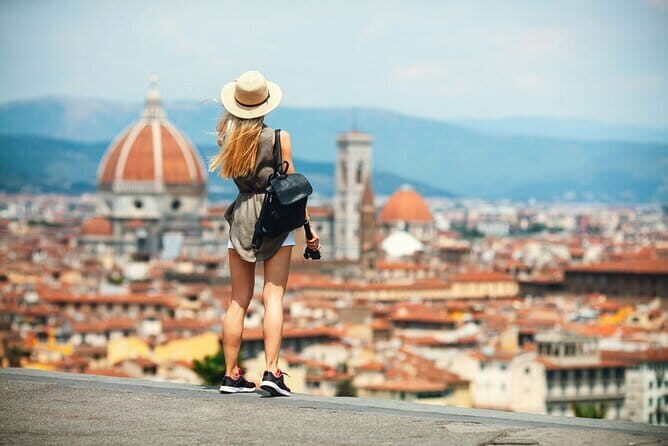
I also like that it’s not only the postcard sites. You’ll hit the Duomo complex and Baptistery, sure. But you also move through Renaissance palaces, church interiors, and the Oltrarno side of Florence where the Medici and grand-ducal power gets explained in a very human way.
You can also read our reviews of more walking tours in Florence
The practical flow: where you start, how it feels, what you’ll do
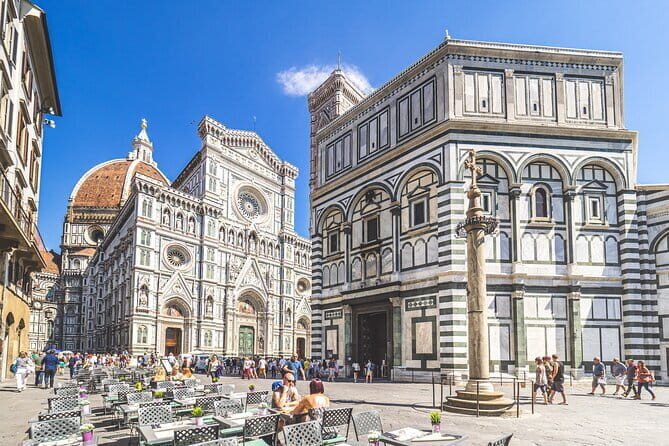
You meet at Piazza della Repubblica at 9:00 am and finish in Piazza della Signoria. That matters because it naturally leads you into the busiest historic core afterward, when you’re ready to keep exploring on your own.
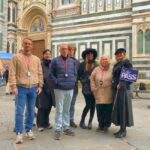
The group cap is 20 people, and the experience is set up so you can hear your guide. In past outings, guides were called out for being easy to follow, and some groups noted that headpieces help with clarity when you’re in crowded streets.
Expect a rhythm like this: brief walk segments, a stop where the guide explains what to look for, and then you move on. It’s especially smart for a first trip because you don’t just see buildings—you learn what each era was trying to accomplish.
If you’re the type who likes to ask questions, this format usually gives you room to do that. Guides are known for answering patiently and keeping the vibe engaging.
Orsanmichele: the grain loggia turned art treasure
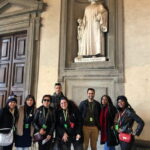
Your walk begins at Orsanmichele, a building that started life in a practical way and then changed jobs over time. It was originally a loggia meant for grain storage and market activity. Later, it was transformed into a church tied to the ancient Florentine arts and guilds.
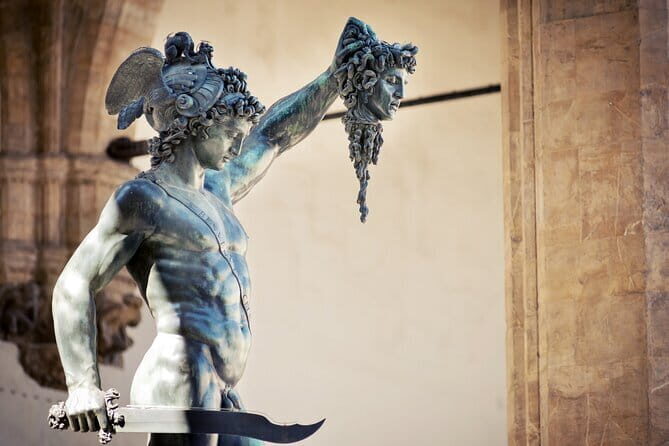
Today, the upper floors house a museum with major sculpture—specifically originals associated with the exterior niches, including famous works by Donatello and Ghiberti. Even if you’ve never studied Renaissance art, your guide helps you see why these pieces matter. You learn that Florence didn’t just “collect art”—the city used art to advertise influence, skill, and civic pride.
The main drawback at this stop is also the format: about 15 minutes means you’re choosing the highlights, not doing a full museum session. Still, it’s a great way to get your bearings quickly, because the guide’s framing makes the details feel intentional.
Passing Dante’s neighborhood: why the poet belongs here
Next comes Museo Casa di Dante—you pass by the area of Dante’s house and get the story of his life, his work, and his Florence. Dante isn’t a distant schoolbook name here. You learn how the city’s politics, religion, and social tensions fed the writing.
Even if you’ve read just part of The Divine Comedy, this stop helps connect the poet to place. You’ll understand why people in Florence still treat Dante like a local figure, not a historical monument.
This is a “short stop, big context” moment. You won’t leave with a complete biography in hand, but you will understand the city through his lens, which makes the rest of your walking tour click.
Duomo, Baptistery, and Giotto: Florence’s skyline lesson
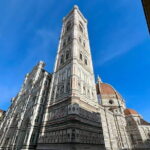
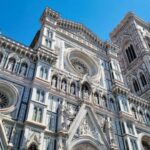
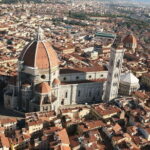
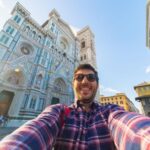
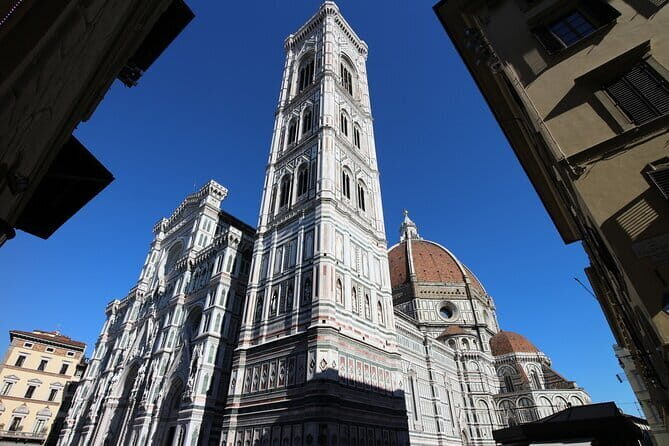
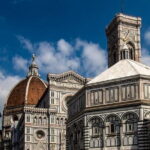
At the Cattedrale di Santa Maria del Fiore, you’re in the heart of the city’s identity. You’ll hear why it’s such a symbol: it was completed in the 15th century, and when it was finished it was considered the largest church in the world. The dome is the kind of feature that makes you pause, then look again, because it still feels astonishing in size.
Your guide also connects it to the earlier foundation beneath it. The church sits where worship has happened since Roman times, with Santa Reparata as the earlier religious base. That’s useful information because it prevents the Duomo from feeling like a one-off project. Florence built upward, layer by layer.
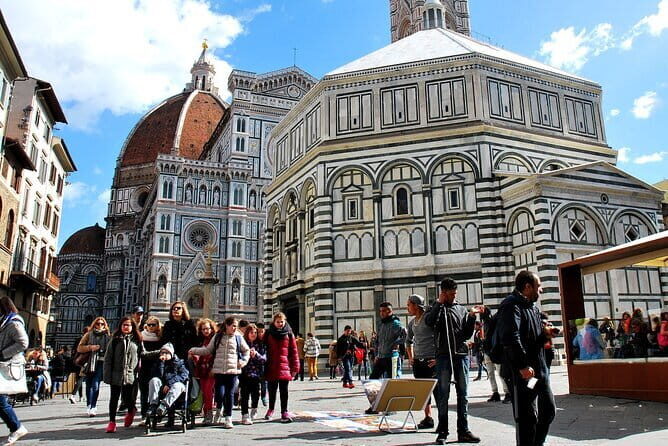
Right beside it is the Baptistery of St. John (San Giovanni Battista). This is where the religious and civic story overlaps. You learn it was the city’s patron-saint space for centuries—where Florentines went for baptism—and also where investiture of knights and poets took place. Dante’s baptism here is a key detail that makes the stop feel more personal.
Then you move to Giotto’s bell tower in Piazza del Duomo. The tower is part of the same “look at the skyline as a system” idea. The guide helps you understand how the cathedral, baptistery, and bell tower form a single visual statement.
You can also read our reviews of more guided tours in Florence
Santa Maria Novella and the Dominicans: church as a landmark system
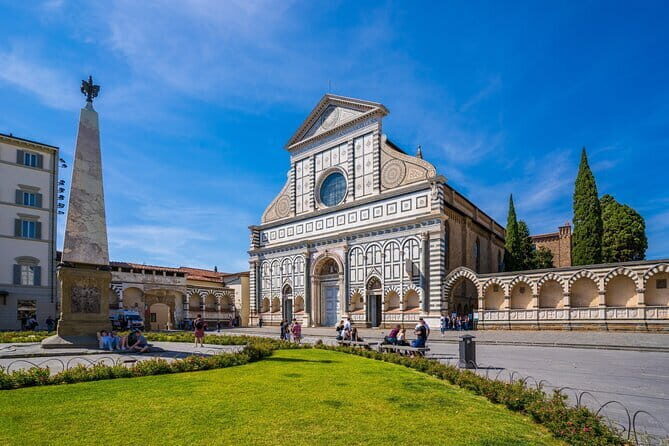
Santa Maria Novella is one of Florence’s major basilicas, and you stop at it as a reference point on the city’s map. Your guide ties it to the Dominicans and explains why the order mattered in Florence’s spiritual and social world.
What I like about including this stop on a short walking tour is that it teaches you how Florentines navigated life with religion, institutions, and public spaces all intertwined. You’re not just looking at stone—you’re seeing a structure that used to organize people’s days.
Again, the visit is brief. But the guide’s framing helps you decide later what you want to return to for a longer look, especially if you enjoy church art and architecture.
Palazzo Rucellai: Renaissance ideas made into stone rules
If you’re interested in architecture (or you just want to know why buildings look the way they do), Palazzo Rucellai is a smart stop.
This palace is tied to Renaissance design thinking. Most scholars attribute the design to Leon Battista Alberti for Giovanni di Paolo Rucellai, dated roughly between 1446 and 1451, with work executed at least in part by Bernardo Rossellino. You learn what that means in a visual way: the facade uses pilasters and entablatures in proportional relationships. In plain terms, it’s Renaissance math expressed as a street-facing show.
The stop is also a reminder that Renaissance design didn’t only live in grand monuments. It showed up in palazzi that were meant to impress people who walked by every day.
Palazzo Strozzi: scale, ambition, and the cost to clear space
Then you head to Palazzo Strozzi, one of the city’s well-known Renaissance palaces. The guide explains how it was made on a very big scale, including the fact that 15 buildings were destroyed to create space for it.
That detail helps you feel the ambition behind the project. A facade like this doesn’t happen by accident. It’s a statement of power, wealth, and willingness to rewrite the urban fabric.
You also learn what makes the building’s entrances distinctive—there are three identical portals on every side. That kind of repetition is more than decoration. It’s a design choice that signals order and control.
Santa Trinita and Ghirlandaio frescoes: the church interior moment
At Basilica di Santa Trinita, you go inside to see fresco work—specifically frescoes by Ghirlandaio. This is the tour’s “slow down and look” moment, even though the overall time remains tight.
Church interiors in Florence often feel like time machines because art and spiritual spaces overlap. Your guide’s job here is to help you locate what you’re seeing and understand why frescoes in this era mattered. It’s not just that the art exists—it’s that it’s part of how people expressed devotion, identity, and status.
If you usually skip church interiors because you think you’ll be bored, this is one stop worth keeping in your schedule. The guide makes it more readable.
Palazzo Pitti and the Medici-to-royalty storyline
Next comes Palazzo Pitti, a huge Renaissance residence in the Oltrarno area near Ponte Vecchio. You learn the building’s origins first: the core dates back to 1458 as the urban residence of banker Luca Pitti.
Then the Medici purchase changes everything. In 1549, the Medici family acquired the palace and it became the main residence of the grand dukes of Tuscany—starting with the Medici, then later moving to Habsburg-Lorraine in 1737. After Italy’s unification, it even served as a royal palace for the House of Savoy during the years when Florence was the Kingdom of Italy’s capital (1865–1870).
This stop is valuable because it ties architecture to real political shifts. You can walk past a palace and think it’s just impressive, or you can walk past it and understand what kind of power was carried inside.
Santa Felicita: oldest-feeling Oltrarno pace
Between Ponte Vecchio and Palazzo Pitti, you stop at Santa Felicita. The guide explains it as one of Florence’s older churches and places it firmly in the Oltrarno district story.
This is a good counterbalance to the big-palace drama. Santa Felicita gives you a sense of spiritual continuity in a part of town that feels more lived-in than the main museum-and-shopping corridor.
You won’t get a long interior session here, but it’s a useful stop if you want your Florence to include the city’s religious roots, not only art and politics.
Vasari Corridor: the elevated route behind power moves
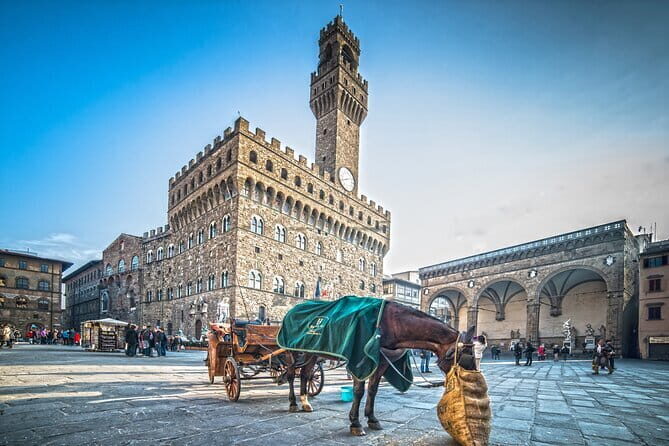
The final major story turn is the Vasari Corridor, an elevated path connecting Palazzo Vecchio with Palazzo Pitti. It passes through the Uffizi and crosses over Ponte Vecchio.
The guide explains the key reason it was built: the grand dukes needed a way to move freely and safely between residence and government palace, especially during uncertain times when public support for the new duke and new government structure wasn’t guaranteed after the Florentine Republic.
Even from the outside, the idea makes sense. This wasn’t a scenic walkway. It was a tool of control and safety, wrapped in architecture.
Gelato and bathroom breaks: small comforts that help the whole day
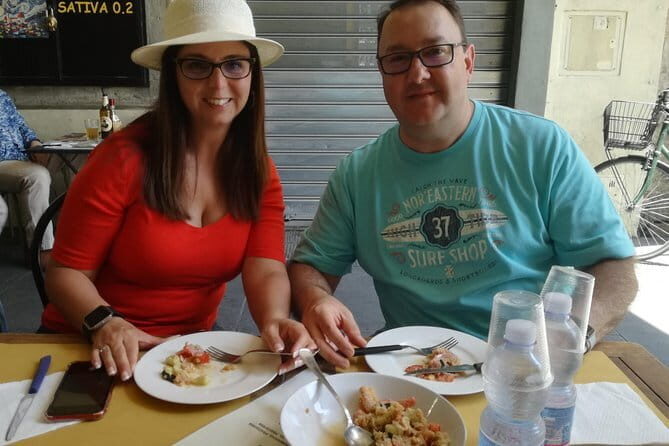
One reason I recommend tours like this is that they plan for human needs. This experience includes time for bathroom breaks on the route, and it includes a stop to taste local gelato while you’re out on the cobblestones.
Those small breaks matter because Florence walking adds up fast. When you know you’ll have a pause built into the plan, you walk with less stress and notice more along the way.
Price and value: what $40.12 gets you
At $40.12 per person for about 3 hours, you’re paying for three things: an expert guide, a tight route that covers the big Florence “systems” (religion, politics, architecture), and a structure that keeps you from wasting time guessing what to prioritize.
The itinerary lists admission ticket free at each featured stop, which boosts the value. You’re not stacking entrance fees on top of a guide service. Instead, you’re getting help turning famous buildings into understood buildings.
Also, the group size is capped at 20. That tends to make your time with the guide more usable than in huge, noisy lines where questions get lost.
What to wear and bring for a comfy, problem-free walk
You’ll want comfy walking shoes. This is practical, not dramatic. Florence streets can be uneven, and the tour is designed for walking between tightly clustered sights.
If you’re sensitive to crowds, keep an eye on where the group bunches up—especially around major plazas like the Duomo area. Your guide’s instructions and timing help, but your own footwork still matters.
Service animals are allowed, and the route is near public transportation, so you can build the rest of your day around transit if you want a lighter load later.
Bring water if you tend to get thirsty. And if you’re the type who takes lots of photos, do it early in the stops—late in the stop you’ll usually be switching from filming mode to listening mode.
Who this tour is best for
This tour is ideal if you want a first-day framework. It’s also great if you’ve been to Florence before but want a guide to connect the dots between sites you’d otherwise treat like separate attractions.
You’ll likely enjoy it most if you:
- like history explained in plain language
- want a guide who can point out what to look for in art and architecture
- prefer guided wandering over self-guided guesswork
It also works well with families, groups of friends, and couples. Past groups praised guides for being engaging with both adults and younger visitors.
Should you book this Essential Florence Walking Tour?
Book it if you want a fast, meaningful orientation that turns Florence into a story you can follow. The best reason is the combination: major monuments, Renaissance palazzi, and Oltrarno power history, all wrapped into one guided loop with gelato and built-in bathroom time.
Skip it (or pair it with something longer) if you’re the type who wants long museum time or you get frustrated when every stop is necessarily brief. This tour is for seeing more, learning more, and then choosing what to revisit later.
FAQ
FAQ
How long is the walking tour?
It runs for about 3 hours.
Where does the tour start and where does it end?
You start at Piazza della Repubblica and end at Piazza della Signoria.
Are there admission fees for the stops?
The tour details list admission ticket free for each of the featured stops.
What group size should I expect?
The tour has a maximum of 20 travelers.
What time does the tour begin?
The start time is 9:00 am.
What if the weather is bad or I need to cancel?
This experience requires good weather. If it’s canceled due to poor weather, you’ll be offered a different date or a full refund. You can cancel for a full refund up to 24 hours in advance.
More Walking Tours in Florence

More Tours in Florence


More Tour Reviews in Florence
- Tuscany Day Trip from Florence: Siena, San Gimignano, Pisa and Lunch at a Winery
★ 5.0 · 21,634 reviews - The Best tour in Florence: Renaissance & Medici Tales – guided by a STORYTELLER
★ 5.0 · 12,316 reviews