REVIEW · FLORENCE
Florenz: most important Moments in 3 hours
Book on GetYourGuide →Operated by Kunstführung · Bookable on GetYourGuide
Florence hits hardest when you know where to look. This guided walk threads together the city’s most recognizable landmarks, while your guide connects them to the families and power players who shaped Renaissance Florence. I love how the route is built for quick understanding, not museum marathons, and I especially like that you start at Santa Maria Novella and finish back there, so the day feels complete when you can stop at the Dominican pharmacy.
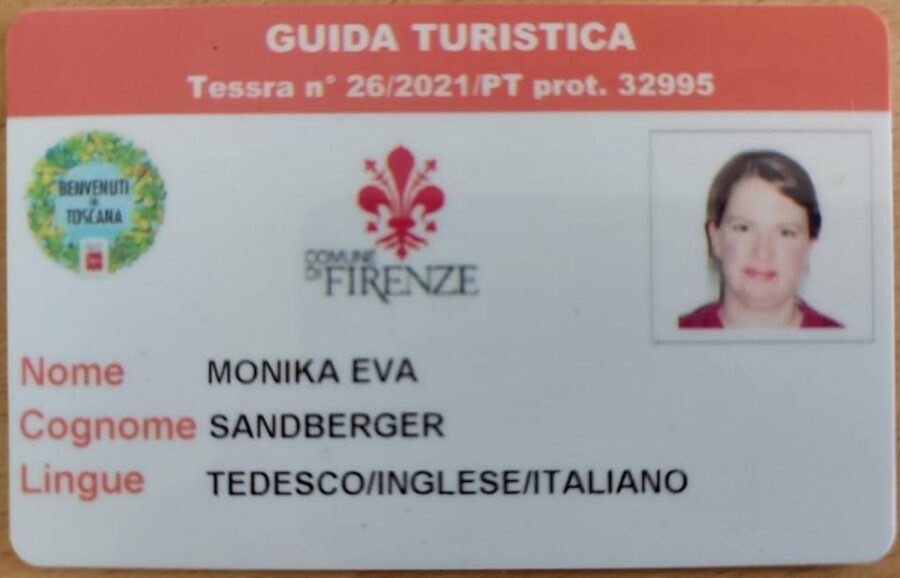
You’ll get a clear sense of the big names—Ruccelai, Ginori, Antinori, Strozzi, Medici, Vespucci, and Pazzi—mapped onto real streets, churches, palazzi, and even shop areas you’d otherwise just pass by. That story-telling can be a big part of the fun; in the feedback I saw, a guide named Monika was praised for being both informative and easy to follow, with a light, entertaining way of explaining what you’re seeing. The main consideration: this is a walking tour with no interior visits, and it’s only about 2 km on foot. If you’re expecting cathedral access inside, you’ll need to plan that separately.
In This Review
- Key highlights at a glance
- Where the tour starts: finding your way at Piazza Santa Maria Novella
- Santa Maria Novella facade and the Alberti connection
- Family power on the streets: patricians you’ll recognize as you walk
- San Lorenzo: Medici burial ground and the leather market energy
- Palazzo Medici-Riccardi: banking as a symbol of Renaissance power
- The Cathedral stop: Brunelleschi’s dome as your visual anchor
- Piazza della Signoria and Ponte Vecchio: public space to old-bridge charm
- Timing that works: about 2 km, no interior tours, and how to plan your day
- What the price covers (and where it doesn’t)
- What to bring so the tour feels easy, not stressful
- Who this tour suits best (and who should choose something else)
- The big takeaway: what you’ll remember after the walk
- Should you book this Florence highlights walk?
- FAQ
- Where does the tour start?
- How long is the tour?
- How much walking is involved?
- Is this tour doing interior visits?
- What sights are included?
- Are tickets or tastings included?
- What languages are the live guides?
- What should I bring?
- Is the tour suitable for wheelchair users?
- What are the age limits?
- Can I bring pets?
Key highlights at a glance
- Santa Maria Novella facade by Alberti: the place where the tour begins, giving you a strong visual anchor right away
- Medici connections at San Lorenzo: the burial area of the Medici plus a leather crafts market vibe nearby
- Palazzo Medici-Riccardi: a quick stop that ties Florence’s power to money and banking
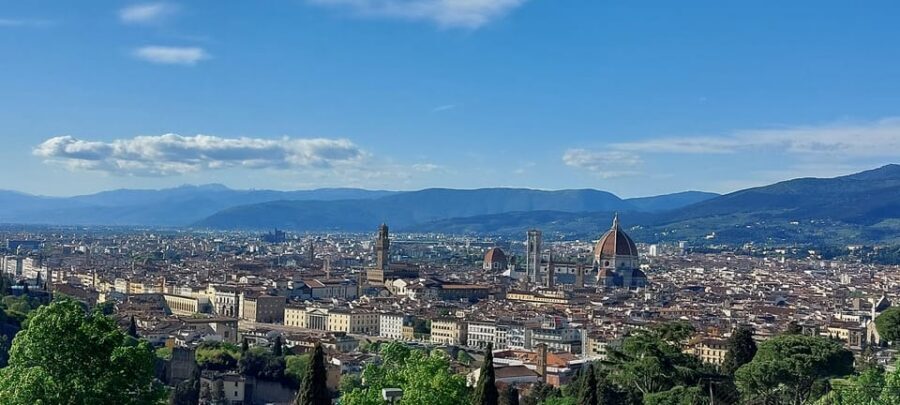
- Cathedral views with Brunelleschi’s dome: the landmark silhouette you came to see
- Piazza della Signoria and Ponte Vecchio: Florence’s public square energy, then the old bridge crossing
Where the tour starts: finding your way at Piazza Santa Maria Novella
Your tour meet-up is in the south part of Piazza Santa Maria Novella, at P.za di Santa Maria Novella, 29r. You’ll be on the right side of the landmark area: opposite the church, under the loggia, at the entrance to the Museo Novecento.
This is useful because Santa Maria Novella is one of those Florence zones where everything is close, but it’s easy to feel turned around if you arrive late or look for the “wrong” side of the church. Starting under the loggia is a practical design choice: you can regroup easily, and you don’t waste time hunting for your guide while everyone else is getting moving.
You can also read our reviews of more tours and experiences in Florence

Santa Maria Novella facade and the Alberti connection
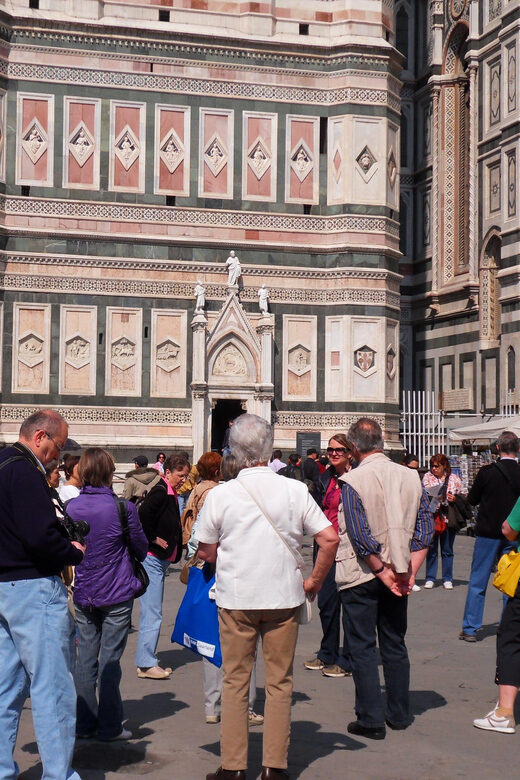
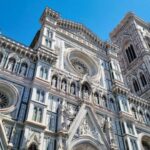
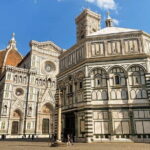
The first real “wow” is the Santa Maria Novella facade, known for the work associated with Alberti. Even if you don’t go inside, you’ll still get something valuable: a quick framework for reading Florence’s architecture. The facade isn’t just pretty stone; it’s tied to how Florentines wanted their public identity to look—order, status, and cultural ambition on display.
Your guide starts the story right at the facade and then builds outward. That means as you walk, you’re not collecting random photos. You’re seeing a sequence: who had influence, where power showed up, and how Renaissance families left recognizable fingerprints in churches, street names, and palazzi.
You also get a nice bonus finish later. Since the tour ends back at Santa Maria Novella, you can follow the story to the place you’ll likely care about most at the end: the Dominican pharmacy. The tour itself doesn’t include entry to tastings or catering, and it also doesn’t do interior stops, but it does set you up so you know what to look for when you choose to visit that area on your own.
Family power on the streets: patricians you’ll recognize as you walk
One of the strongest parts of this tour is how it treats Florence like a living map. Your guide points out how patrician families—Ruccelai, Ginori, Antinori, Strozzi, Medici, Vespucci, and Pazzi—show up in the city’s geography. You don’t need a textbook. You’re learning by place: graves, churches, shops, street names, and palazzo fronts that still carry meaning today.
This approach is great if you want your first Florence day to feel confident. You’ll come away with a sense of cause and effect: families gaining influence, civic space growing around them, and the city’s “public face” reflecting their ambitions. And because you’re covering a small walking loop, the story stays tight enough to actually stick.
In the feedback, Monika was highlighted for delivering this kind of explanation in a way that felt light and easy to follow. That matters, because Renaissance Florence can get names-heavy fast. A good guide slows the pace just enough to keep you oriented without making it boring.
San Lorenzo: Medici burial ground and the leather market energy
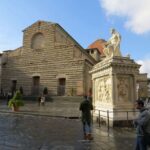
Next up is San Lorenzo, which matters because it’s tied to the Medici—the family whose name you’ll hear everywhere in Florence. Your guide covers the idea of where they are buried and why that location carries weight. Even from the street and surrounding areas, you’ll start to understand how Florence’s elite used religious and civic spaces to project long-term power.
San Lorenzo is also where the “day-to-day” city flavor shows up. You’ll pass by a crafts market with a focus on leather. This is a small but smart contrast in the tour. It helps you remember that Florence wasn’t only Renaissance big ideas and wealthy patrons. It was also everyday trade, workshops, and street life that kept the city moving.
The limitation to keep in mind: the tour is designed around sights and guided context, not interior walking through tombs or craft stalls in detail. So if you’re a stickler for museum-level access, you’ll want to treat this as your best overview layer—then build one or two deeper visits on your own after.
Palazzo Medici-Riccardi: banking as a symbol of Renaissance power
You’ll also see Palazzo Medici-Riccardi, associated with the theme of banking—specifically, how finance and political influence braided together in Florence. This stop is short, but it’s a big idea made visible. The Renaissance wasn’t only artists and domes; it was also contracts, loans, and institutions supporting the kind of wealth that could sponsor culture.
What I like about this angle is that it makes the city make more sense. When you later see money-related symbolism in other places around Florence, you’ll already understand the pattern. Instead of feeling like you’re just chasing landmarks, you’re learning the logic behind them.
- Tuscany Day Trip from Florence: Siena, San Gimignano, Pisa and Lunch at a Winery
★ 5.0 · 21,634 reviews - The Best tour in Florence: Renaissance & Medici Tales – guided by a STORYTELLER
★ 5.0 · 12,316 reviews


The Cathedral stop: Brunelleschi’s dome as your visual anchor
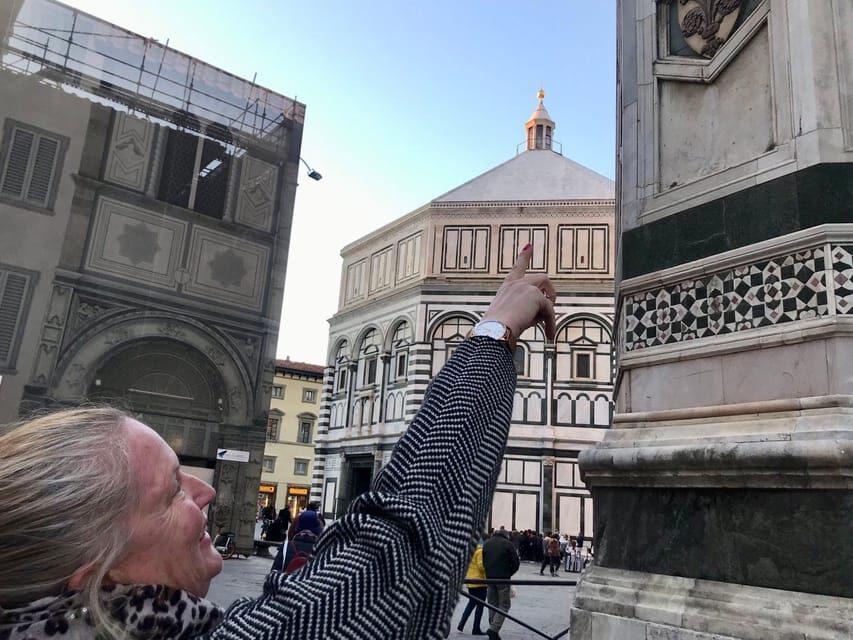
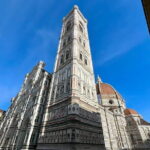
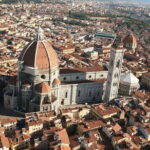
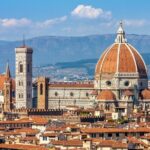
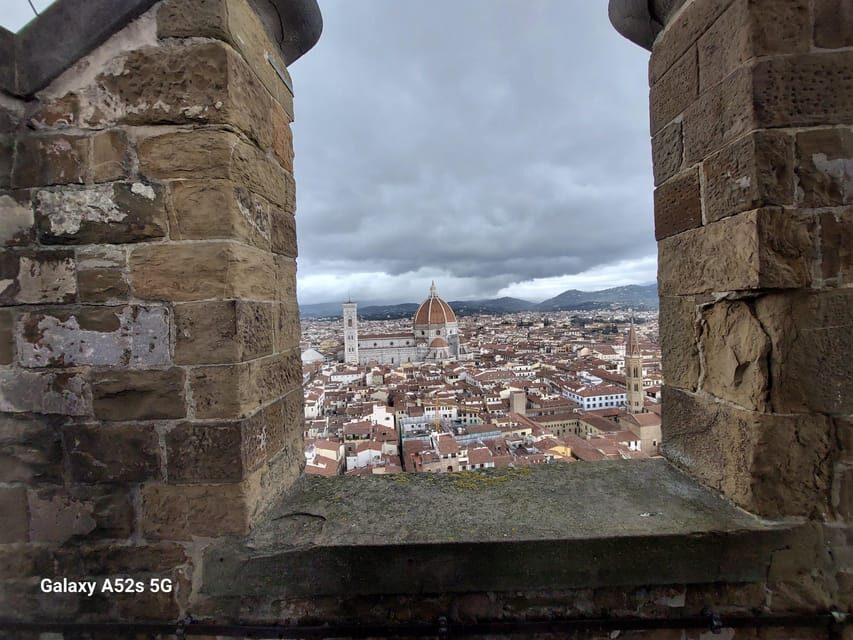
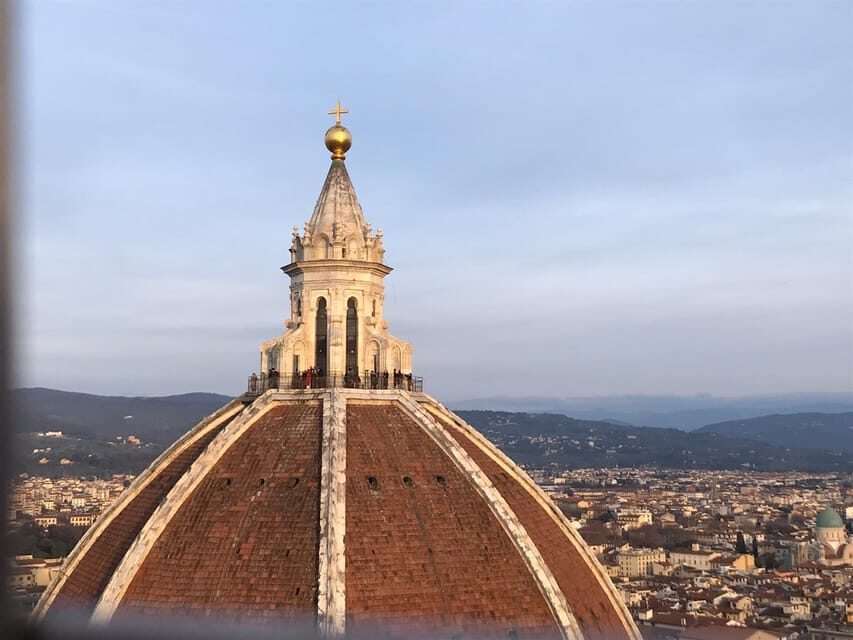
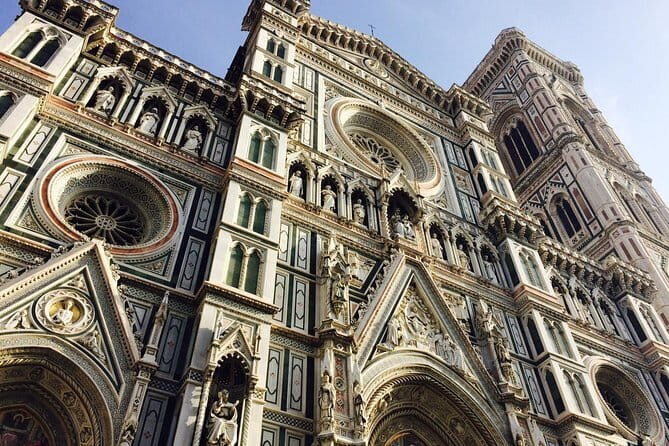
Then comes the Florence classic: the cathedral area with Brunelleschi’s dome. You don’t need a long explanation to see why this matters. The dome is a silhouette that dominates the skyline, and it’s also an engineering statement—proof that ambition can be made solid.
For this tour, the cathedral stop works because it sits in the middle of the larger story arc. You’re moving from family power and civic identity (Santa Maria Novella and surrounding zones) toward a landmark that symbolizes Florence’s creative and technical confidence. Even with no interior tour included, you still get the payoff: you know exactly what the dome represents, and you can photograph it with context rather than just as a background.
Piazza della Signoria and Ponte Vecchio: public space to old-bridge charm
The last major stretches are Piazza della Signoria and Ponte Vecchio. This is a strong pairing because they show two different flavors of Florence at once.
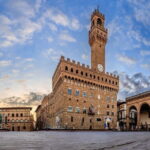
Piazza della Signoria gives you the sense of Florence as a civic stage—space where ideas, decisions, and public display happen. It’s the kind of place you can feel even when you’re just passing through: you understand why this was where people gathered and watched power operate.
Then you end up at Ponte Vecchio, the old bridge that’s become one of the most photographed parts of Florence for a reason. It’s more than a view. It’s continuity—an older urban structure still tied to the idea of commerce and street-facing life. On a short tour like this, the bridge crossing is a perfect close: you finish with something visually memorable and immediately recognizable.
Timing that works: about 2 km, no interior tours, and how to plan your day
This is a “short but meaningful” route. You’ll cover about 2 km on foot in total, and it’s guided the whole way with live commentary in German, Italian, or English. That’s a good length if you want the main highlights without burning half your day.
Here’s the key planning note: the tour doesn’t do interior visits. That means you get the outside-facing story—facades, squares, and landmarks—plus orientation so you can choose later what to enter. If you’re aiming for dome access, cathedral interiors, or long museum time, treat this as your smart first pass. Then you can upgrade with ticketed visits afterwards based on what you liked most during the walk.
What the price covers (and where it doesn’t)
The price is listed as $59 per person for this guided highlight experience. For a short Florence tour, that’s decent value when you consider what you’re paying for: a live guide who connects multiple landmarks into one coherent storyline and helps you read the city faster than a guidebook will on your first walk.
What isn’t included is also important: there’s no tasting, no catering, and no tickets. If you want to go inside anything major after the tour (like the Dominican pharmacy area at the end, or other attractions you decide you care about), you should plan on handling those separately.
Also note the duration details: the tour’s title references 3 hours, while the provided duration figure is 2 hours. Either way, you should use your confirmation to judge the exact schedule. Practically, you’re still in the “short walk” category.
What to bring so the tour feels easy, not stressful
Because Florence weather can flip quickly—sun, shade, and sudden rain—you’ll want to travel prepared. The basics you should follow here are straightforward:
- Comfortable shoes (you’ll be walking about 2 km)
- A water bottle
- Weatherproof gear: an umbrella and sun protection
- Comfortable clothes for walking
- A sun hat if it’s bright
You’ll also be asked for ID documentation: a passport (or ID card), and a passport-sized photo. A copy is accepted.
These details matter because a walking tour lives or dies by comfort. If your feet hurt, you won’t care about the story. If your shade and water are wrong, you’ll rush. Do yourself a favor and show up ready to move at a steady pace.
Who this tour suits best (and who should choose something else)
This is best for adults and older kids who want a guided “hit list” that adds meaning. It’s especially good if you’re going to Florence for the first time and want to get oriented fast—without stepping into interiors or committing to a longer museum day.
It’s also a smart pick if you like history in a practical way: not dates for dates’ sake, but how families and power show up in real places you can see and photograph. The family names and landmark pairing are made for that kind of traveler brain.
On the flip side, it’s not suitable for certain needs. The tour isn’t meant for wheelchair users, people with low fitness, or people who are visually or hearing impaired. It also isn’t for children under 7, and it specifically lists no babies under 1. Pets and walking frames are also not allowed.
The big takeaway: what you’ll remember after the walk
When you do a short tour correctly, it gives you a mental map. This one does that by connecting Renaissance families to tangible city features: churches, graves, palazzo fronts, street names, and the rhythm of the historic center.
By the time you finish back at Santa Maria Novella, you’re not just tired and happy you saw landmarks. You understand how the city’s public identity was built—through influence, money, and artistic confidence—then anchored in physical places you can still point to.
Should you book this Florence highlights walk?
If you want a guided Florence overview that’s focused, walkable, and story-driven, I’d say yes. It’s a good value at $59 because you’re buying clarity: a live guide who ties together Santa Maria Novella, San Lorenzo, Medici-linked spots, Brunelleschi’s dome, Piazza della Signoria, and Ponte Vecchio into one coherent hour-by-hour picture.
I’d skip it if you strongly prefer interior access or museum time, or if a 2 km walk sounds like more effort than you want on your trip. But for a first-time visitor, or anyone who wants to understand Florence quickly before choosing deeper visits, this one is a very solid match.
FAQ
Where does the tour start?
You meet at P.za di Santa Maria Novella, 29r, opposite the church, under the loggia at the entrance to the Museo Novecento.
How long is the tour?
The duration is listed as 2 hours, and the tour name references 3 hours—check your available time slot/confirmation for the exact schedule.
How much walking is involved?
You cover approximately 2 km on foot.
Is this tour doing interior visits?
No. It does not include interior tours.
What sights are included?
You’ll see or pass by Santa Maria Novella, San Lorenzo, Palazzo Medici-Riccardi, Florence Cathedral with Brunelleschi’s dome, Piazza della Signoria, and Ponte Vecchio.
Are tickets or tastings included?
No. Tickets, tasting, and catering are not included.
What languages are the live guides?
The live tour guide is available in German, Italian, and English.
What should I bring?
Bring comfortable shoes, weatherproof clothing (rain/sun), an umbrella, a water bottle, and a sun hat. You’ll also need passport/ID and a passport-sized photo.
Is the tour suitable for wheelchair users?
No. It is not suitable for wheelchair users.
What are the age limits?
It’s not suitable for children under 7 years old, and it lists babies under 1 year as not suitable.
Can I bring pets?
No pets are allowed.


More 3-Hour Experiences in Florence
More Tour Reviews in Florence
- Tuscany Day Trip from Florence: Siena, San Gimignano, Pisa and Lunch at a Winery
★ 5.0 · 21,634 reviews - The Best tour in Florence: Renaissance & Medici Tales – guided by a STORYTELLER
★ 5.0 · 12,316 reviews