REVIEW · FLORENCE
Museums special: Accademia & Uffizi combo tour – monolingual small group tour
Book on Viator →Operated by Ciao Florence Tours Srl · Bookable on Viator
A big Florence day. Accademia + Uffizi in one guided sweep is a smart way to hit the Renaissance heavyweights without spending your whole afternoon stuck in lines. I like that this tour is built for flow: reserved entry, clear pacing, and a guide who narrates as you move so the art actually clicks.
What I like most is the pairing of Michelangelo’s story at Accademia with the broader timeline at the Uffizi, so you don’t just see famous paintings—you see how ideas changed. Another plus: it’s capped at 15 people, so you’ll hear your guide and keep questions from getting lost in the crowd.
One thing to consider: if you go at the busiest times, you may still face a short wait for museum security and entry. Also, this is a highlights-style pass through huge collections, so you’ll need to be okay with not seeing every single corner of the galleries.
In This Review
- Key things I’d watch for before you book
- Why This Accademia + Uffizi Combo Works in 4 Hours
- The Meeting Point, The Walking Bit, and How Not to Get Flustered
- Accademia Gallery: The Hall of Prisoners and Why It Feels Strange (In a Good Way)
- David at Accademia: The Size, the Story, and the Quick Life Lesson
- The Uffizi Entrance: Why Skip-the-Line Still Helps Here
- Uffizi Rooms That Most People Remember: Botticelli, da Vinci, and Michelangelo
- Uffizi Beyond the Stars: Gothic Transitions and 1400s Experiments
- Should You Expect a Deep Art-History Seminar?
- Group Size, Earphones, and The Pace You’ll Feel
- Price and Value: What You’re Actually Paying For
- Practical Tips for Getting the Best Day Out of It
- Should You Book This Tour?
- FAQ
- What museums are included in this tour?
- How long is the tour?
- Is this tour offered in English?
- How big is the group?
- Where do I meet the guide, and where does the tour end?
- What ID do I need for the Uffizi Gallery?
Key things I’d watch for before you book
- Skip-the-line reservations for both Accademia and the Uffizi, plus mobile ticketing
- Small group size (max 15) and earphones if the group swells
- Accademia focuses on the big Michelangelo hits: the Hall of Prisoners and David
- Uffizi runs chronologically so you get a timeline, not random room-hopping
- You can stay inside the Uffizi after the tour ends to finish at your own pace
- Meeting point accuracy matters—the address can be easy to misread, so pin it on maps before you go
Why This Accademia + Uffizi Combo Works in 4 Hours
Florence can be a “too much, too fast” city. That’s why I like combo museum tours that are planned like a route, not just a ticket bundle. This one is built around two different kinds of museum payoff.
At Accademia, you get a tight, emotional hit of Renaissance sculpture—especially the works tied to Michelangelo. At the Uffizi, you get scale: a huge collection, rooms organized across centuries, and famous names you’ll recognize even if you’re not a full-on art-history nerd.
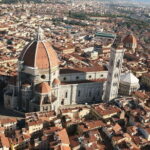
The tour lasts about 4 hours, which is long enough to do real viewing, but short enough to keep you from feeling trapped indoors all day. You also get a little walking orientation to help you understand where everything sits in the city—plus views toward the Duomo, which makes the day feel more like Florence and less like an indoor sprint.
You can also read our reviews of more museum experiences in Florence


The Meeting Point, The Walking Bit, and How Not to Get Flustered
Your day starts at an address on Via Camillo/Cavour in central Florence, and the tour ends at the Uffizi Galleries on Piazzale degli Uffizi. The exact street number matters because this area has a lot of similar-looking shops and meeting offices.
This is the part where I’d be proactive. Before you set off, open your map app and confirm the meeting pin, then take a screenshot. One big practical reason: if you’re a few blocks off, the walking time can eat into the “museum time” you paid for.
The walking portion is short but useful. You’ll pass key plazas and get that Duomo sightline moment that helps you orient yourself for the rest of the day. You’ll also be moving between the museum areas, so if weather is rough, plan accordingly. Comfortable shoes are not optional here.
And yes, on the busiest days, you can still get a short delay even with reserved passes. This isn’t a deal-breaker, but it’s a good mental note so you don’t assume everything will be perfectly frictionless.
Accademia Gallery: The Hall of Prisoners and Why It Feels Strange (In a Good Way)
Accademia is famous for a reason, and this tour goes straight to the heart of it. After a quick walk from the meeting spot, you’ll enter with skip-the-line access and start in the Hall of Prisoners.
This room is lined with unfinished-looking sculptures by Michelangelo. The guide focuses on the idea of non-finito—works left partially carved—which is one of those art concepts that sounds confusing until you see it in person. The effect is emotional. The unfinished parts don’t feel like failure; they feel like motion frozen in stone.
What I think is valuable here is the way the guide points out the exact places where the sculptor worked. That turns “watching people look at statues” into an actual visual experience. You can see how the unfinished surfaces guide your eye and your imagination.
This is also where the tour builds anticipation. The room sets the stage so that when you reach David, it feels like the finale rather than just another stop.
Timing note: plan on about 35 minutes here. That’s enough time to look properly if you’re not rushing, but it’s not enough to read every label deeply. Go for the guide’s story and then do a quick return glance if something really grabs you.
David at Accademia: The Size, the Story, and the Quick Life Lesson

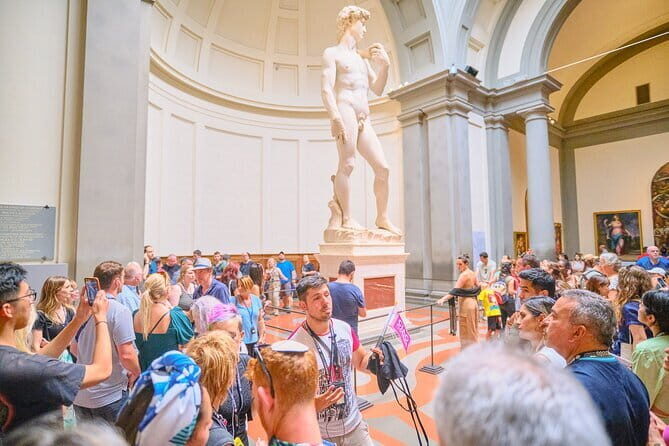
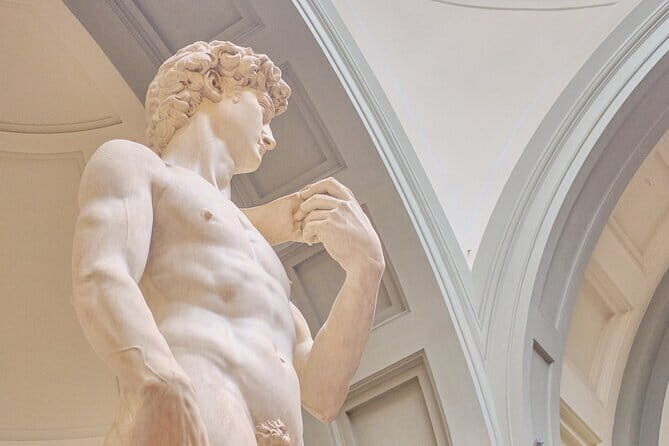
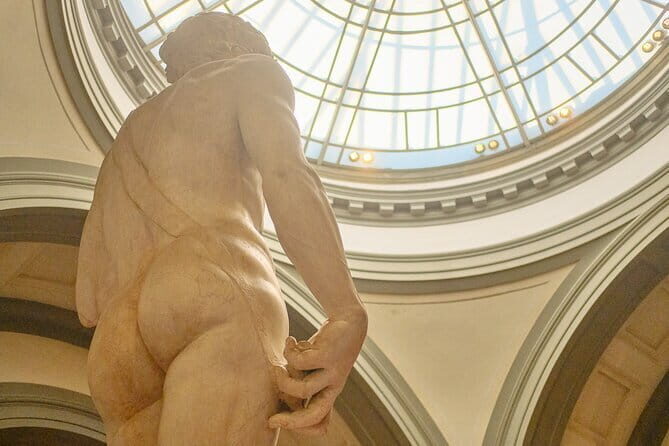
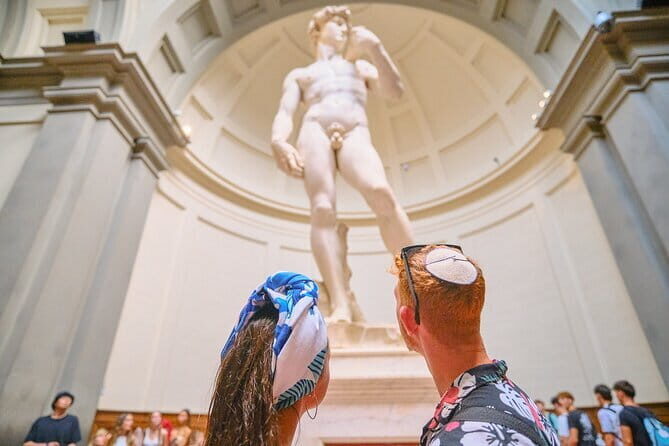
Then you hit the big one: David. It dominates the space above small viewing areas, and it’s hard not to feel a little wow even if you’ve seen photos before.
The tour highlights a few key facts that make the sculpture land harder:
- It weighs over 12,000 pounds
- It stands about 17 feet tall
- Michelangelo was 26 when he finished it
That combination—youth, scale, and intensity—helps you understand why David became more than a sculpture. It’s an image that carries meaning, not just technique.
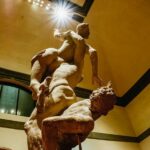
After David, the guide moves you through other important pieces so you don’t leave with only one memory. You’ll also see the Rape of the Sabines by Giambologna, plus works attributed to major Renaissance names like Botticelli, Jacopo di Cione, and Pacino di Buonaguida (among others listed in the tour).
A practical drawback: Accademia is smaller than the Uffizi, so time goes fast. If you’re the type who likes to linger for 20+ minutes per room, you’ll need to save your deeper solo time for later. Still, this tour is strong for first-timers because it prioritizes what matters most.
The Uffizi Entrance: Why Skip-the-Line Still Helps Here

The Uffizi is where Florence art lovers lose track of time—in a good way and sometimes in a “where did my afternoon go” way. With this tour, you enter with reserved time and skip-the-line passes so you lose less time to waiting.
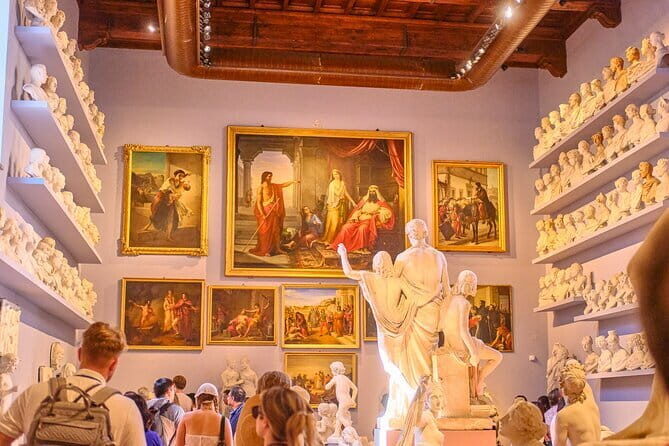
You’ll start the Uffizi walkthrough in the early Renaissance timeline and move forward. The tour is designed to keep you from getting lost in the sheer number of galleries. You’ll spend your guided time in the most talked-about rooms and works, and between stops you’ll also get visual context: ancient sculptures, frescoed ceilings, and views through large windows.
This matters because the Uffizi can feel like maze energy if you show up alone. With a guide guiding the order, you get a clearer sense of how art evolves.
Also, the guide spends time on storytelling rather than just pointing. In a museum this big, that’s the difference between seeing famous works and actually understanding why they became famous.
- Tuscany Day Trip from Florence: Siena, San Gimignano, Pisa and Lunch at a Winery
★ 5.0 · 21,634 reviews - The Best tour in Florence: Renaissance & Medici Tales – guided by a STORYTELLER
★ 5.0 · 12,316 reviews


Uffizi Rooms That Most People Remember: Botticelli, da Vinci, and Michelangelo

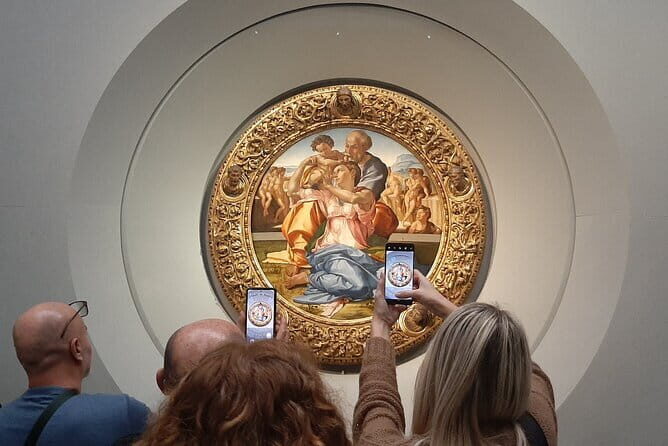
This tour puts the Uffizi’s star collection near the center of the experience. You get time for the Botticelli favorites—especially The Birth of Venus and Primavera. Expect to actually study them rather than do a quick glance and move on.
Then the tour pushes you deeper into Renaissance power names, with guided attention on works connected to Leonardo da Vinci and Michelangelo. The Uffizi highlights mentioned include:
- Tondo Doni by Michelangelo
- Baptism of Christ and The Annunciation by Leonardo da Vinci
Even if some of these paintings aren’t your personal favorites, the guided focus helps you notice details: composition choices, color decisions, and how religious and mythological themes are presented.
One real value here is pacing. The Uffizi is not a museum where you should try to do everything. With a guide, you can do the key rooms and then decide what you want to revisit during your free time.
Uffizi Beyond the Stars: Gothic Transitions and 1400s Experiments
A lot of people think the Uffizi is only Botticelli and big-name faces. This tour counters that by showing how styles shift over time.
You’ll spend time on International Gothic works, including Adoration of the Magi by Gentile da Fabriano. Then you move into the 1400s, when artists experimented more with space and storytelling.
Examples the guide calls out include:
- Battle of San Romano by Paolo Uccello (highlighting new ways of representing space)
- Madonna with Child and Two Angels by Filippo Lippi
- Dukes of Urbino by Piero della Francesca (idealized features and influence on later artists)
If you enjoy art that shows change over time, this section is a great payoff. It’s less about one masterpiece and more about how Renaissance thinking started to shift from symbol-first to human realism and spatial experiments.
Should You Expect a Deep Art-History Seminar?
Here’s the honest balance. This combo tour is packed and guided, but it isn’t trying to be an art-history lecture for the whole museum. A couple of issues can crop up depending on guide style and how quickly the group moves through each room.
One concern to keep in mind: if you want to see every major work or every floor, you may end up feeling like you didn’t get to enough. The Uffizi especially has so much to see that even a well-run guided route can still skip areas you personally hoped to find.
That said, this is also why I like it for most first-timers. You get a structured hit of major works and the timeline connections. Then, if the Uffizi hooks you, you’re allowed to keep going after the tour ends—so you can follow your curiosity without the clock.
Group Size, Earphones, and The Pace You’ll Feel
The tour is capped at 15 people, which is a big part of why it stays manageable. In a museum like the Uffizi, less crowd noise means more chance to hear the guide and actually understand what you’re looking at.
Earphones are provided if the group is larger. That’s useful in Italy, where sound bounces around marble halls. It also makes the experience less stressful if you’re standing near the back.
The pace is also a key part of the value. You’ll hit the big sculpture moments at Accademia and then switch to a chronological Uffizi plan. It’s not slow museum strolling, so bring the mindset that this is a guided “greatest hits plus context” format.
If you’re traveling with family or mixed interests, that structure helps. Art fans get the famous works. People who are less into art still get a clear story and city orientation.
Price and Value: What You’re Actually Paying For
At $130.97 per person, you’re paying for a day that includes:
- Reserved tickets for both Accademia and the Uffizi
- A professional English-speaking guide
- A guided route with skip-the-line access
- A planned walking overview of key city sights
The Uffizi entry is listed as €29, so you can think of your money as covering more than just admission. You’re also paying for the guide’s time and the planning that reduces waiting and confusion.
In other words: the value isn’t just the tickets. It’s the saved time and the way the route helps you see the works that matter most quickly. If you tried to DIY both museums on the same day, you’d probably spend more time sorting tickets, lines, and route decisions than you’d like.
Is it worth it? If you want a first pass that feels focused and efficient, yes. If you want maximum freedom and the option to linger everywhere, you may prefer a slower approach. This is a “smart hit” tour.
Practical Tips for Getting the Best Day Out of It
A few small choices can make this day feel smooth instead of stressful.
Wear shoes you can walk in for hours. You’ll do museum moving plus the short city walk for Duomo views. If it’s sunny, bring water and a hat. If it rains, have a light layer or umbrella, since weather can make walking between stops feel longer.
Also, double-check your identity documents. Entry to the Uffizi requires a valid passport or ID that matches the name used at booking. Provide full names for each traveler up front, because missing or mismatched names can cause entry problems.
Finally, if you’re the type who gets distracted easily, decide in advance what you want most:
- If it’s Michelangelo first, spend your mental energy on Accademia.
- If it’s Botticelli first, plan to let the Uffizi rooms finish strong.
Then, use your extra time inside the Uffizi after the tour ends to circle back to your favorites without feeling rushed.
Should You Book This Tour?
I’d book this combo if you want a guided, efficient Florence day that hits both museums’ biggest moments with less waiting. The Accademia portion is especially strong for first-timers because it zeroes in on Michelangelo’s most famous sculpture stories: the unfinished drama of the Hall of Prisoners and the impact of David. The Uffizi part is also a good fit if you like the idea of a timeline and want help choosing where to spend attention.
I’d think twice if you’re expecting an art-history marathon where every floor and every major artist gets full coverage. This is structured and time-limited, and you may wish you had more minutes in specific rooms.
If you do choose it, go in with the mindset that the tour is your foundation. Then, after the guide leaves you at the Uffizi, stay as long as you like and make the museum yours.
FAQ
What museums are included in this tour?
You’ll visit the Accademia Gallery and the Uffizi Gallery. Tickets and reservations for both museums are included.
How long is the tour?
The tour runs about 4 hours.
Is this tour offered in English?
Yes. The tour is offered in English and is described as a monolingual small group tour.
How big is the group?
The tour has a maximum of 15 travelers.
Where do I meet the guide, and where does the tour end?
You meet at Via Camillo Cavour, 18, 50122 Firenze FI, Italy. The tour ends at the Uffizi Galleries, Piazzale degli Uffizi, 6, 50122 Firenze FI, Italy.
What ID do I need for the Uffizi Gallery?
Each traveler must present a valid passport or ID document that matches the name provided at the time of booking for successful entry to the Uffizi.


More Museum Experiences in Florence


More Tours in Florence





More Tour Reviews in Florence
- Tuscany Day Trip from Florence: Siena, San Gimignano, Pisa and Lunch at a Winery
★ 5.0 · 21,634 reviews - The Best tour in Florence: Renaissance & Medici Tales – guided by a STORYTELLER
★ 5.0 · 12,316 reviews