REVIEW · FLORENCE
Florence: The curious Oltrarno, Self-Guided Audio tour
Book on Viator →Operated by Clio Muse Tours · Bookable on Viator
Oltrarno rewards the slow walker. This self-guided smartphone audio stroll shows you Florence from the “other side” of the Arno, with short stops that connect streets, churches, and craft life into one easy walk. I love the offline content (so you are not trapped by weak signal) and the interactive map that helps you keep your bearings. One possible drawback: the narration quality can be uneven, with some guests finding the voice and Italian pronunciation hard to follow.
One app, one route, no meeting-point stress. The tour is smartphone-only (Android or iOS), lasts about 1 to 3 hours, and is set up so you can start when it works for your day. You’ll get a mobile ticket plus an email with an activation link from the local supplier, Clio Muse Tours, and you’ll want headphones to catch the audio cleanly.
In This Review
- Key points that make this Oltrarno audio walk worth your time
- Why Oltrarno feels different from central Florence
- Price and value: what $9.26 buys you (and what it does not)
- The practical stuff that makes or breaks smartphone tours
- The route at a glance: from Ponte Vecchio to Ponte alla Carraia
- Ponte Vecchio stop: how to use the bridge like a map
- The oldest church stop: early merchants and a religious origin story
- Pitti Palace and Sdrucciolo de’ Pitti: artisan Florence in everyday form
- Ponte alla Carraia stop: the five-arch finish that ties it together
- How to keep the map from turning into a chore
- Headphones and narration: when the audio experience works well
- Who this tour fits best (and who should skip it)
- Should you book the Oltrarno audio tour?
- FAQ
- How long is the Florence Oltrarno audio tour?
- Where do I start and end the self-guided route?
- Do I need Wi-Fi to use the tour?
- Is there a live guide or group tour?
- What phones is the tour compatible with?
- Can I cancel for a refund?
Key points that make this Oltrarno audio walk worth your time
- Offline map and audio: download the experience so you can keep walking even if data dies.
- Small, manageable route: designed for a practical on-foot loop from Ponte Vecchio toward Ponte alla Carraia.
- Artisans and workshop Florence: you’ll hear why Oltrarno has long been tied to traditional trades.
- Good anchor sights: Ponte Vecchio, the Florence oldest-church stop, and a finish at Ponte alla Carraia.
- Extra stops in the mix: you may encounter Florence craft landmarks like Pitti Palace and Sdrucciolo de’ Pitti.
- Audio quality is the gamble: some people report difficulties with voice clarity or Italian pronunciation.
Why Oltrarno feels different from central Florence

Oltrarno is where Florence turns down the volume a bit. On the main tourist side you can feel the city’s postcard pace. On this side of the Arno, you’re more likely to run into quiet streets, workshop energy, and people going about everyday life.
That is exactly why an audio tour works here. You’re not racing between big ticket sights with a clock hanging over your head. Instead, the narration is built around moments: a bridge view, an old church with early Christian lore, and the way the river links neighborhoods. The result is a walk that feels like you’re learning how the city is put together, not just checking boxes.
Even the route logic helps. Starting near Ponte Vecchio gives you a clear anchor right away, and ending at Ponte alla Carraia gives you a satisfying finish that naturally brings you back toward the broader Florence map.
You can also read our reviews of more guided tours in Florence



Price and value: what $9.26 buys you (and what it does not)

At $9.26 per person, this isn’t a “premium guide” purchase. It’s closer to buying a self-paced briefing that turns your walk into an educational route.
Here’s the value math that makes sense:
- You’re paying for interpretation, not transportation or a live expert. There is no physical guide.
- You get offline materials, including an interactive map and audio stops, so you can use it while walking rather than needing to constantly search your phone.
- You control the pace, and you can repeat the tour after you activate it. That repeat option matters if you want to re-walk a part after you understand it better.
What you should not expect for this price:
- No hotel pickup, no guided commentary from a human host.
- No food stops included.
- No AR/VR extras.
If you enjoy wandering, reading signs, and letting audio explain what you’re seeing, this pricing is reasonable. If you want perfect audio quality every minute, you may want to keep expectations realistic.
The practical stuff that makes or breaks smartphone tours
Smartphone audio tours live or die on setup. This one is very clear about the tech requirements, and you should treat them as part of the experience.
Device and app compatibility
- The tour needs an Android or iOS smartphone.
- It is not compatible with Windows phones.
- Older Apple devices and older iPod/iPad models listed as incompatible can be a problem. If you’re using anything near the edge of age, double-check before you buy.
Storage and battery
- Plan on 100–150 MB of space.
- Make sure your phone is fully charged before you start.
- Because you’re in Florence walking between stops, low battery is a bigger risk than it sounds.
Offline listening
The tour includes offline content, including an offline interactive map. That means you can keep moving without panic-scrolling for service.
Headphones
Headphones are recommended. Even if you think you can listen at street volume, bridges and sidewalks add noise fast. With headphones, you’ll catch more details and you’ll miss fewer audio cues.
If you do all that prep, the tour becomes smooth and low-stress—exactly what self-guided tours should feel like.
The route at a glance: from Ponte Vecchio to Ponte alla Carraia
This is not a point-and-stand museum route. It’s a walk with a natural beginning and ending.
Start: Ponte Vecchio (50125 Firenze FI)
You begin right by the iconic bridge. That is a smart choice because Ponte Vecchio is easy to find and easy to orient around. It also gives you a “baseline view” for the rest of the walk: you can look across the Arno and understand you’re moving toward the other side of Florence.
Key mid-stop logic
The tour then moves through major context points, including:
- A stop focused on Florence oldest-church history (with a specific early-Christian merchant origin story)
- Additional craft-and-art landmarks like Pitti Palace and Sdrucciolo de’ Pitti (listed as highlights)
Finish: Ponte alla Carraia
Your ending point is another classic bridge, this one spanning the Arno with five arches and linking Oltrarno back to the rest of the city. Finishing on a bridge is a nice trick: you get a closing view that makes the whole route feel like one loop.
How long it takes
Expect about 1 to 3 hours. That range is useful. You can do it fast if you’re sightseeing hard, or slow if you stop for photos and let the audio breathe.
Ponte Vecchio stop: how to use the bridge like a map

Ponte Vecchio is the kind of place that can feel like you’ve already “seen it” because it’s on postcards. The better move is to use it as your orientation moment.
This tour’s first stop focuses on Ponte Vecchio as a bridge full of curiosity and secrets. Even if you don’t go deep into the bridge details at first glance, the audio framing helps you look differently.
Here’s what you can do right there:
- Take a minute to face the Arno and notice the direction you’re walking.
- Watch how the bridge works as a connector between sides.
- Use the start stop as your launch point for the rest of Oltrarno, not just a photo stop.
If you’re the type who likes to understand how places relate, this opening pays off quickly.
You can also read our reviews of more tours and experiences in Florence






The oldest church stop: early merchants and a religious origin story

One of the tour stops is built around Florence oldest church, tied to a founding story from the second century AD by Greek and Syrian merchants. That early-Christian angle is the kind of detail that makes a neighborhood feel older than the obvious landmarks.
A few practical tips for this stop:
- Slow down and listen all the way through before you move on. Early history stories can be easy to miss if you’re walking and talking to friends.
- Look for cues around the church area that match the story themes: trade, travel routes, and the idea that Florence gathered different people over time.
This stop has a clear purpose: it’s here to explain why this part of Florence isn’t just shops and streets—it has older roots. Even if you’re not a “religion historian,” origin stories like this give you a baseline for understanding why the neighborhood is the way it is.
Pitti Palace and Sdrucciolo de’ Pitti: artisan Florence in everyday form
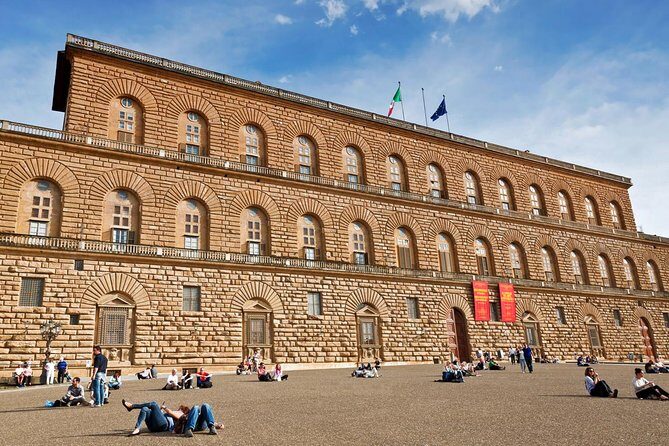
Oltrarno is famous for traditional trades, and the tour’s highlight list points you toward craft-adjacent sights like Pitti Palace and Sdrucciolo de’ Pitti.
You might not get a full guided explanation at each street corner, but the audio tour is designed to give you context while you walk. That’s what makes these landmarks useful on an audio route: you hear what the place connects to—artisans, workshops, and the social fabric of Florence.
Here’s how to make this part work for you:
- When the audio mentions artisans, pay attention to the street-level details you would normally skim: storefront rhythm, doorways, and the feeling of work-in-progress.
- If you spot smaller craft spaces along your path, let the audio context help you understand what you’re seeing.
This is where an audio tour becomes more than background. It turns casual noticing into a better sense of place.
Ponte alla Carraia stop: the five-arch finish that ties it together

Your final stop is Ponte alla Carraia, a bridge with five arches that links Oltrarno to the rest of Florence.
Finishing on a river crossing does two things:
- It gives you a clean visual wrap-up. You can look back and see the direction you came from.
- It reminds you that neighborhoods aren’t isolated islands. Oltrarno is different, yes—but it’s connected.
If you’ve been listening steadily, this ending stop also helps you stitch the theme together: bridges as movement, trade routes as history, and everyday paths as what makes Florence livable.
How to keep the map from turning into a chore
The tour includes an offline interactive map. That is great in theory, but only if you use it without breaking your walking flow.
My best advice:
- Use the map to confirm your next stop, not to constantly check your exact position.
- When you arrive at a landmark, only then pause long enough to match what you see to what the audio is describing.
- Keep your phone secure and comfortable—waving it around on a busy sidewalk wastes focus.
If you do this, you’ll feel like you’re exploring naturally instead of constantly managing directions.
Headphones and narration: when the audio experience works well
This tour’s biggest strength is also its biggest risk: the audio.
Some guests loved the self-paced nature and felt it was excellent value for a good introduction to Oltrarno. Others reported issues like hard-to-listen voice and pronunciation problems.
So here’s the realistic way to think about it before you buy:
- If you find most audio tours easy to follow, you’ll likely enjoy this a lot.
- If you are sensitive to pronunciation, speech speed, or voice clarity, plan to use headphones and give the narration a fair chance—but accept that perfection is not guaranteed.
There is also a note from the provider that AI voice is used only in rare exceptions, and they apologized when it did not meet expectations. That means the audio experience can vary. You can reduce frustration by using good headphones and listening in quieter moments near the landmarks.
Who this tour fits best (and who should skip it)
This is a strong match for you if:
- You like self-guided exploration and want to walk at your own pace.
- You want a simple introduction to Oltrarno’s artisan side without committing to a long guided tour.
- You rely on offline tools because cell coverage can be unpredictable in older streets and between landmarks.
- You enjoy hearing context while you look around, even if you take your time.
It’s not the best match if:
- You’re picky about narration quality and clear Italian pronunciation.
- You don’t want to use your phone as the main guide.
- You’re on an incompatible device or don’t want to manage storage and battery.
Should you book the Oltrarno audio tour?
I think you should book it if you want an affordable, flexible walk that helps you see Oltrarno with better context than you’d get from passively wandering. The offline map, the easy start and finish, and the focus on artisans and neighborhood anchors make it a practical choice.
Skip it if you know you are going to be irritated by imperfect audio delivery. For the same money, you could also spend more time exploring independently with just street research. But if you want the trade-and-history thread woven through your walk, this tour is built for that.
If you do book, do one thing that makes the biggest difference: bring headphones, charge your phone, and expect a self-guided walk that guides your eyes more than it manages your time.
FAQ
How long is the Florence Oltrarno audio tour?
The tour is listed as about 1 to 3 hours.
Where do I start and end the self-guided route?
You start at Ponte Vecchio and end at Ponte alla Carraia, both in Florence.
Do I need Wi-Fi to use the tour?
No. The experience includes offline content and an offline interactive map.
Is there a live guide or group tour?
No. This is an audio self-guided tour with no physical guide included, and it does not include VR/AR.
What phones is the tour compatible with?
It works on Android and iOS smartphones. It is not compatible with Windows phones, and there are limitations for older iPhone/iPod/iPad models listed by the operator.
Can I cancel for a refund?
Yes. You can cancel for free up to 24 hours in advance for a full refund. Within 24 hours, the amount paid is not refunded.



More Guided Tours in Florence


More Tours in Florence





More Tour Reviews in Florence
- Tuscany Day Trip from Florence: Siena, San Gimignano, Pisa and Lunch at a Winery
★ 5.0 · 21,634 reviews - The Best tour in Florence: Renaissance & Medici Tales – guided by a STORYTELLER
★ 5.0 · 12,316 reviews