REVIEW · AREZZO
Private Guided Tour of Pienza on Foot
Book on Viator →Operated by Sara Mammana · Bookable on Viator
Pienza feels like it was designed to be looked at.
In this private, English-guided walking tour, you follow a tight route through the Renaissance ideas that shaped the town, plus church interiors with unusual artwork. I like how you cover the main sights on foot without wasting time, and I also like the focus on specific artistic details (not just names and dates).
The walk is short enough to stay fun, but it’s still deep in places. One thing to think about: several key stops do not include admission in the price, so you may pay extra depending on which interiors you want to enter.
In This Review
- Key things to know before you go
- Why Pienza clicks in just a few hours
- Price and value for a private group up to 15
- The start and the pace: 3 hours on foot in central Pienza
- Piazza Pio II: the inverted perspective you can test yourself
- Palazzo Piccolomini: a papal residence with long roots
- Il Duomo di Pienza: German Gothic inside, Sienese art on display
- Church of San Francesco: 1380 frescoes that tell a life story
- Pieve di Corsignano: baptism history and pagan details at the portal
- Corso il Rossellino: the main street named for an architect
- Palazzo Borgia Museo Diocesano: paintings and sculpture across medieval to Baroque
- Your guide, Sara Mammana: what you can expect from the experience
- Who this walking tour is best for
- Should you book this Private Guided Tour of Pienza on Foot?
- FAQ
- What language is the tour offered in?
- How long is the private guided walking tour of Pienza?
- Is admission included for all stops?
- Is transportation included in the price?
- Where does the tour start and end?
- What’s the group size?
- Is lunch included?
- Are service animals allowed?
- Are there set operating hours?
- Is free cancellation available?
Key things to know before you go
- A compact 3-hour route that matches the walking pace and keeps you moving between major sights
- Renaissance perspective at Piazza Pio II, including a widening effect from an inverted-perspective setup
- Two papal Palaces in different forms: Palazzo Piccolomini and later the diocesan museum inside Palazzo Borgia
- A Duomo interior with German Gothic flavor, plus Sienese 15th-century altarpieces you won’t find everywhere
- San Francesco fresco cycle from 1380, a rare biographical story sequence inside a Gothic church
- Ancient baptism history at Pieve di Corsignano, including the baptismal font linked with Pius II and Pius III
Why Pienza clicks in just a few hours
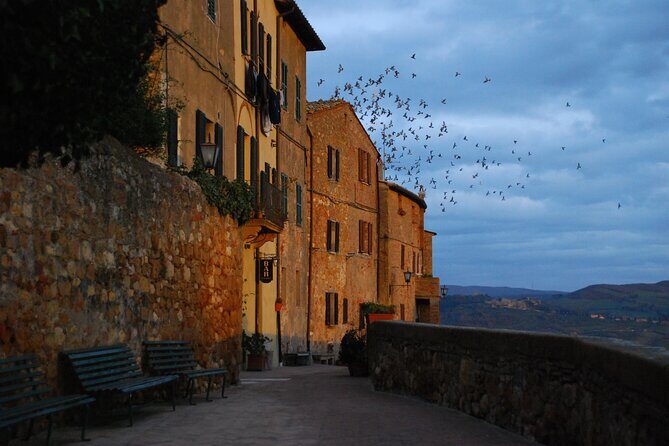
Pienza is famous for design ideas. Not theory. Real, physical ideas you can feel when you look around. This tour keeps you in motion through the parts of town that show those ideas best: the squares, the main street, the cathedral area, and the religious buildings that hold unusual art.
You’ll get the practical benefit of a guide who can slow you down at the right moments. That matters in Pienza, because the most interesting things often aren’t the biggest things. Sometimes it’s a trick of perspective. Sometimes it’s a specific interior style that mixes regions. Sometimes it’s a fresco cycle with a clear story.
And since this is a private experience, you’re not stuck with the usual hurry. A small group can ask questions when something catches your eye, instead of waiting until the end.
You can also read our reviews of more guided tours in Arezzo
Price and value for a private group up to 15
The price is $248.53 per group (up to 15 people). That structure is what can make the tour feel like good value—or not.
- If you’re traveling as a small group of friends or family, splitting the cost can make this a straightforward add-on that still feels personal.
- If you’re traveling solo or just two people, the same group price can feel heavy, especially because some sites require extra ticket purchases.
Also, remember what the tour includes: all fees and taxes. What it does not include is private transportation and lunch. Since the tour is on foot, you’re paying mainly for the guided time and expert interpretation, not for a driver or a vehicle.
The start and the pace: 3 hours on foot in central Pienza
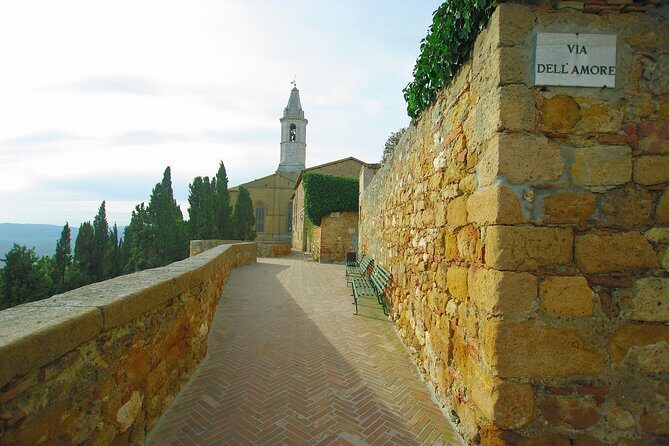
The tour starts in Pienza (53026, Province of Siena) and returns to different ending locations depending on your needs. The experience runs daily in the provider’s window of 8:30 AM to 7:00 PM.
The total time is about 3 hours, and the pacing is built around short stops with enough time to look, listen, and take photos without turning it into a sprint. Because it’s a walking tour, wear comfortable shoes. Pienza is all about viewing angles, and your feet do the work while you figure out where to stand for the best perspective.
Piazza Pio II: the inverted perspective you can test yourself
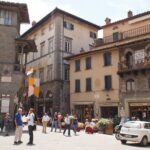
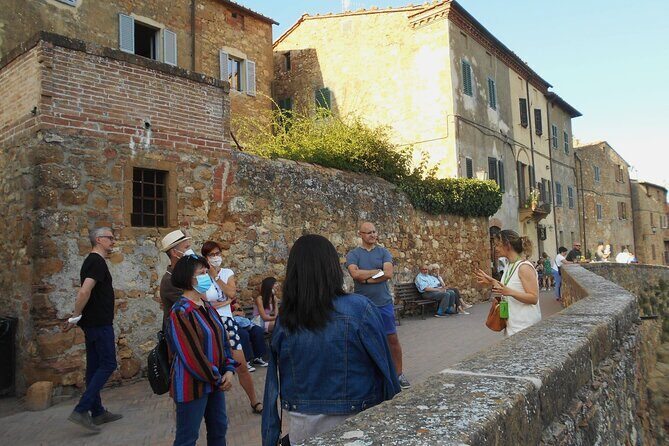
Your first stop is Piazza Pio II, one of the most striking places in town for anyone who enjoys visual tricks. This square is known for Renaissance perspective illusionism, including an inverted perspective that can make the space look like it widens.
Here’s the practical value: you’re not just told something is clever. You’re placed in the right context to notice how the trick works. With a guide, you’re more likely to know where to look, what to compare, and what effect to expect.
It’s also a smart opener because it sets the theme for the whole walk. Pienza isn’t only beautiful—it’s constructed to produce a reaction from your eyes.
Time here is about 15 minutes, and admission is free for this stop.
Palazzo Piccolomini: a papal residence with long roots
Next up is Palazzo Piccolomini, an ancient papal residence with origins dating back to 1462. This stop gives you the “why” behind Pienza’s importance. It’s one thing to admire architecture outside. It’s another to understand how seriously powerful people treated this place as a home base.
The tour time is about 30 minutes. Admission is not included, so if you want to go inside, expect an extra ticket. Even if you spend more time at street level, this building helps you connect the Renaissance ideals you just saw in the square to the real power structures of the papal world.
You can also read our reviews of more private tours in Arezzo
Il Duomo di Pienza: German Gothic inside, Sienese art on display
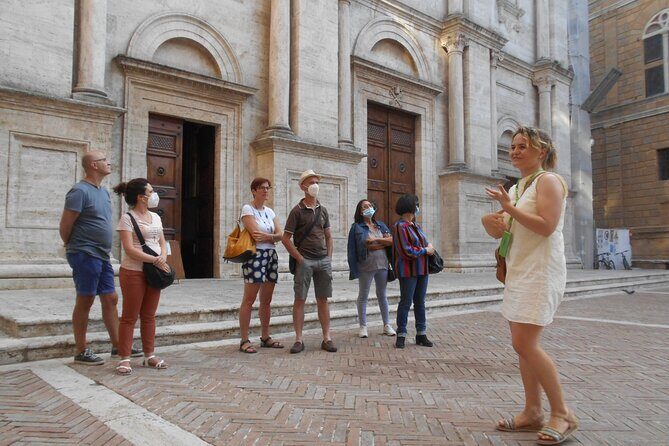
Now comes the cathedral stop: Il Duomo di Pienza. This is where Pienza gets interesting in a different way. The cathedral is Renaissance in overall identity, but the interior is described as having a rare German Gothic character.
Then there’s the artwork: marvelous altarpieces from the Sienese fifteenth century. This is the kind of detail that changes how you remember a building. You’re not only looking at walls and arches; you’re seeing period-specific artistry tied to Siena’s artistic world.
Time is about 30 minutes, and admission is free for this stop.
A small word of advice: if you’re the type who likes to take in interiors slowly, you’ll probably want the full half hour here. The cathedral’s value is in what you notice when you stop moving.
Church of San Francesco: 1380 frescoes that tell a life story
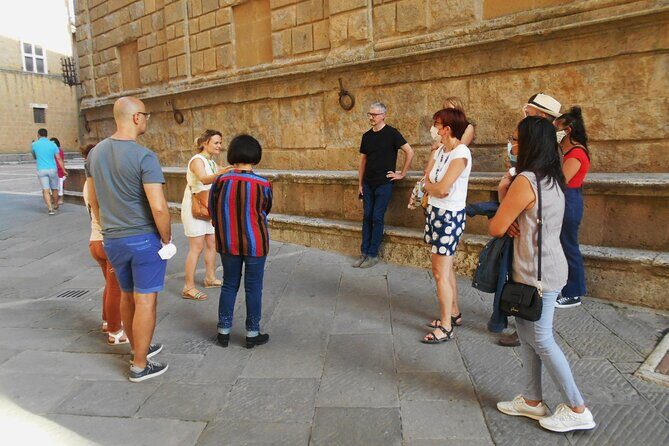
After the duomo, you visit the Church of San Francesco, a 13th-century Gothic church. What makes this stop special is the rare fresco cycle from 1380 inside, depicting biographical events of San Francesco d’Assisi.
This is a great moment on the walk because frescoes can be hard to interpret if you don’t have context. With a guide, you’re more likely to connect the scenes, understand what you’re looking at, and catch the way the story is organized.
Time is about 10 minutes, and admission is not included. Because the time is short, decide ahead of time whether your priority is the fresco cycle itself or just getting your bearings in the church. Either way, it’s a stop that rewards attention.
Pieve di Corsignano: baptism history and pagan details at the portal
Next is Pieve di Corsignano, described as an ancient rural parish church with early Christian origin, built on an ancient immersion baptismal font. That alone is compelling, because it links architecture to a very specific kind of ritual space.
But it goes further. The main portal has a peculiar decoration with pagan features from the 9th century AD. So you have a Christian religious building with older decorative influences showing through. That tension between periods is part of what makes Pienza and its surrounding churches feel layered.
Inside, the focus turns to baptismal history: you’ll see the baptismal font where the two pontiffs of the Piccolomini family were baptized: Pius II and Pius III, plus a crypt.
Time here is about 30 minutes, and admission is not included.
If you like symbolic details, this stop will stick with you. The portal decoration alone is the kind of thing you might overlook without guidance. The font story is what turns the building from a photo stop into a real historical anchor.
Corso il Rossellino: the main street named for an architect
Then you move onto Corso il Rossellino, the ancient main street of Pienza. It’s dedicated to the architect Bernardo Gambarelli, known as Rossellino, who was architect and designer of Pienza.
This stop can feel more “outdoor” than the churches and palaces, but it’s important. Streets are where you understand how the pieces connect. Corso il Rossellino also shows main cardinal palaces of the papal city, which helps you see Pienza not as a single landmark but as a whole system of power, residences, and streets.
Time is about 20 minutes. Admission is not included, but that’s also what keeps this stop flexible. You can spend more time looking at facades and street layout without worrying about tickets.
Palazzo Borgia Museo Diocesano: paintings and sculpture across medieval to Baroque
The final stop is Palazzo Borgia Museo Diocesano, described as a museum of medieval, Renaissance, and Baroque Tuscan painting and sculpture. It sits inside the palace of Cardinal Jouffroy, which adds another layer: this isn’t a museum building that feels neutral. It’s housed in an ecclesiastical power setting.
You’ll spend about 45 minutes here. Admission is not included.
This stop is valuable if you want more than architecture and frescoes. You’re shifting from story art on church walls to a museum collection that spans multiple artistic periods in Tuscany. If you’re the kind of person who can get tired after too many churches, the museum gives your eyes a new kind of focus—frames, works, and styles arranged differently than in religious interiors.
Your guide, Sara Mammana: what you can expect from the experience
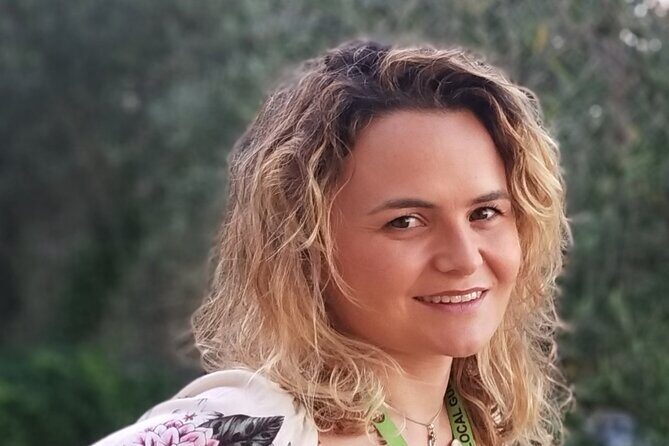
The provider is Sara Mammana. From the feedback I’ve seen tied to her tours, you can expect excellent English and a high-energy, enthusiastic way of explaining what you’re seeing.
That combination matters more than people think. In Pienza, it’s easy to read a guidebook and still miss what’s visually happening. A good guide helps you notice the right details—where to stand for the perspective effect, how to interpret the church art, and why certain decorations matter historically.
If you book this tour, I’d bring a simple question style with you:
- Ask what visual feature you should look for first at each stop.
- Ask what detail most visitors typically miss.
- Ask which interior elements change how you understand the building’s purpose.
You’ll feel your time become more efficient.
Who this walking tour is best for
This tour fits well if you want:
- A tight 3-hour plan that still feels meaningful
- A private format where your pace matters
- A route focused on art details: perspective illusions, cathedral interior styles, fresco story cycles, and baptism history
It’s also a good choice if you’re traveling with someone who doesn’t want a half-day of moving around with no structure. The stops are timed, and the theme stays consistent.
It might feel less ideal if your main goal is to linger for hours in one place, or if you strongly prefer all admissions to be included. Since several stops have tickets not included, you’ll want to budget for that.
Should you book this Private Guided Tour of Pienza on Foot?
I think this is a strong buy when you want the town’s art and design ideas explained in a focused way. The best reason to book is the mix: Piazza Pio II’s perspective trick, a cathedral with an unusual interior style, fresco storytelling at San Francesco, and baptism history at Pieve di Corsignano. That’s a lot of meaning packed into a simple walk.
I’d say you should skip or reconsider if you’re trying to minimize extra ticket costs, or if you already know the art themes and just want free time to wander. For a first visit, though, a guided approach saves time and helps you see what makes Pienza more than a pretty postcard.
FAQ
What language is the tour offered in?
The tour is offered in English.
How long is the private guided walking tour of Pienza?
It runs for about 3 hours (approx.).
Is admission included for all stops?
No. Admission is free for Piazza Pio II and Il Duomo di Pienza. Admission is not included for Palazzo Piccolomini, the Church of San Francesco, Pieve di Corsignano, Corso il Rossellino, and Palazzo Borgia Museo Diocesano.
Is transportation included in the price?
No. Private transportation is not included.
Where does the tour start and end?
It starts in 53026 Pienza, Province of Siena, Italy and ends in different locations depending on your needs.
What’s the group size?
It’s a private tour, with only your group participating. The price is per group (up to 15 people).
Is lunch included?
No. Lunch is not included.
Are service animals allowed?
Yes, service animals are allowed.
Are there set operating hours?
The provider’s opening hours are Monday through Sunday, 8:30 AM to 7:00 PM.
Is free cancellation available?
Yes. You can cancel for a full refund up to 24 hours in advance.