REVIEW · FLORENCE
The Best of Florence Walking Tour with Audio Guide and Guide
Book on Viator →Operated by ACCORD Italy Smart Tours & Experiences · Bookable on Viator
Florence, guided without the fuss. I love how this walk gives you headsets and an art-historian edited audio app, so you can follow along without getting lost. It also covers the main landmarks quickly, which is perfect when you want to get your bearings fast and decide later what to go inside. The tradeoff is that a couple major stops don’t include entry tickets, so you may need separate plans if you want to tour interiors.
Two more things I like: the pace is designed for real orientation, and the route focuses on the kind of city history you can recognize just by looking up. With a small group (max 20), the tour leader can actually help if you’re stuck. Still, it’s not meant to be a slow, sit-down museum lesson—think “smart highlights” over “every detail.”
Plan on about 2 hours 30 minutes (approx.), with time split across major squares and churches plus walking between them. The experience also includes a lunch pairing option, but the exact food choice depends on what you select. One more practical note: it’s offered in English, and the tour leader is listed as English/Italian speaking, so I’d rely on the audio as your consistent thread.
In This Review
- Key things to know before you go
- Why this Florence walk is a smart first move
- Meeting points and timing: how to start smoothly
- How the guide + audio app work on the ground
- Basilica di San Lorenzo: Brunelleschi’s marble front and big-name art
- Piazza del Duomo: the Cathedral, Baptistery, and Giotto’s Bell Tower
- The central squares: Column of Plenty, arches, and human-scale Florence
- Piazza Santa Trinita: Renaissance church details and the Column of Justice
- Piazza Santo Spirito: where you find craft shops and quieter views
- Palazzo Pitti area: Medici power, Artichoke Fountain, and street life
- Ponte Vecchio: end your walk with Arno views and 16th-century goldsmith tradition
- The lunch pairing: how it adds value to the whole day
- Price and overall value: is $17.49 a fair deal?
- Who this tour suits best (and who should skip it)
- Should you book this Florence best-of walk?
- FAQ
- How long is the Florence walking tour?
- Is the tour available in English?
- What’s included in the price?
- Do I need tickets for the sights?
- Where do I meet the tour, and where does it end?
- How big is the group?
- Is free cancellation available?
Key things to know before you go
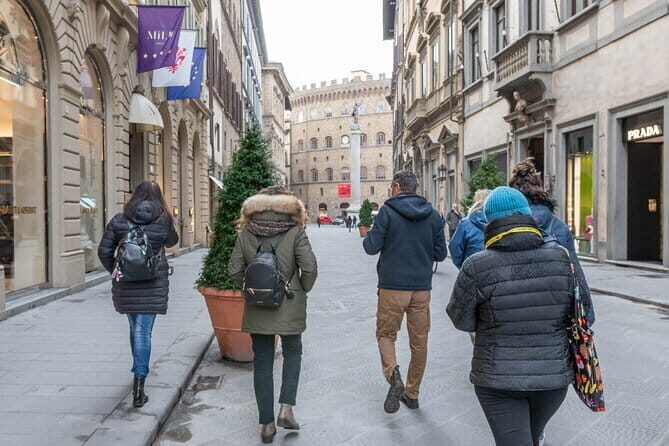
- Headsets + guided audio help you understand what you’re seeing even if the group is moving fast
- A local-led route lets you hit the big Florence highlights without navigating from scratch
- Two stops don’t include entry tickets, so bring your museum expectations accordingly
- Lunch is included as a pairing option, such as schiacciata Fiorentina or tagliere
- Small group size (max 20) makes it easier to hear and keep up
- Start/end points are different, so you’ll finish near Piazza della Signoria
Why this Florence walk is a smart first move
This tour works because it’s built for the way most people actually travel: you arrive, you feel overwhelmed, and you want Florence in your head by the end of the day. In about 2½ hours, you’ll pass through several of the city’s strongest “picture points,” from Renaissance facades to the Arno river view at the end.
I especially like that you’re not stuck committing to museum time up front. Even when you don’t enter a building, the guided look helps you understand what you’re seeing—like why certain materials, shapes, and names matter. That makes your next step (ticket-buying or independent wandering) feel way easier.
You can also read our reviews of more walking tours in Florence

Meeting points and timing: how to start smoothly
You start at Piazza di Madonna degli Aldobrandini, 8 (then you end at Piazza della Signoria). That matters because this is not a circle tour. You’ll want a plan for what you’ll do right after you finish—grab a gelato, tour nearby, or connect to public transport.
The start square is described as small, and it’s easy to end up in the wrong corner. My advice is simple: arrive a little early, scan for the group, and don’t assume someone will come chasing you. Once you’re in the right spot, the headsets and audio app keep everything moving.
Because the tour averages about 39 days in advance, I’d book early if you’re traveling in peak season. More limited availability usually means more timing pressure—and I’d rather you spend energy on the sights.
How the guide + audio app work on the ground
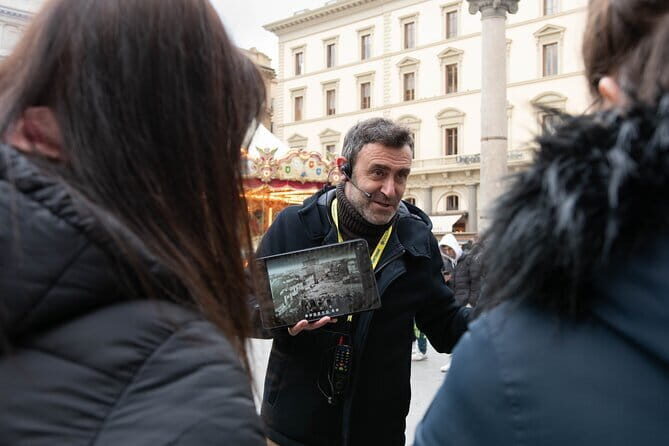
This experience is a mix of an English/Italian speaking tour leader and a multilingual audio app edited by an art historian. You’ll have headsets, which is huge in Florence, where streets are noisy and people always seem to stop suddenly for a photo.
The best way to use this setup is to treat the audio as your baseline and the guide as your chance to ask questions. If you want extra context about what you’re looking at—materials, symbolism, or why artists mattered—you’ll get more out of the live component.
One practical consideration: the tour leader’s English effectiveness may vary day to day. If you’re sensitive to unclear narration, don’t worry—your audio segments are built to carry the historical facts and explanations as you go.
Basilica di San Lorenzo: Brunelleschi’s marble front and big-name art
Your first stop is Basilica di San Lorenzo, known for its Renaissance façade in white and green marble. You’ll also look up at the dome and notice artistic details tied to major figures like Donatello and Michelangelo. Even if you don’t go inside, the point here is to connect the exterior style with the artists you’ll hear about.
Just know the entry situation: admission is listed as not included for this stop. That’s not a dealbreaker if your goal is orientation, but it does mean you shouldn’t plan on using this tour ticket to cover interior access here.
If you’re deciding whether to enter later, this is a good “scouting visit.” After seeing the façade and hearing the key names, you’ll be in a better position to decide if the interior is worth paying for on your schedule.
Piazza del Duomo: the Cathedral, Baptistery, and Giotto’s Bell Tower
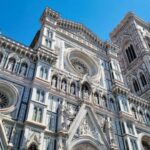
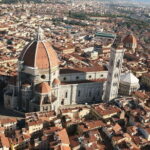
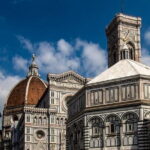
Next you’ll pause in Piazza del Duomo, which is one of those places where Florence’s art history feels packed into a small area. From here you can admire the Cathedral of Santa Maria del Fiore with its polychrome marble façade, plus the Baptistery of San Giovanni and its famous bronze doors by Ghiberti.
Also on the square is Giotto’s Bell Tower. Even without paying for museum time, standing here with audio and a guide helps you understand why these buildings belong together visually and historically. The audio explanation helps connect the dots between architecture and the city’s identity.
This stop lists admission tickets as free for the viewing area, and it also mentions the Museo dell’Opera del Duomo nearby. The museum itself isn’t included, but seeing the museum connection from the square makes it easier to decide later if you want to go deeper.
You can also read our reviews of more guided tours in Florence


The central squares: Column of Plenty, arches, and human-scale Florence
After Duomo, you move into a central square area that feels like the “living room” of the city—cafés, historic buildings, and a sense of everyday life. The highlight here is the Column of Plenty, plus the presence of a grand triumphal arch.
What I like about this stop is the contrast. You’re no longer just reading Renaissance surfaces. You’re also seeing how people actually use these public spaces: lingering, shopping, and keeping the square active with street-level energy.
For families, there’s also mention of a carousel and horse-drawn carriage-style moments. If you’re traveling with kids, this can turn an architecture-focused walk into something that feels less like a lecture and more like a day out.
Piazza Santa Trinita: Renaissance church details and the Column of Justice

At Piazza Santa Trinita, you get a calmer, more composed feel. The church of Santa Trinita is highlighted for its Renaissance façade and frescoes inside, which is a reminder that Florence isn’t only about the big tourist stops—it’s everywhere.
In the center of the square stands the Column of Justice, topped with a statue of Justice. That gives you a strong “look up” moment that isn’t just about a pretty view. It also helps explain how symbols and civic ideas show up in stone around the city.
You’ll also notice the Logge dei Tornaquinci and fountains that add movement and visual breaks. This stop is also described as a shopping area with fashion boutiques and luxury shops, so it can be a useful pause if you want to walk off a little energy before continuing.
Piazza Santo Spirito: where you find craft shops and quieter views

Next is Piazza Santo Spirito, which is a great “step sideways” from the heaviest tourist circuits. The star is the Basilica of Santo Spirito, a work of Brunelleschi, noted for its sober façade and sumptuous interiors.
This stop also includes the Obelisk of Santo Spirito, which is one of those landmarks that instantly makes a square feel memorable. Around it, you can look for artisan shops and markets where local art shows up at street level.
There’s also a park space in front of the basilica mentioned in the experience description. That matters because you’ll have walked hard for a couple hours by this point. A nearby open space lets you reset your eyes and enjoy a view without constantly chasing another building.
Palazzo Pitti area: Medici power, Artichoke Fountain, and street life
Your penultimate culture hit is the Palazzo Pitti area. This is where the story shifts from religious art and city squares into Medici-scale influence. The palace is described as majestic Renaissance architecture and tied to the power of the Medici.
The square details are fun here. Look for the Artichoke Fountain, plus the Palazzo della Meridiana as part of the architectural flow. There’s also mention of street artists and markets, which is exactly the kind of everyday creativity that makes Florence feel lived in rather than staged.
Here, admission is listed as not included. If you want interior access, plan that separately. But as a visual stop, it works well because you’ll understand the setting and the “why” behind the size and presence.
Ponte Vecchio: end your walk with Arno views and 16th-century goldsmith tradition
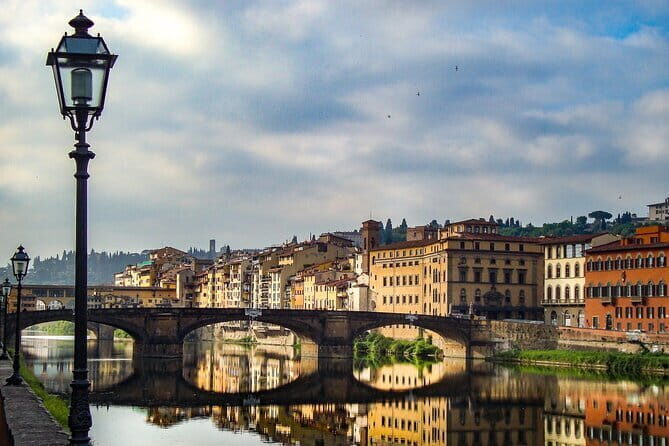
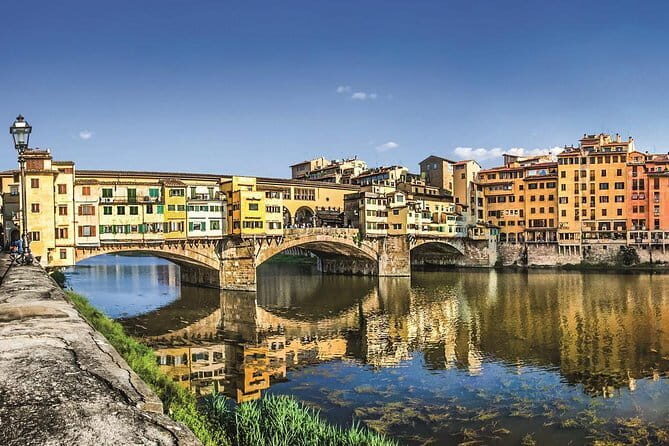
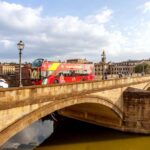
To close, you head to Ponte Vecchio, one of Florence’s most recognizable bridges. The experience description emphasizes the panoramic view of the Arno River, and it’s hard to beat that payoff after a morning/afternoon of walking.
A big part of why this bridge is special is what’s built into it. The goldsmiths’ and jewelers’ shops have crowded the bridge since the 16th century, and that tradition is part of the bridge’s identity, not just a modern shopping layer.
You’ll also see the historic covered corridors supported by stone columns. Those details give the bridge its distinct character—less “just a bridge,” more “a structure that became a whole world.”
Admission is listed as free for this stop, so you’re ending with a win: a final landmark that doesn’t require tickets to feel complete. Just be ready for crowds around photo time.
The lunch pairing: how it adds value to the whole day
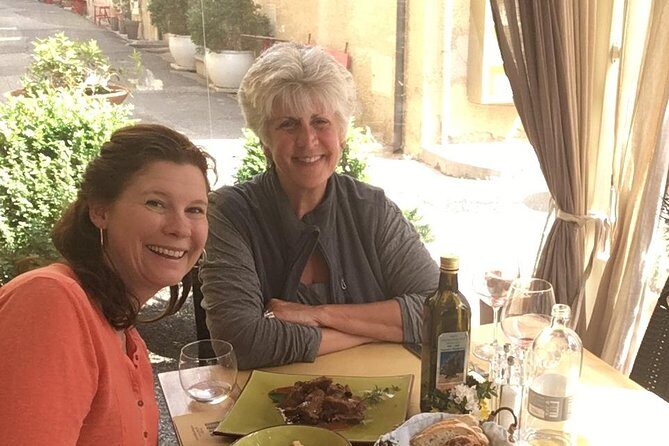
One of the better ways to judge this tour is to look at what’s included. Beyond the guide and audio, you get a lunch pairing option—either schiacciata Fiorentina or tagliere—but you’ll need to pay attention to the different options available when you book.
That matters for value because food in Florence can be pricey if you’re trying to eat between major sights. Having a built-in pairing means you can plan your day with less guesswork. Also, it keeps you from losing momentum after the walking portion; you already earned a break.
If you have preferences (vegetarian, no pork, etc.), check your exact lunch option during booking. The description strongly suggests there are choices, and I’d treat your selection as part of the tour value.
Price and overall value: is $17.49 a fair deal?
At $17.49 per person, this is positioned as a budget-friendly “best of Florence” overview. For that price, you’re getting a live tour leader component, headsets, and a multilingual audio app edited by an art historian, plus the lunch pairing option.
The parts that cost extra elsewhere are the ones you might want later—museum admissions and interior visits. But this tour isn’t pretending to replace those. It’s more like paying for orientation plus a structured route, then using your saved energy to choose what’s worth the extra ticket money.
So if your goal is to walk the city’s core highlights and leave with a clearer understanding (and a full stomach), the value is strong. If your goal is “I want to enter everything,” you’ll need additional purchases beyond what’s included.
Who this tour suits best (and who should skip it)
This is a great fit if you’re:
- Visiting Florence for the first time and want a fast sense of the city’s major landmarks
- The type who likes to see the outside first, then decide on museums later
- Traveling with limited time and want a structured route without navigation stress
- Someone who benefits from headsets and audio explanations while walking
It may be less ideal if you:
- Want a long, slow deep art lecture
- Expect all buildings to be entered during the tour (two key stops are specifically not included for entry)
- Have a hard limit on walking time, since it’s a moving experience across multiple central areas
The sweet spot is “high impact, low planning.” If that sounds like you, this tour will likely feel efficient in the best way.
Should you book this Florence best-of walk?
Yes, I’d book it if you want a structured introduction to Florence that ends at a prime location near Piazza della Signoria. The combination of a local-focused route, headsets, and a multilingual audio app is exactly how you turn a chaotic first day into something coherent.
You should also consider booking if the included lunch option helps you stay on schedule. With a small group size (max 20) and a very strong overall rating (4.8 out of 5 with 93% recommended), this is the kind of experience that tends to work for many travel styles.
Just be realistic: plan for separate entry tickets for the stops marked not included, and treat this as your foundation layer. Once you’ve heard the stories and seen the key shapes, you’ll be ready to pick your next museum or church with confidence.
FAQ
How long is the Florence walking tour?
It runs for about 2 hours 30 minutes.
Is the tour available in English?
Yes. The tour is offered in English, and the tour leader is listed as English/Italian speaking.
What’s included in the price?
The experience includes an English/Italian speaking tour leader, a multilingual audio app edited by an art historian, headsets, and a lunch pairing (schiacciata Fiorentina or tagliere, depending on your selected option).
Do I need tickets for the sights?
Museum and entry tickets are not included. Some stops specifically note admission not included (for example, Basilica di San Lorenzo and the Palazzo Pitti area), while other stops are listed as free to view.
Where do I meet the tour, and where does it end?
The tour starts at Piazza di Madonna degli Aldobrandini, 8, 50123 Firenze FI, Italy and ends at Piazza della Signoria, P.za della Signoria, 50122 Firenze FI, Italy.
How big is the group?
The tour has a maximum of 20 travelers.
Is free cancellation available?
Yes. You can cancel for a full refund up to 24 hours before the experience’s start time.
More Walking Tours in Florence

More Tours in Florence


More Tour Reviews in Florence
- Tuscany Day Trip from Florence: Siena, San Gimignano, Pisa and Lunch at a Winery
★ 5.0 · 21,634 reviews - The Best tour in Florence: Renaissance & Medici Tales – guided by a STORYTELLER
★ 5.0 · 12,316 reviews