REVIEW · FLORENCE
Florence Walking Tour with Audioguide on Your Smartphone
Book on Viator →Operated by TouringBee · Bookable on Viator
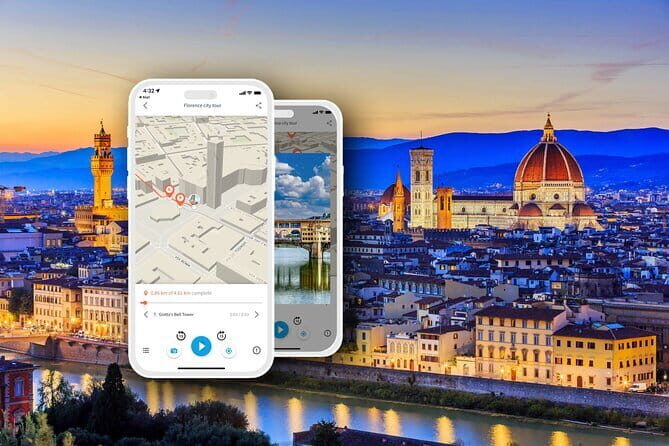
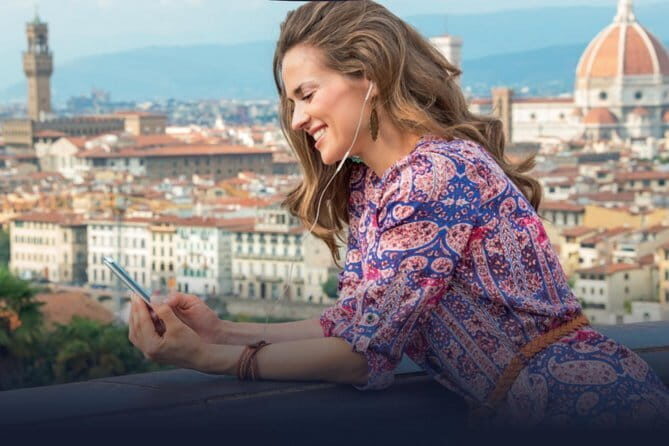
Florence sounds different when you walk with audio. This smartphone audioguide turns the biggest sights into a paced route you can control, using recorded narration tied to the landmarks you’re actually seeing, plus an offline map when you’re moving between stops.
I like the 30 audio recordings narrated by a professional historian. I also like the offline GPS map with route points, so you’re not guessing which street to take when Florence gets crowded and confusing fast.
One catch: you have to get the app working on your device, and the phone’s GPS direction can be off in busy spots. If that happens, you’ll still be able to follow the tour by selecting stops manually, but it can slow you down.
In This Review
- Key things that make this Florence walk worth your time
- Smartphone audioguides in Florence: staying on track without a human
- Value check: what $7.14 gets you (and what it doesn’t)
- Start at Santa Maria Novella: a fast way to get your bearings
- Santa Maria del Fiore and Giotto’s Bell Tower: the skyline payoff
- Piazza della Repubblica and Palazzo Strozzi: Renaissance power in plain sight
- Palazzo Medici and San Lorenzo: where Florence’s families showed their cards
- Palazzo Strozzi, Parte Guelfa, and Piazza Signoria area: government, then art
- Mercato Nuovo and Santa Croce: eating your way through Florence’s culture
- Museo Galileo and La Casa di Galileo: science breaks the art-only pattern
- Uffizi and Ponte Vecchio: planning around what may cost extra time
- Villa Bardini and Forte Belvedere: finishing with views that feel earned
- Practical tips that save time (and keep the app from becoming a headache)
- Who this Florence audio walk is for
- Should you book this audio tour?
- FAQ
- What do I need to use the audio guide?
- Is there a human guide on this tour?
- How long is the walk?
- Where does the tour start and end?
- Is this tour offered in English?
- Does it include admission tickets?
- Will I have navigation if I don’t have internet?
- How many audio recordings are included?
- Is this a small group tour?
Key things that make this Florence walk worth your time

- Historian narration split into 30 short recordings, so you can stop, restart, and keep moving
- Offline map with GPS navigation, useful when data signal gets spotty in stone-and-stair Florence
- Illustrations that help you spot the exact building you’re looking for
- Self-guided pace, ideal if you hate being rushed through chapels and courtyards
- Smartphone-only setup, so you control language, headphones, and timing
- One-year access to the tour audio, letting you revisit the route later
Smartphone audioguides in Florence: staying on track without a human
This is a self-guided walk built around your phone, not a group meeting with a person holding a flag. That matters in Florence. The city is beautiful, but it can also feel like you’re constantly dodging people while trying to read small details on facades and plaques.
The good part here is the combination of audio + illustrations + an offline map. The illustrations help you identify the right landmark when multiple churches and palaces crowd the same view. And the offline map with GPS navigation keeps the route logic clear as you move from one famous stop to the next.
You’re not locked into a strict “follow the leader” rhythm. If you want to linger at the Basilica of Santa Maria Novella, you can. If you want a shorter pause at Piazza della Repubblica, you can skip ahead in the app.
You can also read our reviews of more walking tours in Florence

Value check: what $7.14 gets you (and what it doesn’t)

At $7.14 per person for about 2 hours 30 minutes, the value is strong if you want structure without paying for a live guide. You get:
- the audio content (30 recordings)
- the mobile app (iPhone and Android)
- illustrations for landmark spotting
- offline map navigation
- access for 1 year in your chosen language
What it does not include is the cost of entry to places that require tickets. The tour notes that entrance fees/tickets are not included, with a few stops labeled Admission Ticket Free. So build your budget like you would for independent sightseeing: plan to pay for major museum entries when you decide to go inside.
Also, this is not a “headphones included” situation. Bring your own. If your earbuds are broken at home, Florence will not fix them.
Start at Santa Maria Novella: a fast way to get your bearings
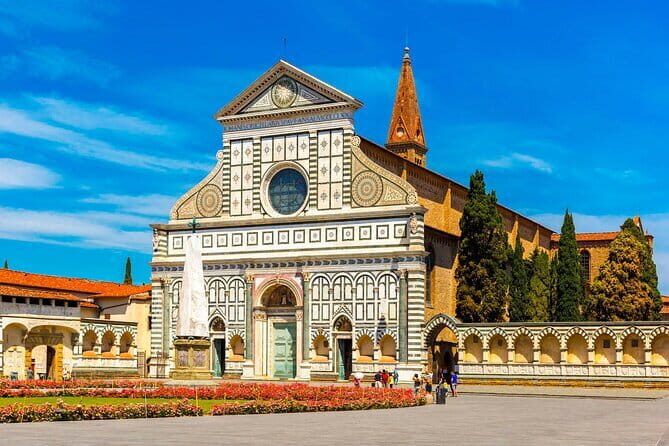
Your walk begins at the Basilica of Santa Maria Novella, right at Piazza di Santa Maria Novella 18. Starting there is smart because it gives you a landmark that’s hard to miss, and it puts you in the dense heart of the city where the rest of your route makes sense.
Santa Maria Novella is a strong opener: 13th-century Gothic architecture, a façade with intricate decoration, and a rose window that makes a great “okay, that’s what you’re here for” moment. Inside, the audio guides you toward the kind of details that are easy to miss when you’re just sightseeing on autopilot—think artworks by major names and the calmer spaces like cloisters.
If you’re arriving hungry, plan your first drink or snack later. This opening stop is more about training your eye for Florence’s mix of religious art and powerful families. You’ll get plenty of “look at that” moments after.
Santa Maria del Fiore and Giotto’s Bell Tower: the skyline payoff
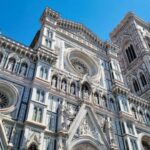
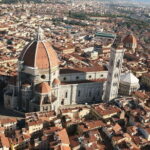
The next big chapter is the Cathedral of Santa Maria del Fiore (the Duomo area). The audio focuses on what makes this place a landmark: the iconic dome, its colorful marble façade, and the inside’s grandeur. You’ll also hear about the stained-glass presence and the frescoed interior.
There’s also a built-in “choose your intensity” moment. The Cathedral is listed as Admission Ticket Free for about 10 minutes in this route. That helps you experience the building even if you don’t want to rush into paid areas.
Then comes the Giotto’s Bell Tower, listed at 82 meters tall and a climb of 414 steps. The route encourages you to see it as more than a climb to check a box. The narration highlights the bell tower’s Gothic design and its decorative reliefs. The real payoff is the view over Florence, especially with the Duomo rooflines and surrounding rooftops in frame.
Practical tip: if you’re the type who hates stairs, consider how you feel about 414 steps before you commit. The climb is worth it for the views, but you should choose it knowingly.
Piazza della Repubblica and Palazzo Strozzi: Renaissance power in plain sight
After the Duomo zone, you’ll move toward Piazza della Repubblica, a central square that traces back to a Roman forum. Today it’s ringed with cafés, shops, and historic buildings, so it’s a useful break spot. It’s also great for regrouping while the audio guides your attention back to architectural cues.
From there, you hit Palazzo Strozzi, a Renaissance palace used for rotating art exhibitions. Even if you don’t have time to do a full museum-length visit, this stop is about architecture and proportion—how the building “holds” the space around it and how Florence’s wealthy families used stone and symmetry as status.
If you love art but don’t want to drown in museum hours right away, this is a good middle stop. You get a major name and a sense of Renaissance design without committing to a full-day indoor schedule.
You can also read our reviews of more tours and experiences in Florence



Palazzo Medici and San Lorenzo: where Florence’s families showed their cards
Two stops in particular make Florence feel less like a postcard and more like a political story: San Lorenzo and Palazzo Medici.
San Lorenzo is tied to Renaissance redesign by Filippo Brunelleschi, and the audio points you toward the church’s key layout: columns, chapels, and the harmony that makes it feel “planned.” It also guides you to major artworks connected to the Medici era. If you’re interested in how art and power overlap, this is one of the better stops in the city for that.
Then you move to Palazzo Medici, associated with the Medici family’s rise and their role as patrons. The façade with rusticated stonework and the grand arches sets the tone before you even step inside. The audio pushes you toward the decorated rooms and the famous Chapel of the Magi, described as a “hidden gem” in the tour info—meaning it’s the kind of detail you can miss without guidance.
If you like your Florence stops to explain why the art looks the way it does, these two palaces and churches are some of your best anchors.
Palazzo Strozzi, Parte Guelfa, and Piazza Signoria area: government, then art
Florence isn’t just museums. It was also a place where political factions and city governance shaped the skyline.
You’ll visit Palazzo di Parte Guelfa, originally from the 13th century and tied to the Guelf faction. Today it’s used by an association, and the tour audio steers you toward courtyard features and frescoed architectural details. This is a good stop if you like political context, because it explains that medieval Florence had active party power, not just artists and merchants.
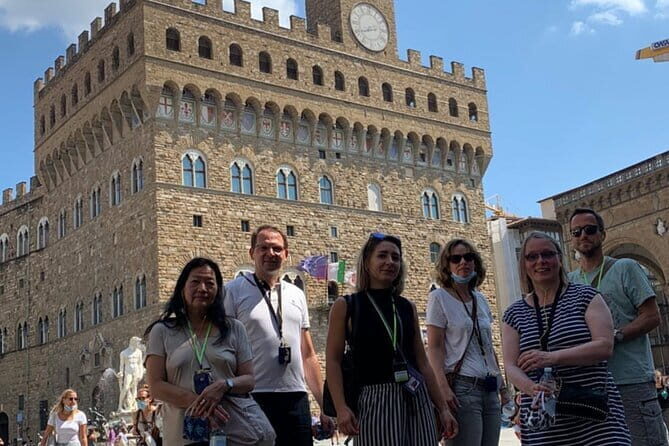
Then the route moves you into the zone around Palazzo Vecchio and Piazza della Signoria, with Loggia dei Lanzi as the open-air sculpture bonus. Palazzo Vecchio is the government seat story in stone, finished in the 14th century. The audio highlights the Salone dei Cinquecento and the tower viewpoint option. Even if you don’t do everything inside, the building’s fortress feel sets up the rest of the day.
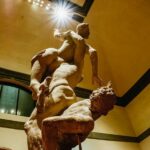
At Loggia dei Lanzi, the audio points you to big sculpture names like Cellini’s Perseus and Giambologna’s Rape of the Sabine Women. Since this is outdoors, it’s also a good “wind-down” moment before more museum time.
Mercato Nuovo and Santa Croce: eating your way through Florence’s culture
In the middle of the route you’ll pass Mercato Nuovo, a food market in the San Lorenzo area. The audio frames it as a sensory stop: fresh produce, local delicacies, artisanal cheeses, and counters for Tuscan food. Even if you don’t buy anything, stepping through the market gives you a different Florence than the one made purely for visitors.
Then later you reach Basilica di Santa Croce, often called the Temple of the Italian Glories in the tour description. The audio encourages you to connect the church to major figures, including Michelangelo, Galileo, and Machiavelli. It also points out the church’s Gothic façade and the frescoes by artists like Giotto, plus the serene chapels and cloisters.
One thing I like about Santa Croce for this route: it’s a major stop without needing you to cram into a museum schedule. If you pace the day well, Santa Croce becomes your “sit for a minute and reset” moment.
Museo Galileo and La Casa di Galileo: science breaks the art-only pattern
Most Florence routes are art-heavy, with a bit of church architecture sprinkled in. This one also adds science.
You’ll visit Museo Galileo, focused on scientific instruments and artifacts from the Renaissance onward. The tour info emphasizes Galileo Galilei’s impact and notes interactive exhibits that make the concepts easier for different ages. Even if you don’t feel like a science person, the museum connection is useful because it shows how Florence isn’t only about paintings—it’s also about experiments and ideas.
Then you can continue to La Casa di Galileo Galilei, described as his humble birthplace. The audio points to personal artifacts and education-focused displays, including telescope-related themes and celestial maps. That pairing—Museo Galileo plus La Casa di Galileo—gives you a full “person + work” sense instead of one-off facts.
Practical note: museums take time. If you want the full museum experience, keep the rest of your stops lighter.
Uffizi and Ponte Vecchio: planning around what may cost extra time
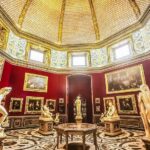
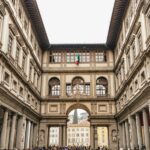
The route includes the Uffizi Gallery, one of the world’s best-known art museums. The audio highlights famous artists and iconic works like Botticelli’s Birth of Venus and Primavera. This is the one stop where you should be realistic about time. A gallery can swallow an afternoon if you let it.
The tour info says entrance fees/tickets are not included overall, so you’ll want to plan for that if you’re going to Uffizi in a real, inside-the-doors way. If you don’t go in, you can still enjoy the surrounding sense of location and learn the story via audio, but the big masterpieces are inside.
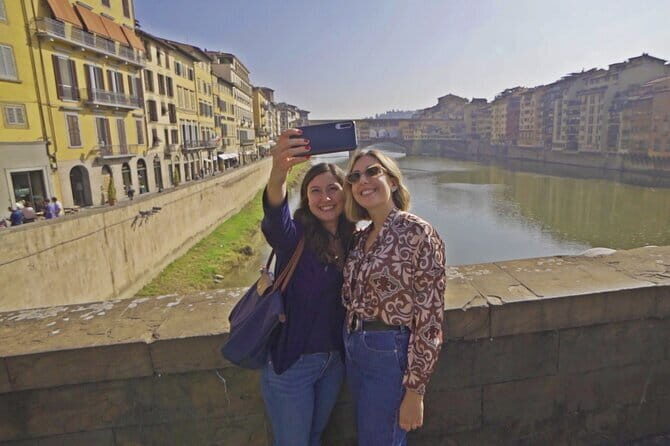
After Uffizi, you reach Ponte Vecchio, described as Florence’s oldest bridge, built in the 14th century and lined with goldsmith shops. The audio also covers the Vasari Corridor, the elevated passage meant to let the Medici family move discreetly. You’ll learn why it mattered to power and privacy, even if you can’t follow the corridor path in the same way as the bridge.
This segment is one of the best “walk and look” parts of the day. Ponte Vecchio also gives you a chance to slow down because you can watch the Arno river and take photos without needing to read a ticket desk.
Villa Bardini and Forte Belvedere: finishing with views that feel earned
To wrap the route, the audio guides you toward two higher spots and a cooler pace.
First is Villa Bardini, described as a hillside villa with landscaped gardens, colorful flowers, and terrace views over the city. The tour also mentions art exhibitions that mix contemporary and classical works. This is a nice change from palaces and museums: you get open air, less crowd pressure, and a viewpoint that helps you understand Florence’s geometry.
Then you head to Forte Belvedere (also listed as Forte di San Giorgio Firenze). The audio explains it as a hillside fortress built in the late 16th century under Francesco I de’ Medici, serving as defensive stronghold and royal residence. The route suggests wandering courtyards and enjoying the broad panorama.
This ending works well because you’re not just leaving monuments behind. You’re finishing with the place that gives you the map in your head: rooftops, river bends, and the way Florence layers on itself.
Practical tips that save time (and keep the app from becoming a headache)
A few small things make a big difference with a self-guided audio tour:
- Download the audio app and test it before you start. One of the common annoyances is getting stuck on which app to download. Doing it early keeps your first stops stress-free.
- Bring headphones you actually trust. The tour doesn’t include them.
- Save battery. Audio and GPS can drain phones, especially with constant navigation.
- Expect GPS hiccups. If direction arrows or location dots act weird, don’t panic. Use the app’s stop selection and illustrations to reorient.
- Use the offline map. The route is designed so you still have a guide even when signal is weak.
If you’re the type who hates tech tasks while on vacation, you’ll want to set things up while you’re still in “hotel mode.” Once you start walking, you’ll enjoy the independence more.
Who this Florence audio walk is for
This tour fits best if you:
- want to hit major sights without paying for a live guide
- like history explained in a guided way, with a historian recording your listening
- prefer to stop when you want, rather than when a group needs to move
- are comfortable using an app and bringing your own headphones
It may be less ideal if you:
- hate smartphone setup or don’t want to deal with app activation
- strongly rely on perfect GPS directions
- want an all-in-one experience where entry tickets are included
And it’s worth noting the tour is limited to a maximum of 20 travelers, which is typical for a packaged tour, but since this is self-guided, your day won’t feel like you’re trapped in a big crowd file.
Should you book this audio tour?
Book it if you want structure without a guide, and you like the idea of learning as you walk through Florence’s big names: Santa Maria Novella, San Lorenzo, Medici palaces, the Duomo area, Palazzo Vecchio, Santa Croce, Galileo sites, and the Uffizi corridor of art.
Skip it or look for a different option if you want a fully ticketed museum plan or you expect GPS navigation to be flawless. With audio tours, the human touch is replaced by your device settings. Once that part works, the rest is an enjoyable, flexible way to see Florence at your own speed.
FAQ
What do I need to use the audio guide?
You need a smartphone (iPhone or Android) and your own headphones. You also download the audio guide app, activate your purchase, and follow the route using the app map.
Is there a human guide on this tour?
No. This is a self-guided tour, so there is no person waiting at the meeting point.
How long is the walk?
It’s listed at about 2 hours 30 minutes.
Where does the tour start and end?
It starts at the Basilica of Santa Maria Novella, Piazza di Santa Maria Novella 18, 50123 Firenze FI, Italy, and ends back at the same meeting point.
Is this tour offered in English?
Yes, it’s offered in English. The audio is also available in your preferred language for your 1-year access period.
Does it include admission tickets?
Entrance fees/tickets are not included. Some stops are marked as Admission Ticket Free in the tour description, but you should plan on paying for ticketed sites if you want to enter.
Will I have navigation if I don’t have internet?
Yes. You get an offline map with route and GPS navigation.
How many audio recordings are included?
The tour includes 30 audio recordings narrated by a professional historian.
Is this a small group tour?
It has a maximum of 20 travelers, but you complete the route on your own using the app.

More Walking Tours in Florence

More Tours in Florence



More Tour Reviews in Florence
- Tuscany Day Trip from Florence: Siena, San Gimignano, Pisa and Lunch at a Winery
★ 5.0 · 21,634 reviews - The Best tour in Florence: Renaissance & Medici Tales – guided by a STORYTELLER
★ 5.0 · 12,316 reviews